


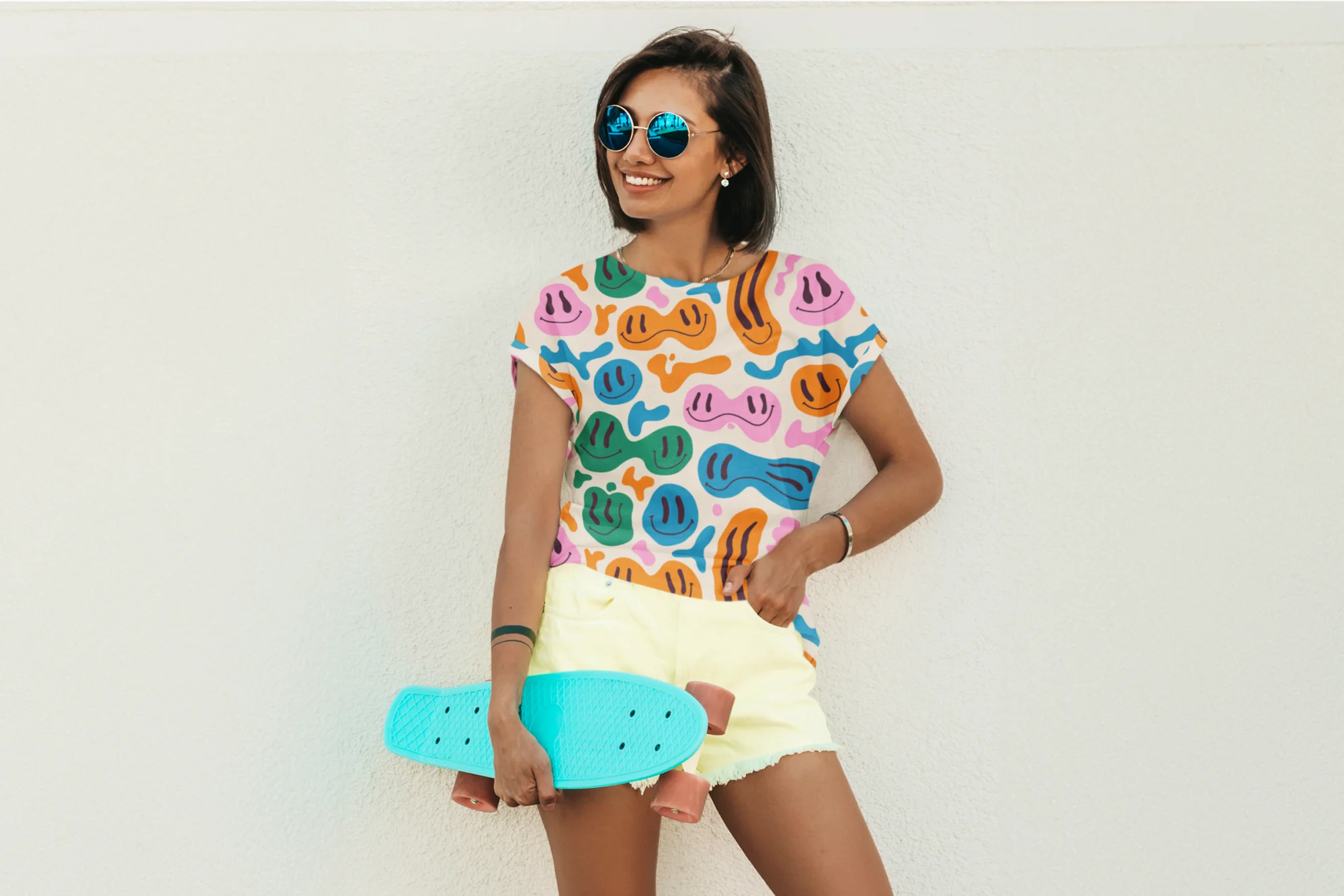
Have a design that’s just too good to be limited by a print area? All-over print (AOP) lets you put it on the entire t-shirt – front, back, sleeves.
That kind of seam-to-seam coverage turns the whole garment into your canvas. More design freedom, more visual impact, and a premium feel that justifies higher price points when selling.
In this guide, we’ll walk you through how to make all-over print shirts – from designing for full coverage to launching your first AOP shirt with Printify.
Disclaimer
This post may contain affiliate links, which means we may earn a commission if you make a purchase through those links. This comes at no additional cost to you.
Key takeaways
- All-over print (AOP) shirts use dye sublimation to apply designs across the entire garment – front, back, sleeves, and seams – with no print area limits.
- Synthetic fabrics like polyester are ideal for all-over print custom shirts to maintain durability and vibrant colors.
- The dye sublimation printing market is projected to reach $38.96 billion by 2033, signaling strong long-term demand for AOP-style apparel.
- Printify lets you design and sell AOP shirts with no upfront investment, no inventory, and no minimum orders.
What is an all-over print shirt?

An all-over print (AOP) shirt is a custom garment where the design covers the entire fabric surface rather than being limited to a single print area, such as the chest or back.
It’s typically made using dye sublimation, a shirt-printing technique that bonds ink directly into the fabric fibers. That’s what makes seam-to-seam coverage possible without cracking, peeling, or losing color over time.
Here’s how the all-over printing process typically works:
- Start with a high-resolution design file built for the full garment dimensions, with bleed areas extending past the seams so the artwork aligns correctly when the shirt is assembled.
- Place the artwork across the front, back, sleeves, and seams. This is where you set up repeating motifs or seamless patterns that flow across the whole shirt.
- Print the design onto special transfer paper using sublimation inks across multiple fabric panels, then apply heat and pressure to convert the ink into gas that bonds with the polyester fibers in the fabric.
- Cut and sew the printed fabric panels together into the finished shirt, producing true seam-to-seam coverage.
While other printing methods – like direct-to-garment or screen printing – work with cotton-based fabrics, AOP apparel performs best on polyester fabric and polyester blends. That’s because sublimation only bonds with synthetic fibers.
Pros of AOP

Ideal for showcasing patterns or eye-catching designs that need to be seen from every angle.
Produces durable print quality that holds color and detail well after repeated washes.
Designs can extend over collars, cuffs, and side seams – areas that other print methods can’t reach.
Cons of AOP

Fabric options are limited to polyester and synthetic blends.
Since the design is printed on white fabric, any unprinted areas can show through as faint white lines when the shirt stretches.
The cut-and-sew process can introduce slight pattern misalignment at seams, which is harder to control than with single-area prints.
Want to know more? Check out our AOP webinar with Hicham Amrani, Founder of Subliminator, one of our Print Providers, to learn the ins and outs of all-over print products.
How to make custom all-over print shirts in 3 steps

While you can print t-shirts at home, making all-over print tees yourself is difficult. Plus, the equipment alone costs thousands of dollars before you sell a single shirt.
That’s why it’s best to create your own shirts with all-over print t-shirt print-on-demand services like Printify. It’s free to start, and you can have your first design ready to orderin minutes. No upfront costs, no inventory, and no minimum order quantity.
1. Sign up for Printify
Create a free Printify account. You only pay the production costs when:
- You order for yourself.
- A customer buys from your store. Their payment covers it, and you keep the profit.
If you plan to grow your business, upgrade to Printify Premium to get up to 20% off product costs on every all-over print shirt you sell.
3. Make your all-over print design
In Printify’s Product Creator, you can:
- Upload your own images directly.
- Browse free t-shirt designs.
- Use our Shutterstock integration for quality visuals.
- Generate original images with AI.
- Create patterns in one click.
- Apply a single design to all print areas at once.
- Adjust layers, fonts, and placements to refine your print design.
- Flip artwork horizontally or vertically to mirror a design across panels.
All-over print shirt custom design tips
- Cover the entire garment. Add background colors or use the pattern tool to fill blank spaces – any unprinted area will appear white when the fabric stretches.
- Extend full-bleed images into the grayed-out edge of the mockup preview, but keep important elements like text or logos away from the seams, where the print can shift slightly.
- Use high-resolution images. PNG and JPEG are the optimal file types. Upload at 300 DPI or higher. AOP prints across a much larger surface than a chest-area design, so low-res files lose sharpness fast.
- Pick bold, high-contrast colors. Bright shades that create contrast against the fabric show up best on polyester.
Before publishing, hit Preview to check the front, back, and sleeves. Then, order a sample and test it after a machine wash, tumble dry, and a low-heat iron to catch potential design issues.
Why sell all-over print shirts?

There’s real money in custom clothing right now. The custom t-shirt printing market is on track to nearly double, reaching $9.82 billion by 2030.
Dye sublimation printing – the method behind custom all-over print clothing – is heading toward $38.96 billion by 2033.
What does that mean for you? Demand for personalized apparel keeps climbing, and AOP shirts sit at the premium end – higher perceived value, more design freedom, more room to stand out than with basic tees.
Want to tap into this lucrative opportunity? Learn how to start a t-shirt business with Printify for free.
How to sell custom all-over print shirts

Now that you know how to design all-over print shirts, it’s time to sell your products. Follow these steps to turn your custom t-shirts into a profitable business.
1. Choose your sales platform
Decide where to sell your custom all-over print t-shirts. Printify offers direct integrations with popular eCommerce platforms like Shopify and marketplaces such as Etsy, TikTok Shop, and Amazon.Printify’s free plan lets you connect up to five stores, while Printify Premium supports up to 10.
Tip
For a side-by-side look at fees, control, and profit margins across each option, read our guide on the best eCommerce platforms.
2. Integrate with Printify
After choosing a sales channel, connect it to your Printify account so orders flow from your store directly to our production network – no manual order entry, no minimum quantities.
Check out these integration guides for more information:
Using a different platform? Find integration instructions for other sales channels in our Help Center.
If you’re a website owner who wants full technical control over your storefront, integrate with Printify’s custom API. Or, launch a Printify Pop-Up Store to start selling quickly – no additional software needed.
Once connected, publish your AOP designs, then set up your order approval settings so customer purchases route to production automatically.
3. Set up your online store
A well-organized store helps customers find products, understand what they’re buying, and trust their purchase. That starts with how you present each all-over print t-shirt – what it’s made of, how it looks from every angle, and what makes it different from competitors.
Focus on these elements:
- Branding. A recognizable brand identity turns one-time buyers into repeat customers. When someone connects with what you stand for, they're buying into your style, your taste, and the next shirt you release.
- Product descriptions. Specify the fabric (for example, 100% polyester or a poly-blend), include a size chart, and note that the seamless pattern covers the entire product. Detailed specs help customers understand what they’re getting.
- Visuals. All-over print designs have more angles than single-area prints. Upload mockups from the Product Creator or take product photos from sample orders, and always show the front, back, and sleeves.
- Trust. Set clear store policies on shipping costs, returns, and care instructions. Customers buying online can’t feel the fabric or check the stitching before paying, so this helps reduce hesitation and cuts down on support questions and returns.
4. Market your AOP shirts
Effective marketing is key to driving traffic and turning visitors into loyal customers. Use these strategies to promote your custom all-over print shirts.
Social media
Short-form video is the dominant format on TikTok, Instagram Reels, and YouTube Shorts. Product demos, design process clips, and styling videos give you more ways to show how a t-shirt actually looks than a static product photo can.
You can also sell on social media directly through Instagram Shopping and TikTok Shop.
Email marketing
Create a mailing list to keep customers engaged. Announce new collections, exclusive discounts, and seasonal promotions to drive repeat purchases and keep your brand top of mind.
SEO and AI search
Optimize product titles, descriptions, and image alt texts with the keywords your customers search on Google. Tools like eRank (for Etsy search), Ahrefs, and Google Keyword Planner help you find them.
Write product pages that directly answer what shoppers might ask. Create a blog with styling guides, design inspiration, or the story behind your brand to attract more traffic via search engines.
Clear, structured content performs well in regular search and gives AI tools like ChatGPT something useful to cite.
Paid advertising
Each advertising channel fits a different stage of the buying journey.
TikTok Ads and Meta Ads (Instagram and Facebook) are built around visual discovery – they put your products in front of people scrolling for inspiration. Google Ads work for capturing intent – people searching for “all-over print shirts” who are ready to buy.
Test small budgets on one advertising channel before expanding to another platform.
Customer reviews
Ask buyers for feedback and showcase positive reviews on your store to build credibility and trust. Reviews not only help convert potential customers but also improve your visibility on marketplaces.
Important things to keep in mind about all-over printing
Use high-resolution graphics
Increase the resolution of your image files using graphic design tools or software to get the best prints possible. AOP covers a much larger surface than single-area prints, so low-res images that look fine on a chest print can come out blurry on a full shirt.
Know when to avoid all-over print
Not every design suits all-over printing. The cut-and-sew construction can shift the print slightly between panels, so placement-dependent artwork is better suited to direct-to-garment or direct-to-film printing techniques.
Design around the white fabric
The sublimation printing method only works on white fabric, so any unprinted area in your design will appear white on the finished shirt – including gaps, outlines, and negative space.. Darker designs may also produce visible white streaks at the seams and underarms when the fabric stretches. To minimize these issues, stick to cut-and-sew all-over print shirts.
FAQ
Conclusion
Now that you know how to make custom all-over print shirts, the next step is putting it into practice.
All-over print gives you the freedom to create complex designs across the entire garment, sell across niches that thrive on bold visual identity, and stand out in a crowded market.Sign up to Printify for free to start designing your own t-shirt – no equipment, no inventory, no minimum orders.