Let Sterling Brown’s Success Story inspire your next Shopify POD idea
See how Sterling turned his love for cars into a thriving Shopify POD business using Printify and smart testing on TikTok.


Compare Printify vs Zazzle in terms of pricing, products, fulfillment, integrations, and earning models to find the right print-on-demand platform for your business.

4.7
Based on 4000+ reviews on

The biggest difference comes down to the business model.
Zazzle operates as an online marketplace where creators earn royalties.
Printify connects production to your own store and sales channels, giving you direct control over products, pricing, and customer relationships.
 |
 |
|
|---|---|---|
| Platform costs | ||
| Free plan | $0 | $0 creator account |
| Premium plan | Printify Premium from $39/month | No required creator subscription** |
| Premium discount | Up to 33% off the Catalog price | N/A |
| Sample t-shirt pricing | $9.04* | $17.26 sale / $20.30 regular |
*Price with the Printify Premium plan, which gives up to 33% off the Catalog price.
**Zazzle Plus costs $19.95/year, but it’s a customer shipping membership, not a seller subscription.
|
|
|
|---|---|---|
| Print network | ||
| Print partners | Over 70 independent Print Providers | Hundreds of independent Makers plus Zazzle production facilities |
| Provider choice | Yes | Production partner generally depends on the product |
| Local production | Choose providers by location, price, and delivery | Depends on the product and Maker |
| Average US delivery | 2-5 business days production + delivery time | Product-specific production, plus 4-7 business days standard shipping |
Zazzle currently has a network of hundreds of independent Makers globally, rather than a small centralized fulfillment network.
|
|
|
|---|---|---|
| Business performance | ||
| Product catalog | 2,000 | ~1,300 |
| Sales channel integrations | Shopify, Etsy, TikTok Shop, Amazon, WooCommerce, Wix, eBay, Squarespace, PrestaShop, and more | Zazzle’s own marketplace |
| API access | Printify API | Create-a-Product API |
| Built-in storefront | Printify Pop-Up Store | Zazzle Creator Store |
Zazzle’s API focuses on creating products and linking shoppers back to Zazzle, where checkout takes place.
|
|
|
|---|---|---|
| Customer support | ||
| Live chat | 24/7 | Virtual agent 24/7, human chat generally 3 am to 5 pm PT |
| Contact form | Yes, with replies by email | Yes |
| Published response time | 24/7 access | 1-2 business days for messages |
| Phone support | No public phone channel | Phone lines are currently closed |
Verdict: Printify gives sellers more control over suppliers, sales channels, their own retail prices, and branding. Zazzle gives creators a ready-made online marketplace with built-in buyer-facing personalization.
Move your products, keep your brand, and choose where you sell.
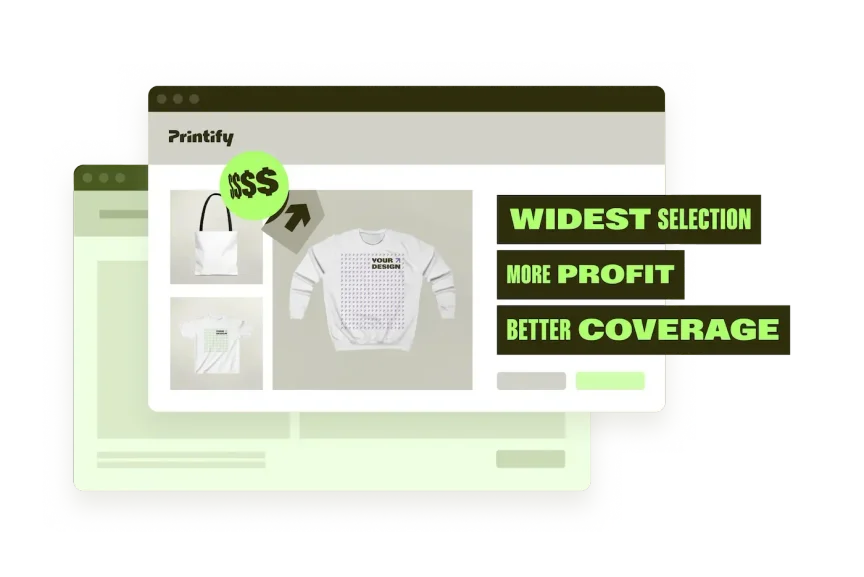
Compare how you earn, where you sell, who produces your custom designs, and how much control you retain over pricing and branding when selling custom products online.
Printify offers competitive pricing and lets you set your own retail prices and own markup. Zazzle pays creators a royalty from marketplace sales, so the two platforms calculate profit margins differently.
|
|
|
|---|---|---|
| Monthly seller subscription | $39* | $0 |
| Bella+Canvas 3001 price | $9.04* | $21.85 sale / $25.70 regular |
| US shipping | From $3.99 | $8.89** |
| Total Printify cost | $13.03 | N/A |
| Gross seller earnings from a $25 sale | $11.97 before channel fees and taxes | $2.50 gross royalty at a 10% rate** |
| 30 t-shirts sold/month | $334.11* | $75 gross royalty** |
| 100 t-shirts sold/month | $1,172.01* | $250 gross royalty** |
*Printify figures use Printify Premium pricing. Monthly figures subtract one monthly subscription fee and exclude taxes and sales channel fees.
**Zazzle calculations assume a $25 sale price and a 10% creator royalty. Figures show gross royalties before applicable Zazzle royalty or marketing fees, so actual earnings may be lower.
Verdict: Printify gives you more control over profit margins because you set the selling price after accounting for product and shipping costs. Zazzle simplifies the transaction, but creators earn royalties rather than keeping the difference between the cost and the retail price.
Both platforms offer a broad range of products. Printify focuses on products that merchants can sell through their own channels, while Zazzle combines products with strong buyer personalization.
|
|
|
|---|---|---|
| Products | 2,000 | ~1,300 |
| Categories | Core apparel, accessories, drinkware, home goods, wall art, and more | Apparel, stationery, gifts, party supplies, home goods, wall art, and more |
| Printing methods | DTG, DTF, embroidery, all-over print, sublimation, engraving, and more | Varies by product and Maker |
| Branding | Neck labels, packaging inserts, gift messages | Creator Store branding and customizable product templates |
| Buyer personalization | Available on supported products | Core platform feature |
| Eco-friendly range | 70+ products | 33 products |
Printify’s current decoration methods include DTG, DTF, embroidery, sublimation, all-over print, engraving, and other product-specific methods.
Zazzle lets creators make editable templates so buyers can change text, images, colors, and other design elements on supported personalized products.
Verdict: In Zazzle vs Printify, the difference here comes down to focus. Printify offers an extensive catalog for building an independent brand, including custom merchandise and multiple decoration options, while Zazzle puts more emphasis on marketplace personalization.
This is where the platforms separate clearly. Printify connects fulfillment to external eCommerce platforms. Zazzle centers the seller experience on its own marketplace.
|
|
|
|---|---|---|
| Etsy | Included | Not included |
| Shopify | Included | Not included |
| TikTok Shop | Included | Not included |
| Amazon | Included | Not included |
| Squarespace | Included | Not included |
| Wix | Included | Not included |
| eBay | Included | Not included |
| PrestaShop | Included | Not included |
| WooCommerce | Included | Not included |
| Custom API integration | Included | Create-a-Product API |
| Built-in storefront | Included | Included |
Verdict: Choose Printify when you want to build an online store and sell custom products online across several marketplaces while keeping fulfillment connected. Zazzle suits creators who want to focus primarily on its online marketplace.
Printify is a strong Zazzle alternative for sellers who want more control over their business.
Among Zazzle competitors and other print-on-demand sites, Printify focuses on helping you build a standalone business rather than relying on a single marketplace.


Set prices around your costs instead of relying on a marketplace royalty.

Build collections across apparel, accessories, home goods, drinkware, and more at the best base prices on the market.

Compare prices, locations, and delivery options before choosing who will produce your orders.

Connect Shopify, Etsy, TikTok Shop, Amazon, WooCommerce, and other major platforms, or open a Printify Pop-Up Store with no monthly fees.

Create branded merchandise with custom neck labels and packaging inserts on supported products.

Order samples to check product quality, then stick with tested providers when consistent quality matters across repeat orders.

Choose DTG, DTF, embroidery, sublimation, all-over print, and other supported decoration methods.

Work with a global network of Print Providers and choose Standard Shipping or Express Delivery where available.

Get live chat help around the clock, plus guides and tutorials for your print-on-demand business.
Whether you’re a high-volume seller or a small business owner, let us do the heavy lifting for you.

Listings migration
We’ll move your products over to Printify for you, so you can focus on selling.

Rebates
We’ll give you money back on sales when you transfer eligible products.

Account manager
Our Expert Team provides dedicated guidance to print-on-demand businesses.
Never share sensitive information (credit card numbers, social security numbers, passwords) through this form.
This site is protected by reCAPTCHA and the Google Privacy Policy and Terms of Service apply

Are you looking for maximum creative control, higher profit potential, or seamless integration with your existing brand? Printify empowers you to take charge of your print-on-demand business. Explore the possibilities and start bringing your designs to life today.
The information provided on this page, including any comparisons of services and prices, is based on data obtained from publicly accessible sources associated with the companies mentioned. The data was last updated on November 10, 2026.
While we strive to provide accurate and timely information, we make no representations or warranties of any kind, express or implied, about the completeness, accuracy, reliability, suitability, or availability of the information contained in this article for any purpose. The use of this information and any reliance you place on such information is therefore strictly at your own risk. We understand that the information may change over time and therefore may become outdated or may not accurately represent the current services and prices offered by the companies mentioned.
If you are a representative of one of the companies mentioned in this article and believe any information is inaccurate or outdated, we invite you to contact us at [email protected] to provide updated information. We are committed to promptly updating any information found to be inaccurate.