



Turn your dreams into success
For most people, selling cars and selling shirts have nothing in common. But Sterling Brown isn’t most people.
After years in his family’s car dealership, Sterling turned his industry knowledge into clever car-themed designs – and a new kind of business entirely. With Shopify, Printify, and a knack for timing, Sterling rebuilt his career from the driver’s seat, built for the long road.
His journey isn’t flashy, but it’s the kind of real success story new sellers need to hear. Because sometimes, all it takes to shift gears is a good idea and a willingness to hit upload.
From sweeping cigarette butts to selling shirts
Sterling Brown has been surrounded by cars for as long as he can remember. His story started in a car lot just outside Atlanta, where his dad ran a dealership and his mom worked before becoming a stay-at-home parent.
His first taste of work came early. “My first job as a kid was sweeping up cigarette butts at my dad’s dealership,” he laughs. After graduating from college, worked for other dealerships.
However, Sterling knew it was time for a change. “I realized I liked working for family,” he says. “And working for myself falls in that category, too.”
That moment pushed him toward starting something of his own. He began selling car accessories online – a simple, low-cost way to stay close to the industry he knew while testing the waters of entrepreneurship.

Finding the right fit with Shopify and Printify
When Sterling decided to take his car accessory store online, he started where most beginners do – by setting up a Shopify store. The platform felt accessible, backed by endless tutorials and community content.
While exploring its app integrations, he stumbled across Printify – and that one discovery quietly changed the direction of his business.
“When I was navigating through the apps, Printify came up – and all signs pointed to Printify,” he recalls.
He began experimenting with the platform late into the night, often using two computer screens at once. “I’d have YouTube open on one and Printify on the other, just learning and testing as I went.”
What sealed the deal was its simplicity. “It was super easy to use and really well supported,” Sterling says. He upgraded his plan soon after and joined Printify’s Sellers Club.
The power of community and honest feedback
For Sterling, joining Printify’s Sellers Club marked a turning point. After months of figuring things out alone through forums and videos, he found a space where real people shared real experiences.
“The different people that are in Sellers Club make it very unique,” he says. He could see what other sellers were testing, what was working, and what wasn’t.
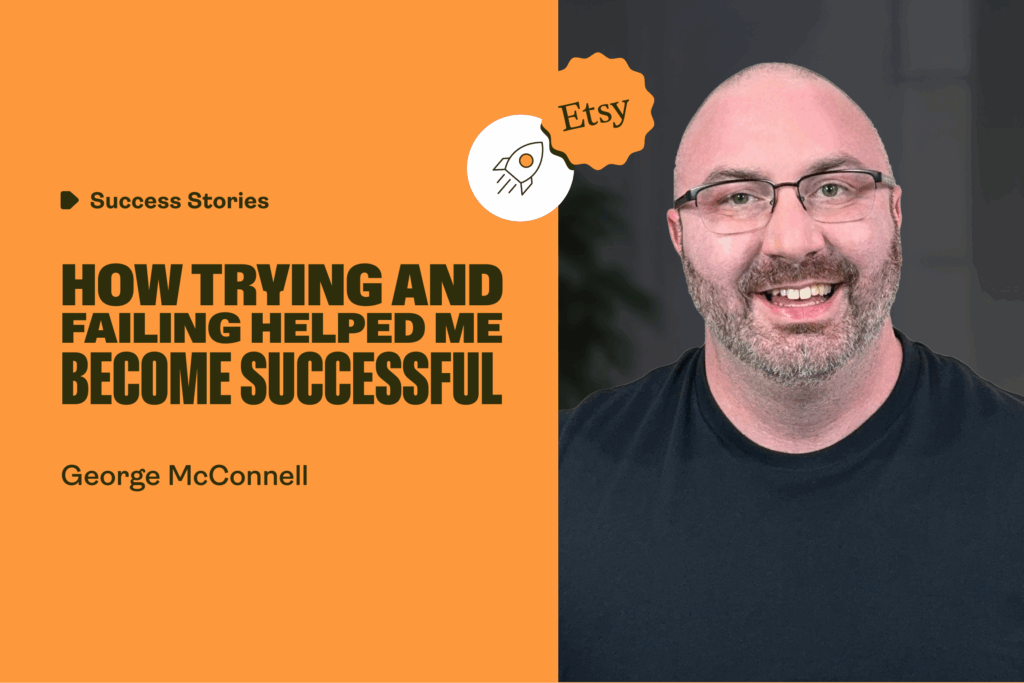
One mentor in particular, George McConnell, stood out. “He gives really honest feedback,” Sterling says. “If a product isn’t working, he’ll just tell you to take it down. There’s no shame in it.” That kind of guidance helped Sterling make quicker, smarter decisions about his listings.
Sellers Club became his learning environment – part motivation, part mentorship, and a constant reminder that he wasn’t building alone. The steady stream of peer feedback and shop reviews sped up his learning and kept his products streamlined.
He adds a practical warning about scale: “If you have to go back and edit 1,000 products to adjust for an algorithm change, you’re not going to get any sleep for a couple of nights.”
So Sterling narrowed his Catalog and focused his attention where it mattered. “It was very much a sense of relief once I scaled down,” he says.
Learn, grow, and scale just like Sterling did
Printify’s Sellers Club is a community where experienced merchants share real numbers, real lessons, and step-by-step courses you can actually act on.
✔Hands-on guidance from mentors who’ve built high-income POD stores
✔Data-backed insights from millions of Printify sales
✔Practical, bite-sized courses that match your pace, not overwhelm you
The fastest way to grow your shop is to learn from people who already figured it out.
Start your 7-day free trial, then continue for just $9.99/month. Cancel anytime.

The TikTok test that turned into $90,000
Sometimes, all it takes is one good bet. For Sterling, it was a shirt inspired by a popular TV show. “I just laid it on the floor, zoomed in, added music, and ran a small ad,” he explains. “Next thing I knew, it was taking off.”
He started marketing with Meta ads, then switched to TikTok, and that’s when things exploded.
TikTok outperformed every other platform he tried.
The numbers speak for themselves. “I was spending a dollar to sell a shirt. That return was phenomenal. At one point, I was selling 200 shirts a day.”
Over a 30-day period, the campaign generated between $80,000 and $90,000 in sales. “It was unreal,” he says. “I made in one month what I used to make in a year in the car business.”
The key was timing, creative simplicity, and the confidence to test what felt right.

How one bad consultant taught him to trust his gut
Not every investment pays off, and Sterling learned that lesson the hard way.
Early in his journey, he hired a consultant to help refine his product strategy. “Because I didn’t have an unlimited amount of money, I tried to find an affordable consultant,” he explains. The experience quickly went sideways.
Sterling had pitched a design idea he believed in, a shirt inspired by a popular TV show. The consultant dismissed it, steering him toward a generic dropshipping product instead. “He told me to do a different product that I felt was already saturated,” Sterling recalls. The result was predictable – “We didn’t have success with what he recommended.”
Once the consultation ended, Sterling circled back to his original idea and launched the shirt anyway. This time, it took off.
His takeaway? Experts are great, but no one knows your audience like you do.
“Sometimes you have to try something 24 times before it works,” he says. “You just can’t stop at ten, you need to double your efforts.”
What great customer service actually looks like
Sterling believes customer service is where reputation is won or lost. For him, it’s simple: take care of the customer, even when it costs a little. “The adage is true – the customer is always right, with few exceptions,” he says.
He recalls a customer who bought universal car mats that didn’t fit her older Mercedes. “Universal fit still only works for about 85% of cars,” he explains. “When she told me they didn’t fit, I apologized and sent her a return label right away so she could ship them back easily.” He also gave her a full refund.
The outcome says it all. “She left me a five-star review,” Sterling says. “It showed me that people really do appreciate quick, honest communication.”
That experience shaped how he runs his business. “Mistakes happen, that’s part of it,” he says. “But when you respond fast and treat people fairly, it always works out.”
This simple principle (quick communication, empathy, and accountability) has helped him maintain 4.6 to 4.7-star ratings and a customer base that keeps coming back.
Skipping Q4 hype to win the long game
When most new sellers rush to cash in on the holiday boom, Sterling decided to sit it out. He felt the Q4 surge could overwhelm a business still finding its footing.
“I knew that I wouldn’t be able to handle the Q4 rush, Black Friday, Christmas, and end-of-year sales,” he says. “So I didn’t actively participate.”
Even so, his seasonal experiments hinted at strong potential. “I made some products that were relevant for the time, but I didn’t really promote them or anything,” he explains. “Even though I didn’t promote them, I still had some success with those products.”
One of those early wins came from car-themed ugly Christmas sweaters that sold surprisingly well without a single ad dollar behind them.
That experience taught him that timing matters as much as creativity. “You have to be aware of what time you’re in,” Sterling says. “If it’s Halloween, have some fall items. If it’s Christmas, have something seasonal.”
This year, he’s approaching Q4 prepared, armed with proven designs and clearer systems. “Last year helped me see what works,” he says. “Now I can plan ahead instead of catching up.”
Balancing ambition with reality
Sterling’s first year brought huge wins, but his focus now is stability. He’s learned that success is about managing growth well, rather than the growth itself.
After his TikTok breakthrough, he began exploring ways to make his business more sustainable. “I do plan on expanding in general,” he says. “I have the Meta ads at a low figure, I have the Amazon ads at a low figure, and I’m going to recalibrate the TikTok advertising to be in a more sustainable place.”
He’s also investing profits back into the business to build a stronger foundation. “I’m taking the money I made from TikTok sales and reinvesting it in myself and the business,” Sterling explains. He recently started working with an ad company that specializes in Google and Amazon campaigns – another way to spread risk and reach new customers.
Through it all, Printify remains central to how he operates. “Printify is connected to TikTok, Amazon, and Shopify. That connectivity has been very beneficial,” he says. “It made things actually achievable for me.”
The freedom that makes it all worth it
For Sterling, success is defined by what his workday feels like. A year ago, he was navigating a career transition after years in the car business. Now, his print-on-demand store gives him the flexibility he always wanted. “The biggest difference is that every morning when I wake up, I’m looking forward to the work.”
That sense of excitement tells him he’s found the right path. “Not that I didn’t love being in the car business,” he reflects. “It’s just that I realize how much I love this much more.”
Freedom means more than working for himself. It’s being able to learn, experiment, and build something lasting.
After all, when you can trade a dealership desk for designs that sell themselves – why look back in the rearview mirror?