


Most affiliate content earns pennies on the dollar because it competes on links, not trust. A user who sees you actually use a product is far closer to clicking your affiliate link than one who reads a paragraph about it.
That’s why learning to make videos for affiliate marketing has become the fastest way for creators, side hustlers, and small marketers to turn small audiences into real, passive income.
In this guide, we’ll show you how to make videos for affiliate marketing, from picking a niche and scripting a hook to promoting across platforms.
Key takeaways
- Video builds trust faster than blog posts or banner ads because it shows viewers the product in action.
- Product reviews, comparisons, listicles, and tutorials each fit a different stage of the buyer journey. Mixing formats catches potential customers wherever they are in the funnel.
- A smartphone, a quiet room, and free editing software cover most of what you need for affiliate content creation.
- Optimizing videos for search, repurposing long-form into short clips, and amplifying through email and communities help you drive traffic to your affiliate links well beyond a single upload.
- Every video must clearly disclose the affiliate relationship to remain compliant with Federal Trade Commission (FTC) rules and platform guidelines.
Why video works for affiliate marketing
Here are the benefits of video marketing for affiliates:
Increased engagement and viewer retention
Video is where audiences already are – YouTube alone reports over a billion hours of watch time per day.
That level of consumption translates into serious engagement, too. According to Buffer’s analysis of 52 million posts, video earned the highest median engagement rate on TikTok, Pinterest, and Threads.
Higher conversion from viewer to buyer
Video reinforces your affiliate recommendation in a way text can’t – potential customers see you use the product, hear the honest verdict, and trust the benefits more as a result. In fact, 87% of people have been convinced to buy a product or service after watching a video.
More visibility in search and recommendations
More than half of ranking videos in Google’s search results are hosted on YouTube, meaning your affiliate content can show up on both YouTube and Google at once and reach a wider audience with a single upload.
Trust and authority over time
Affiliate marketing works best when your audience trusts your personal experience and recommendations.
Every review, comparison, and honest verdict adds to your track record. From there, viewers will subscribe, join email marketing lists, and follow you across platforms, giving you more chances to build trust, promote products, and drive conversions over time.
How to make affiliate videos that convert
Whether you’re learning how to make YouTube videos for affiliate marketing or short-form clips for TikTok, the process is similar.
Here’s how to plan, film, and grow a library of affiliate marketing videos that turn views into sales.
Step 1: Plan your video marketing strategy

Before you start creating content, define your niche and target audience. These two play a key role in starting a profitable affiliate marketing business.
To research affiliate marketing niches:
- Start with what you’re already interested in. Pick a topic you’ll happily keep creating videos about. It may be home fitness gear, personalized jewelry, AI tools, or pet products.
- Search commercial-intent keywords. Adding terms like “best,” “review,” or “under $100” surfaces what people search when they’re close to buying. Our guide to affiliate marketing keyword research walks through the full process.
- Check demand with free tools. Google Trends, Pinterest Trends, and TikTok Creator Search Insights all show whether a topic is growing, stable, or fading.
Once you’ve chosen the right niche, look for affiliate programs that pay well and match what your potential customers are looking for. Evaluate each affiliate offer on:
- Commission rate – How much you earn per sale. For example, Printify’s affiliate program pays a 5% commission on every order your referrals place, for 12 months. Others, like Amazon Associates, may adjust the rate by product category.
- Cookie duration – How long after someone clicks your affiliate link can you still earn a commission if they buy? Printify’s cookie lasts 90 days. Some programs cut off after 24 hours, which means anything a viewer doesn’t buy immediately doesn’t count.
- Brand reputation – You’re building trust and staking your own credibility on every recommendation. A bad experience with a program you promoted can undo months of goodwill with your target audience.
- Product fit for video – Physical products with visual appeal demo well on camera. Abstract software takes more scripting to make watchable.
Map video formats to the buyer journey
Not every viewer is ready to click your affiliate link on first watch. Some are still figuring out what problem they have, while others know exactly what they want and are choosing between two products. Matching the video content to that stage is what turns views into sales.
Here’s what to make for each stage of the buyer journey:
- Top of funnel – Viewers here are searching for solutions, not brands. How-to tutorials and educational explainers work best here.
- Mid-funnel – Now they know they need something, but haven’t made their choice. Create listicles and category roundups to help viewers compare a shortlist of multiple products and introduce your affiliate offer as a credible option.
- Bottom of funnel – Viewers are choosing between specific options. Comparison versus videos and in-depth product reviews with real-world use cases do the heavy lifting here. They’re one honest verdict away from clicking and driving an affiliate sale.
Need some affiliate marketing content ideas to start with? Below are video formats that work for multiple niches:
- “I tested [X] [products] so you don’t have to.” You do the legwork so viewers can make informed decisions in a fraction of the time.
- “[Product] vs [Product]: Which should you buy?” Viewers who search for them are usually close to making a purchase.
- “Top 5 [category] under $[price].” The dollar figure in the title tells search engines and viewers exactly who this video is for.
- “[Product] I’d never buy again – and what I use instead.” Contrarian angles get clicks because they signal honesty. Pair the “never again” pick with your affiliate offer as the alternative.
- “Before/after: My [setup/results/workflow].” Visual transformations perform well because the payoff is instant. Show the change, then walk viewers through the affiliate products that got you there.
Save these ideas in your video content calendar. Batch a few ideas each week and mix in reviews, comparisons, and tutorials to reach potential buyers at every funnel stage.
Quick tip
Starting affiliate marketing on TikTok? Check out our TikTok content calendar guide for a template and posting schedule you can adapt to any niche.
Step 2: Script and structure your affiliate marketing videos

Well-structured, engaging video content holds attention longer, which results in more clicks on your affiliate links.
Even for casual talking-head content, sketch out a loose outline or bullet-point script before you start recording. It saves time on editing and keeps every video pointing back to your affiliate offer.
Open with a hook that promises a specific outcome
The first three seconds of a video decide whether someone keeps watching or scrolls past. A strong hook grabs viewers with a problem, a bold statement, or a specific result – and keeps them interested to learn more about your affiliate product.
Hook examples:
- “Here’s how I launched an online store with zero inventory in one weekend.”
- “I tested five skincare serums under $30 – one clearly beat the rest.”
- “This editing shortcut cut my video creation process in half.”
- “Stop buying running shoes that fall apart at 200 miles. Here are three pairs that lasted me over 500.”
- “I used [software] for 30 days – here’s the honest verdict.”
Quick tip
Need more POD-specific examples? Our guide on how to go viral on TikTok has a list you can adapt for your affiliate videos.
After the hook, tell viewers exactly what they’ll gain by staying: “By the end of this video, you’ll know which option to pick, why it beats the alternatives, and where to buy it for the best price.”
Don’t overpromise. Clickbait titles may pull in a wider audience, but they wreck trust and tank your channel over time. If your hook says “I made $10,000 in a week,” your video had better prove it – or your affiliate marketing success stops before it starts.
Use on-screen text for the hook in short videos, too, so people scrolling with sound off still catch it.
Show the product in action

Videos that demonstrate products in action generally perform better with audiences. Live demos and tests provide proof that is much harder to fake than a written review.
Structure the middle of your video clearly: explain the problem your viewer has, show the solution, then walk through how the affiliate product solves it step by step. Focus on presenting benefits rather than just product features.
Examples of what to film:
- Screen recordings – Walk through the exact steps to set up an account, use a feature, or complete a task. Works for digital software like AI tools and eCommerce platforms.
- Unboxing and first-use footage – Show the packaging, the product out of the box, and your genuine reaction. Video footage of a real product beats mockup images every time.
- Timed tests – “I used this for 30 days” videos work because the timeframe itself is the proof.
Layer in social proof to build trust and drive conversions, like quick testimonials from other users, screenshots of your own results with sensitive data redacted, or a short mini case study.
Keep explanations jargon-free. If you catch yourself explaining what a term means mid-sentence, cut the term and rewrite the sentence to make your video content more concise and easier to understand.
Add strong call-to-actions (CTAs)
Clear calls to action play a key role in driving sales. You can produce the best review on the platform, but if the video ends without a clear next step, that free traffic goes nowhere – and neither does your affiliate income.
That said, CTAs should guide viewers to affiliate links in a non-pushy manner. Keep these tips in mind:
- Short-form: One CTA is enough. Repeating “link in bio” three times in 30 seconds feels pushy and eats into the runtime.
- Long-form: Two CTAs – a soft mention around the midpoint for viewers who’ve already made up their mind, and a stronger one near the end for viewers who watched the full pitch.
- Multi-product videos (listicles, roundups, comparisons): One grouped CTA works better than one per product. Say something like “all the products I mentioned are linked below in order” once, instead of naming a link for every pick.
Test different CTA wording across videos and track which ones drive conversions the most. Some examples:
- “Everything I used is linked below – grab whatever fits your budget.”
- “If you want to try [product] for yourself, my link’s in the description.”
- “The one I recommend the most? It’s in the pinned comment.”
Step 3: Film and edit affiliate videos without expensive gear

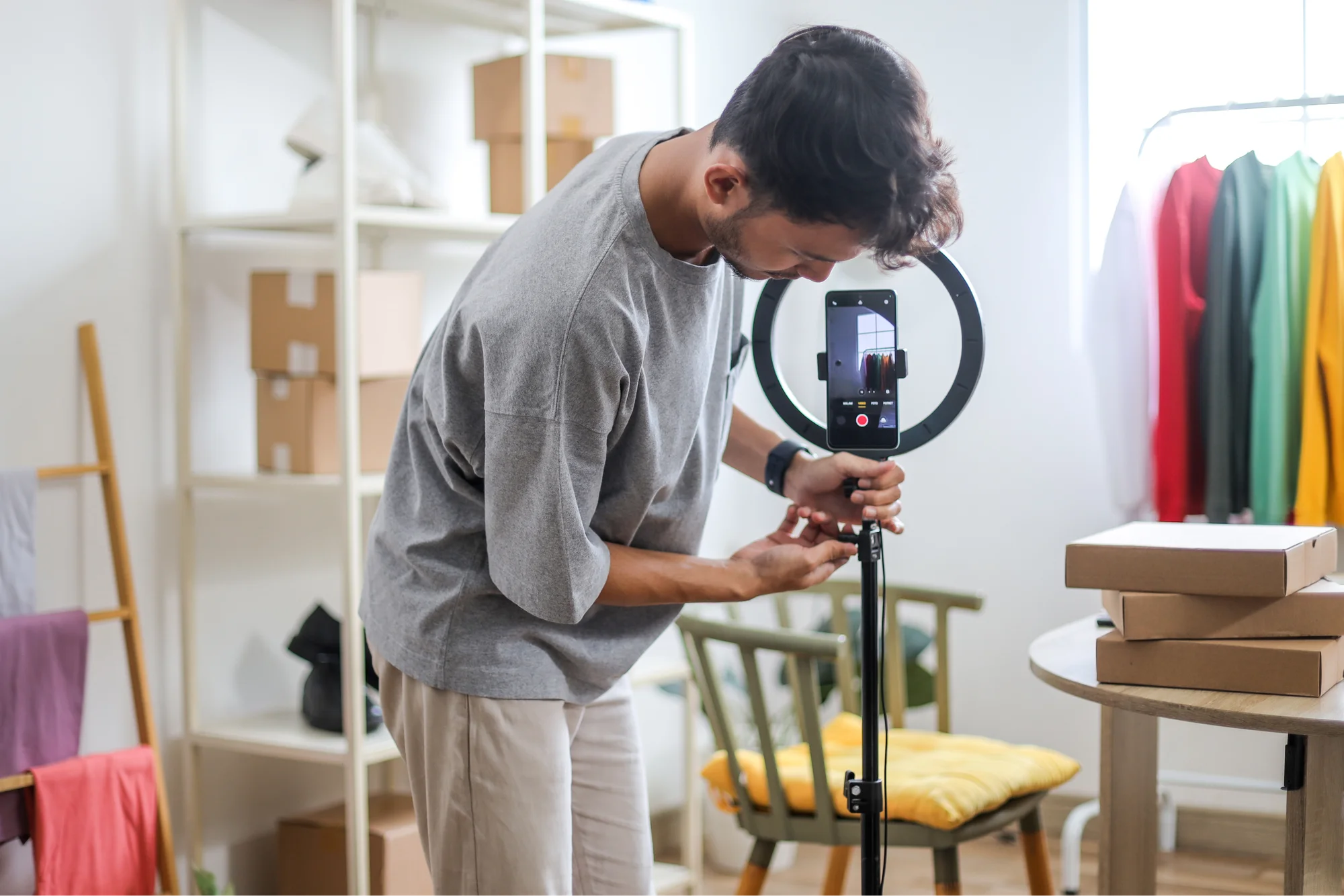
The barrier to entry for the video creation process has never been lower. A smartphone, basic lighting, and free editing tools are more than enough for affiliate marketers to produce high-quality user-generated content (UGC) videos.
Here’s a simple starter gear list:
- Smartphone (1080p or higher)
- Ring light or natural window light
- Lapel microphone or quiet room (clear audio matters more than video quality for viewer retention)
- Free editing software (DaVinci Resolve, CapCut, Canva Video)
Talking-head videos
- Position your smartphone or webcam at eye level with a simple, uncluttered background. Light your face from the front, never from behind.
- Frame yourself using the rule of thirds and record in 1080p – enough for YouTube and every major social media channel.
- Record in a quiet room to reduce background noise.
- Shooting for TikTok, Reels, or Shorts? Set your camera to shoot vertically (9:16) from the start, and keep the important content in the upper two-thirds of the frame – the bottom is where captions and platform UI sit.
Screen-sharing videos
- Use free tools like OBS or your operating system’s built-in recorder.
- Close every irrelevant tab and turn off notifications before you start.
- Zoom in on the specific button or menu you’re pointing at – viewers watching a full desktop recording can’t see what you’re clicking.
Quick tip
Capture extra video footage for B-roll – product close-ups, behind-the-scenes shots, or screen recordings of relevant pages – to give you cutaways during editing and make the entire video more visually interesting.
Edit for pace and captions
Editing is where most affiliate marketers win or lose their audience. Follow these tips to keep watchers engaged from hook to CTA:
- Cut aggressively. Clear, concise storytelling in video content helps build trust and credibility. Jump cuts, tight edits, and quick pacing are standard on YouTube and non-negotiable on short-form.
- Use text overlays for key points. Prices, product names, and CTAs land harder when they appear on screen rather than when they’re just spoken.
- Add captions to every video. Many watchers scroll with sound off. Most editing tools generate them automatically – check the transcript before publishing.
- Skip the heavy effects. Simple cuts and clean text overlays matter more for video quality than any expensive transition pack.
- Match length to the platform. Under 30 seconds for TikTok, Instagram Reels, and YouTube Shorts, and 7 to 15 minutes for YouTube long-form.
Batch your production to keep the process sustainable. Filming multiple videos in one session, editing another day, and scheduling posts in advance is how affiliate marketers publish consistently without burning out. That consistency is what compounds affiliate marketing success over time.
Quick tip
Creating content for TikTok? Our guide to the best time to post on TikTok shows which days and hours drive the highest engagement.
Disclose affiliate relationships properly
Legally required disclosures about affiliate relationships must be clearly stated in videos. The FTC requires them, and every major platform enforces its own version of the same rule. Skip them, and you risk warnings, takedowns, or fines.
Your affiliate disclosure has to be clear, conspicuous, and hard to miss. A simple line that works: “This video contains affiliate links, which means I earn a commission if you sign up through them at no cost to you.”
Step 4: Drive traffic through multiple channels

Posting content is half the work – the other half is making sure people actually see it. Driving traffic takes a multi-channel mindset: SEO, social media, communities, and email all pointing to your key affiliate products.
Optimize titles, thumbnails, and descriptions for search
Optimizing video titles and descriptions with relevant keywords can improve discoverability. Search engines like YouTube and TikTok now rank videos the way Google ranks blog posts.
- Match your title to the search intent. Keyword-first titles (“best budget headphones 2026”) rank better for people actively searching. Story-first titles (“the headphones I’ve used every day for a year”) signal authenticity and often win on trust-driven picks.
- Write descriptions like short blog posts. Include your target keyword in the first two lines, summarize what the video covers, and add timestamps for major sections. Platforms use this text to figure out what to rank you for.
- Put your affiliate link above the fold. The first line or two of the description is where a decided viewer clicks – anything hidden behind “show more” gets missed.
- Design covers with the platform in mind. Aim for bold text, a single clear focal point, and high contrast that reads well at small sizes.
- Tag every link. Use UTM parameters to track links and see which videos and platforms drive the most sales – otherwise, you’re just guessing.
- Use platform-native shopping features when available. Instagram product stickers, TikTok shoppable videos, and YouTube’s shelves put your recommendations one tap away from checkout.
Repurpose long-form into short-form
One 15-minute YouTube tutorial can be split into 3-5 short clips for TikTok, Reels, and Shorts. Point each clip back to the full video or your link in bio, and you turn one production session into a week of content – a fast source of free traffic without extra filming.
Pick your best moments – a punchline, a surprising stat, a step viewers ask about – and cut around them. Add captions, a hook overlay, and a clear CTA at the end of each clip.
Amplify through communities, collabs, and email marketing
Here’s how to keep sending traffic to your affiliate videos after publishing them:
- Engage in niche communities. Blogger forums, subreddits, Discord servers, and Facebook groups convert well if you show up as a participant first. Answer comments, share what you’re learning, and drop links only when they genuinely help.
- Collaborate with other affiliates in the niche. Co-hosted tutorials, guest appearances, and cross-promotions expose your affiliate content to a wider audience that already trusts the person recommending you.
- Build an email list. Offer a free checklist, mini-course, or resource guide as a lead magnet, then send subscribers a link to your video every time you publish.
Step 5: Measure performance and double down

Tracking metrics like click-through rates and engagement is crucial for optimizing video and channel performance. Every small, data-driven improvement you make can result in real affiliate sales.
The metrics that matter most aren’t views, but how many clicks and sales each video generates for you as an affiliate marketer.
Track these metrics per video:
Metric | What to track |
Views | Total views on each platform |
Watch time | Average minutes watched and retention percentage (what portion of the video people actually finish) |
Affiliate CTR | The percentage of viewers who clicked your affiliate link |
Conversions | The percentage of link-clickers who actually completed a purchase or sign-up |
Revenue | Commission earned per video |
Once you have a few months of data, act on what it tells you:
- A/B test thumbnails, titles, and CTAs to see which changes increase engagement and drive conversions.
- Spin winners into series. If one video outperforms the rest, make three more on adjacent topics.
- Update evergreen videos regularly. Refresh the information and affiliate product links to keep old videos earning.
- Cut the losers. Videos that underperform for six months rarely turn around. Learn from what didn’t work and stop publishing that format.
Quick tip
Are you a TikTok content creator? Our guide to TikTok metrics covers which numbers matter most for growth.
Start earning with the Printify Affiliate Program
If you’re publishing affiliate content in the eCommerce, side hustle, or creator economy space, the Printify Affiliate Program is one of the easiest programs to join.
What you get:
- 5% commission for 12 months on every order your referrals place – not just their first purchase, and with no cap on how much you can earn.
- 90-day cookie window – long enough to catch watchers who bookmark your video and come back to sign up weeks later.
- Custom promo codes available on request to make your CTA more shareable across social platforms.
- Monthly PayPal payouts with no minimum payout threshold.
Just fill out a short application, and our team will review it within two working days. From there, you get a unique affiliate link to share and start earning.
Write down these tips and start promoting products
The affiliate marketers who earn consistently aren’t the ones with the best gear – they’re the ones who publish honestly and keep going after the first few videos flop.
Pick a single social media channel to focus on this month, ship three to five videos per week, and let your analytics point you toward the next batch. That’s the pattern behind real affiliate marketing success.
And if your target audience is anywhere near the eCommerce or side hustle space, the Printify Affiliate Program is worth adding to the mix as a content creator.