


Most beginners who want to sell online get stuck in the same place – no inventory to invest in and no budget to risk.
Print on Demand solves both problems. Products are printed only after a customer orders, so there’s no stock to buy and no need to manage inventory. A POD service like Printify handles printing, packing, and shipping, leaving you free to focus on design and marketing.
In this guide, we’ll show you how to start a print-on-demand business for beginners, so you can go from a simple idea to listing your first product.
What is Print on Demand?
Print on Demand (POD) is a business model in which a product is made and delivered only after a customer buys it. You choose a blank item like a t-shirt, add your artwork to it, and list it for sale. When an order comes in, the POD supplier prints your design and ships it straight to the customer.
Print-on-demand services often let you sign up for free, so you can start your own online store with minimal upfront costs. That’s what makes POD a popular side hustle for students, parents, and anyone testing a business idea alongside a full-time job.
How does a print-on-demand business work?
Here’s how a print-on-demand business works:
- You sign up with a POD supplier like Printify and connect it with your online store.
- Choose a product from the POD catalog, add your design, set a retail price, and list it for sale.
- A customer places an order and pays the price plus shipping costs.
- The supplier produces the item, checks its quality, and ships it to the buyer.
- The print-on-demand service deducts the base cost and shipping from your retail price, and what’s left is your profit.
Is Print on Demand good for beginners?
Yes – if you want to learn how to start a business for beginners, Print on Demand is one of the easiest fulfillment models to try. Here’s why:
- Low startup costs. You only pay for the product after a customer orders, so there’s no upfront cost and little to lose if a design flops.
- No inventory risk. Because you sell custom, made-to-order products, nothing sits unsold.
- Room to experiment. Print on Demand lets small business owners test designs without real financial risk, keeping the ones that sell and dropping the rest at no cost.

What do you need to start a print-on-demand business?
You need:
- A niche. A specific audience or interest to design for, like cat lovers, hikers, or new parents.
- Some design ideas. Your own artwork, a simple graphic, or even plain text works.
- A print-on-demand service like Printify. Signing up gives you access to its product line and a network of Print Providers that will produce, pack, and ship items for you.
- A place to sell. An eCommerce website or an online marketplace where customers can find and buy your products.
How much does it cost to start a print-on-demand business?
Signing up with POD suppliers like Printify is often free, so most of your spending will go to:
- Sales channel. A marketplace like Etsy usually charges listing fees, whereas selling on your own online store typically requires a monthly platform subscription.
- Design. While creating it yourself costs nothing but your time, some POD business owners choose to hire a professional.
- Marketing efforts. Costs like partnering with social media influencers, launching limited-time promotions, running paid ads, or using content marketing tools to drive organic traffic to your store.
- Other operational costs. Recurring expenses like taxes and product samples.
What are the best print-on-demand sites for beginners?
Printify is one of the best print-on-demand sites for beginners. It’s free to start, offers a large Catalog of POD products, and comes with an easy-to-use Product Creator to help you make designs without any prior experience.
Other than that, Printful, Spreadshop, and Redbubble also suit first-time sellers. All of these print-on-demand companies are free to sign up and fit a slightly different kind of beginner:
| Platform | How you sell | Best for beginners who want to… |
|---|---|---|
| Printify | Connect your own site or online marketplace, or use Pop-Up Store to launch a free storefront | Maximize profit with the widest product range and affordable base prices |
| Printful | Connect your own site or online marketplace, or use Quick Stores to create a free storefront | Build a branded product line with in-house production |
| Spreadshop | Create a free hosted shop or list your products on the Spreadshirt marketplace | Open a ready-made shop with minimal setup |
| Redbubble | List your products on the Redbubble marketplace | Sell custom designs to a built-in audience |
Printify
Starting your first online business is easier when the platform handles the hard parts for you, and Printify is built for exactly that.
With 2,000 print-on-demand products, a free Product Creator, and an AI image generator, you can test ideas and build products with no design skills.
Printify also connects you with 70 Print Providers worldwide – letting you compare prices, quality, and shipping speed, then pick what suits your budget. Sell through your own online store on platforms like Shopify or Etsy, or set one up for free with the Printify Pop-Up Store.
Printful
Printful prints everything in its own facilities to maintain a consistent quality. That matters when you’re a beginner and can’t personally check each order.
Sellers can add their logo to labels and packaging, so the order looks like it came from a real brand, not a print shop. Printful also offers unlimited color embroidery – handy for detailed logos on hats or polos.
Spreadshop
Spreadshop gives you a ready-made POD store and marketplace to start selling without building a website beforehand. However, you get a smaller choice of print-on-demand products and printing techniques than you get with Printify or Printful.
Redbubble
Redbubble is a popular print-on-demand site for artists. Simply upload your designs, and the marketplace prints, ships, and handles customer support.
The catch is that Redbubble keeps a share of each sale, so your margins are slimmer than they would be if you ran your own shop.
Quick tip
Whichever company you lean toward, order samples first to check the product quality and delivery speed. Working with a reliable POD partner is important for business success – it affects both your product quality and your reputation.
Print on Demand for dummies: Step-by-step guide

Here’s how to start a POD business for beginners:
Step 1: Choose a niche
A niche is a specific group of people or interests you sell to, like dachshund owners or night-shift nurses. Picking one early is a crucial step that saves you from designing for everyone and reaching no one.
Printify merchants Brett and Daisy saw almost no sales when they listed whatever designs came to mind. After researching what was already selling, they hit a six-figure sales month within their first year.
Here’s how to find and test a print-on-demand niche:
- Start from your own interests. Hobbies, jobs, or groups you belong to.
- Check real demand. Search a marketplace like Etsy and look for products with steady sales.
- Read customer feedback. They reveal what buyers wish were better and give you ideas on what to sell.
- See what gets shared. Browse social media channels to find the jokes, phrases, and styles that your target audience already responds to.
- Respect intellectual property laws. Never build a design on brand names, logos, characters, or slogans you don’t own. Read our POD copyright guide for more details.
The tighter you aim at specific demographics, the easier it is to create designs that speak directly to them. A narrow niche also means less competition, which helps beginners with no following get found.
Here’s a focused niche done well: Printify seller April broke into one of Etsy’s most crowded categories – teachers – by listing for specific professions like art teachers, school nurses, and office secretaries. Within six months, she became a top seller in that space.
Step 2: Sign up for a POD supplier and choose a product
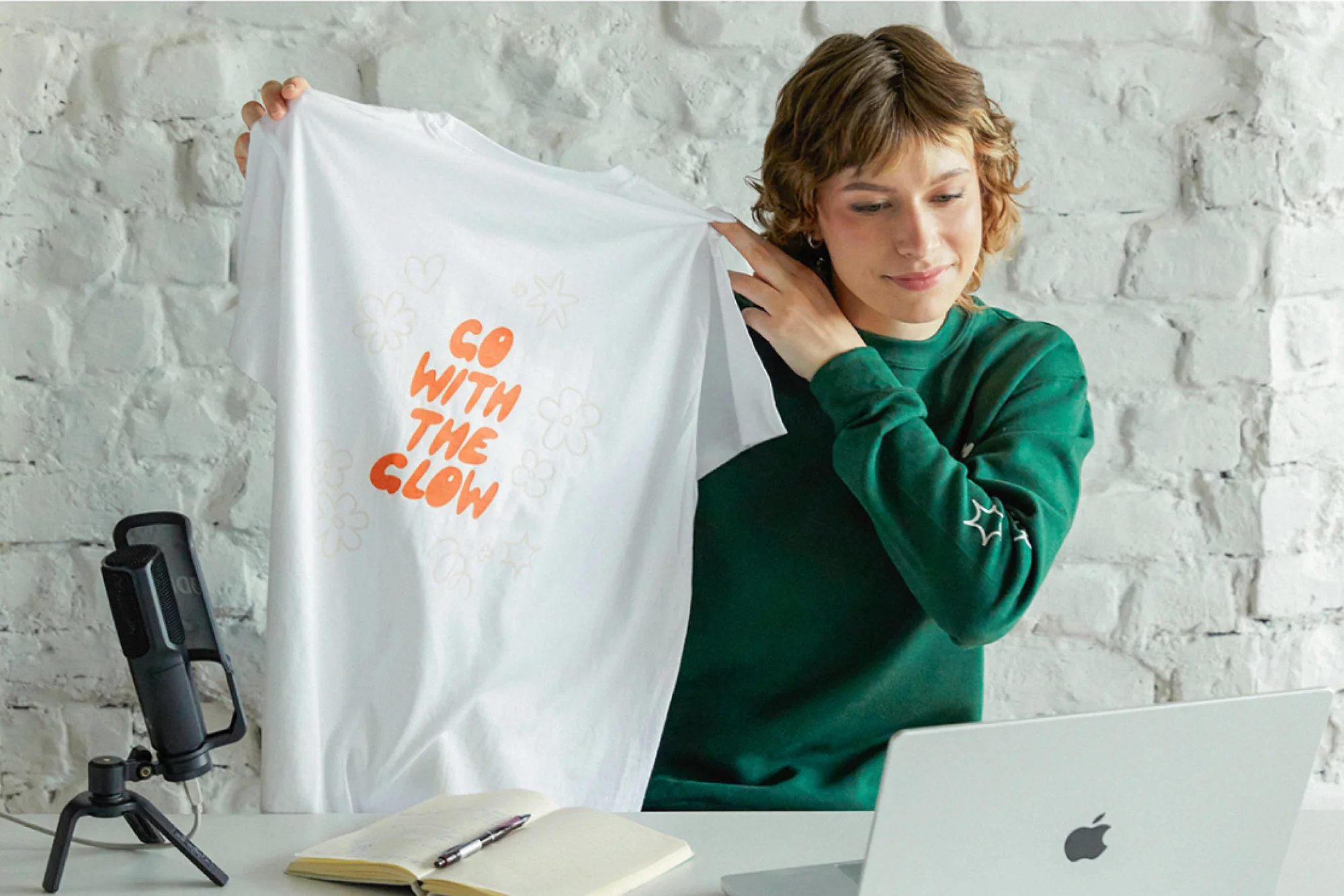
Next, sign up for a POD service – we’ll use Printify here. You only need a free account to access our Catalog of 2,000 high-quality products, from custom t-shirts to wall art and phone cases.

Which product to choose depends on your niche, but many experienced sellers recommend beginning with a single product before adding more.
Printify merchant Annie Keller spent her early days testing a bit of everything before she found her footing, and her advice to beginners is simple – focus on one product, one niche, and just make it good.
Catherine Waites, who now runs several Etsy shops, agrees. Master one category before expanding, because t-shirts, mugs, and wall art each need their own sizing and mockups.
If you want a safe first pick, start with a proven bestseller. T-shirts, mugs, and posters are the easiest entry points since they fit almost any niche and shoppers already search for them.

Step 3: Add your design
Once you’ve chosen a product, go to the Product Creator to access all of Printify’s design tools. You can:
- Upload your own photos, artwork, or logo.
- Design from scratch with our free graphics library or AI image generator.
- Create text-based designs using hundreds of fonts.
- Drag, drop, and layer elements the way you want.
- Turn images into patterns in a few clicks.

A few tips for your first custom designs:
- Keep them clean. One clear idea reads better on a t-shirt or mug than a busy layout.
- Make the text easy to read. Simple, bold fonts stay legible when a shopper sees your small product images in search results.
- See what’s selling. Check the latest design trends to identify which styles, colors, and themes buyers are responding to right now.
- Test more than one. With Print on Demand, sellers can list as many t-shirt designs as needed before a full-scale launch. Try several and let your sales show you which ones resonate with shoppers.
Step 4: Set up your product listing
Next, choose your mockups. These are the photos shoppers see, so pick up to 15 high-quality images that show the product from multiple angles and in realistic settings. Even better, order a sample and take your own photos to build trust with potential customers.

Next, write your title and description. Printify generates them for you by default, but you can refine them with our AI tool or rewrite them yourself.
Aim for a title that matches how shoppers actually search, like “art teacher coffee mug.” That way, your listing can show up in relevant Google searches and drive traffic to your store.
For the product description, cover key details in plain words – what the item is, the material and fit, sizing, and who it’s for.

Lastly, set your retail price. Many POD sellers aim for a 30% to 50% profit margin, then adjust based on the niche and perceived value. A few tips for pricing your first product:
- Cover your full cost first. Add up the base cost and any platform fees before marking anything up to avoid selling at a loss.
- Research competitor prices. See what similar products sell for in your niche, then price near that range. Undercutting too hard can signal low quality and shrink your margin.
- Let the data guide you. Our Pricing tool can suggest a price range based on real sales data before you publish.

Step 5: Connect your online store
Before you can sell custom products, connect Printify to your sales channel so that your listings and orders sync automatically. Printify integrates with Etsy, Shopify, TikTok Shop, Amazon, and more.
The exact steps depend on the platform. Check out our Help Center for step-by-step guidance.
No shop yet? Use the Printify Pop-Up Store instead. It gives you a free storefront with no separate platform to set up, making it the simplest way to sell online.
Once your store is connected, publish your products. From here, Printify handles printing and shipping for every order, so you can focus on scoring your first sale.
Step 6: Market your POD business
The last step is getting people to see your products. No need for a big budget – most beginners do best with free methods first, then paid ones once they’ve started selling.
Easy ways to market a print-on-demand store:
- Post on social media. Share your products where your niche already hangs out, like Instagram, TikTok, or Pinterest.
- Ask for reviews. Customer feedback builds trust with new shoppers and shows you what to improve. They also double as testimonials for marketing purposes.
- Build an email marketing list. Collect email addresses from buyers and interested visitors to share information about your latest designs, restocks, and discounts.
- Reward returning buyers. A quick thank-you message, a small discount on the next order, and solid service can turn one-time shoppers into repeat customers.
- Try paid ads. When a product is already converting, a small amount of ad spend on social media or search can widen its reach.
Do these regularly, and your happy buyers can grow into a loyal customer base that keeps sales coming.
Avoid these print-on-demand beginner mistakes
Watch for these beginner mistakes when starting your POD business:
- Giving up too early. Many sellers had months of slow or no sales before momentum picked up. Keep listing and learning, and give your store time to find its buyers.
- Selling to no one in particular. As a beginner with no ad budget or audience, a sharp niche, a focused catalog, and a strong brand identity can make your business stand out to shoppers.
- Competing on price. POD base costs are higher than mass-produced goods, so a very low retail price leaves almost nothing after fees. Add up your total costs to get real profit, rather than going for the cheapest spot in your niche.
- Ignoring your store setup. Missing shipping details, return terms, and FAQ answers create confusion and refund disputes. Fill them in to set customers’ expectations before they order.
- Skipping sample orders. Ordering samples is how you catch print, sizing, or quality issues before a buyer does. It also shows you how long fulfillment and delivery take.
- Keeping no cash buffer. Print on Demand is profitable, but it’s not entirely cost-free to run. You still pay for samples and any promotion you do before making any income.
Print on Demand for beginners: FAQ
Ready to start your POD business?
Now that you know how to start a print-on-demand business for beginners, the next step is to actually get started. Choose a niche you’re familiar with, create your first product, and let your sales show you what to make next.
Since nothing is printed until someone buys, you can test ideas without risking your savings. Create your free Printify account and launch your first product today.