


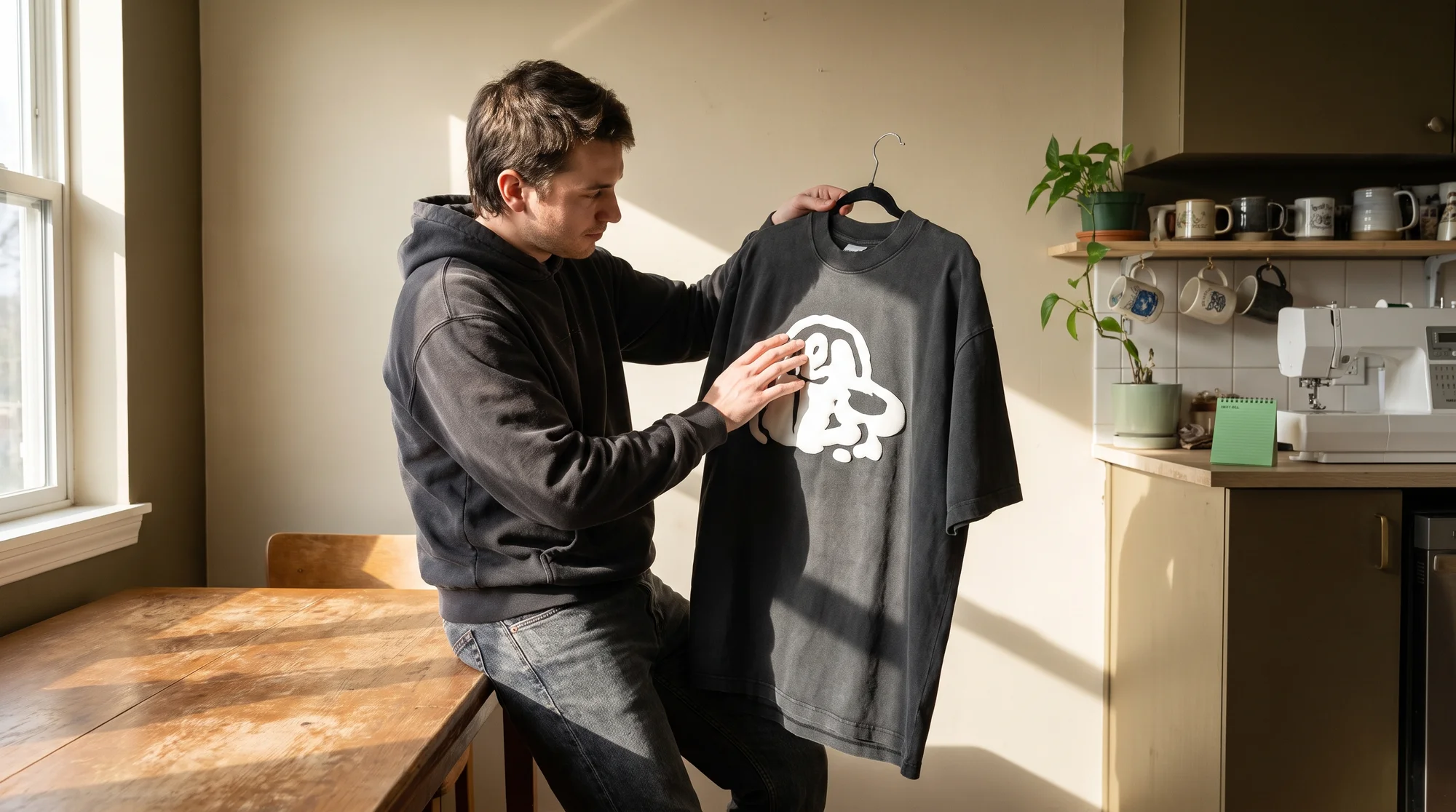
You spotted the trend three weeks too late again — and by the time your bulk screen printer emails back a 50-piece quote with a 2-week turnaround, the moment's already dead. Puff print flips that script: it's a specialty printing method that lets you charge streetwear prices for a design you can make in 15 minutes and drop tomorrow. In this guide, you'll learn the artwork rule that keeps your designs crisp, how puff fulfillment works in Print on Demand, and the exact heavyweight blanks that make raised ink look expensive.
What puff print actually is
Puff print is a specialty printing method where a blowing agent is added to plastisol or DTF inks, causing the printed graphics to expand and rise when exposed to heat during curing. This creates an elevated, 3D textured finish on apparel. Print on Demand sellers use puff print to elevate simple typography, streetwear logos, and minimalist line art into premium, high-margin merchandise.
Here's the reframe: puff print is the fastest way to make simple bold typography look expensive. One word, one heavyweight tee, and a 3D texture your customer can feel — that's a $45 drop built on a $12 blank.
Why puff print beats bulk screen print
The competitor problem
Bulk screen printers want 50 pieces, factory quotes, dedicated reps, and 10 business days of production before you've validated a single sale. That's the trap. You spot a trend, you get excited, and then you're stuck pre-paying for 50 shirts on something the market hasn't confirmed it wants.
When that trend flops — and half of them do — you're sitting on 50 dead shirts and a lighter bank account. The risk lands entirely on you.
The zero-inventory puff advantage
Puff print through Print on Demand removes every one of those barriers:
- No minimums. Sell one shirt or one hundred — same price per unit.
- No bulk quote emails. No reps, no back-and-forth, no waiting for a factory to respond.
- No setup fees. Nothing eats your margin before the first sale.
Test on TikTok Shop or Etsy today, drop it tomorrow, and kill it if it flops — with zero downside. That's the whole game.
Rule 1: The artwork simplicity rule
Puff ink expands in all directions when heated. That means tiny negative spaces, tight line gaps, and small text (under 16pt) blur together as the ink puffs up. Fine detail doesn't survive the process — it turns to mush.
What puffs clean vs what fails
Do this:
- Bold, clean vector typography
- Chunky block shapes
- Thick outer strokes (over 3mm)
Avoid this:
- Fine lines
- Script fonts
- Tight negative space
- Small text (under 16pt)
Stick to the "do" list and every raised edge stays crisp with clean 3D separation.
The design-in-15-minutes loop
One bold word plus one heavyweight blank equals a testable drop. That's it. You don't need a design degree — you need a heavyweight font and a >3mm stroke.
Here's the loop that builds momentum:
- Batch 5 typography ideas in one sitting.
- Publish all five.
- Let the algorithm pick the winner.
This simplicity is a feature, not a limitation. It's exactly why puff is the fastest trend-test method that exists.
Rule 2: How puff fulfillment works
Traditional screen printing uses a puff additive in screen inks. But modern Print on Demand fulfillment works differently — it uses Puff DTF Transfers or specialized screen-print hybrid nodes to get the same raised result without the minimums.
The Puff DTF transfer explained
When heat-pressed onto heavyweight cotton, the transfer cures into a raised, rubbery foam texture — the exact 3D hand-feel that reads "premium" to a buyer.
It holds up through commercial laundering when cared for properly. Tell your customers the care routine:
- Turn the garment inside out
- Wash cold
- Low heat or air dry
Follow that, and the puff stays raised drop after drop.
Why you don't touch a heat press
You never buy equipment, and you never hold stock. Your Print Provider presses and ships each order as it comes in. You upload the design, publish the product, and collect the margin — Printify handles the production and the speed of getting it out the door.
Rule 3: The blank pairing that matters
Raised ink needs a stable surface. Pair your puff print graphics with heavyweight, high-density cotton blanks in the Printify Catalog, or the texture puckers and sags on thin fabric.
3 heavyweight blanks that support raised ink
Pull any of these from the Printify Catalog:
- Shaka Wear Max Heavyweight Tee
- Comfort Colors 1717
- Lane Seven Heavyweight Hoodie
Each one gives the structural stability that keeps puff ink sitting proud instead of collapsing.
Why fabric weight equals premium value
Two things happen when you go heavyweight. First, the dense fabric stops the ink from puckering or sagging — it holds the raised texture flat and clean. Second, the heavyweight hand-feel justifies streetwear pricing before the customer even sees the design.
That's the quality signal doing your selling for you.
The full flip playbook
Step 1: Spot a trend early
Watch TikTok Shop and Etsy for a phrase or aesthetic gaining speed.
Step 2: Type one bold word
Set it in a heavyweight font and apply the >3mm stroke rule.
Step 3: Drop it on a heavyweight blank
Open the Printify Catalog and place it on a Shaka Wear Max or Comfort Colors 1717.
Step 4: Publish and watch the data
Post the mockup to your store and let the numbers talk.
Step 5: Scale winners, delete flops
Scaling costs nothing extra, and killing a flop costs you exactly $0.
Margin math per puff drop
Here's the spread that makes puff worth it. A heavyweight blank with a Puff DTF transfer sits at a modest base cost — but the 3D texture unlocks streetwear retail pricing that thin, flat-print tees can't touch.
That gap between your blank cost and your retail price is your profit. And because there are no setup fees and no minimum spend, every single sale is pure validated margin. You're never digging out of a pre-paid inventory hole — you're banking from sale one.
More money. More autonomy. More living.
FAQ
Does puff print survive washing?
Yes. When cared for properly — inside out, cold wash, low heat or air dry — the raised texture holds up through commercial laundering.
Can I do multi-color puff?
Puff works best with bold, simple designs. Keep colors clean and blocky rather than layering fine multi-color detail, since intricate work blurs as the ink expands.
What's the smallest text I can use?
Stay at 16pt or larger and keep strokes over 3mm. Anything smaller puffs together and loses definition.
Do I need a heat press?
No. Your Print Provider presses and ships every order. You never buy equipment or hold stock.
Is there really no minimum order?
Yes, really. No minimums, no bulk quotes, no setup fees. Sell one or one hundred at the same per-unit price.