


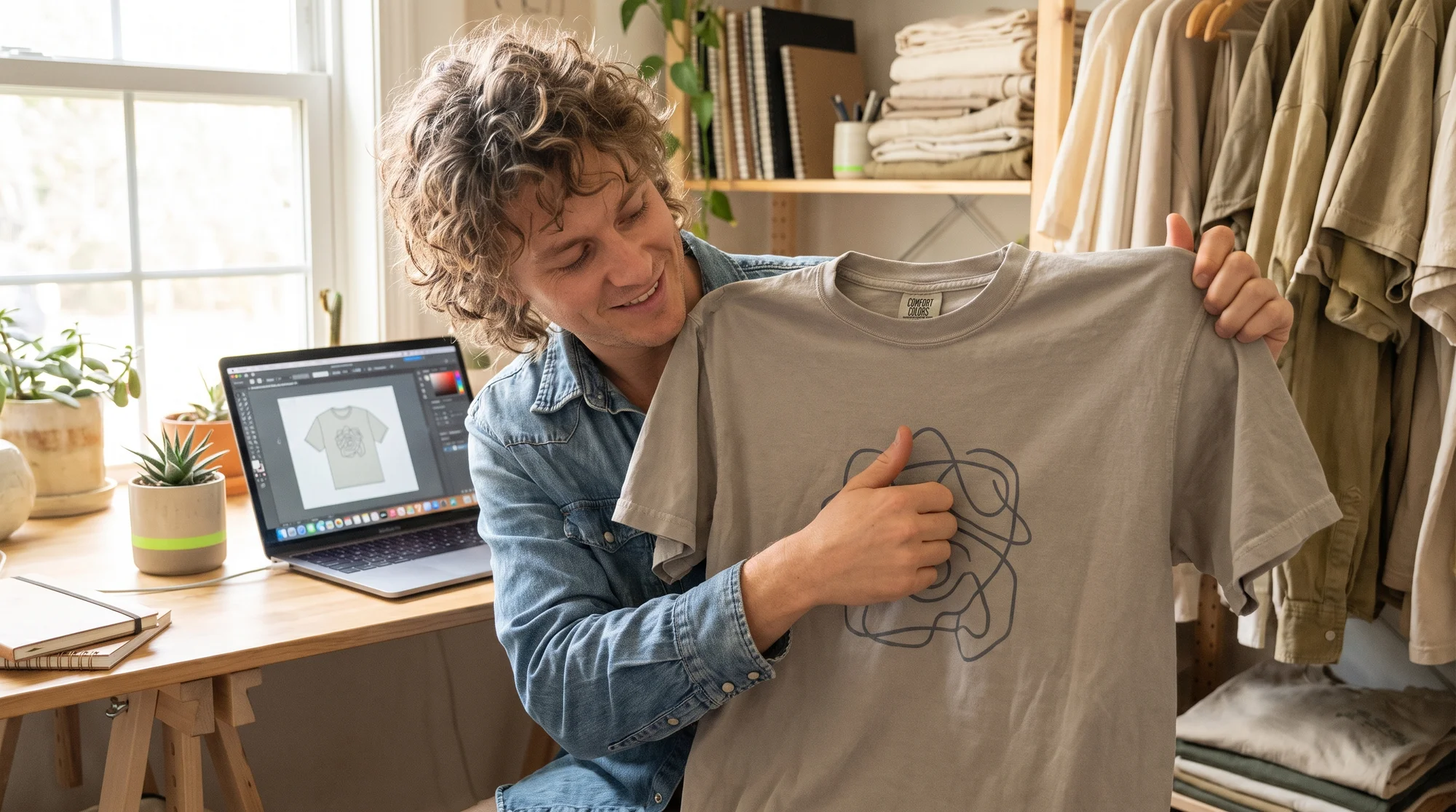
You didn't get into this to become a screen-printing chemist — so why is every article demanding you memorize curing temps and PVC ratios before you can sell a single shirt? Here's the shortcut: you don't have to choose between water-based and plastisol ink at all. Skip the chemistry, skip the $2,000 dryer, and get the soft-feel look buyers pay premium prices for by designing inside the Product Creator and letting our Print Providers handle the printing.
Bottom line: Plastisol ink is a PVC-based suspension that sits on top of fabric fibers, delivering bright, opaque, and highly repeatable prints on any color or fabric blend. Water-based ink uses water-soluble pigments that soak directly into garment fibers, producing an ultra-soft, breathable, "zero-feel" print best suited for 100% natural cotton garments.
The trap hiding inside the ink debate
Why articles push chemistry
Search "water-based vs plastisol ink" and you'll drown in cure temperatures, mesh counts, emulsion types, and PVC ratios. That's a distraction. Every hour you spend memorizing chemistry is an hour you're not launching a product or making a sale.
The real question to ask
The real question isn't "which ink." It's "how do I get the soft-feel look buyers pay for without the overhead?" Premium shoppers today want that vintage, broken-in hand-feel — and they'll pay for it. You need the result, not a garage full of curing gear.
When ink choice matters
Here's the reframe: the entire ink debate only matters if you are the one running the screens. Spoiler — you shouldn't be. When someone else owns the equipment, the ink question disappears entirely.
Chemistry and hand-feel
If you're one of the artists who cares about the finished product, this is the part that matters. Your buyer never asks about ink type. They feel the shirt — and that feeling decides whether they buy again.
Plastisol: A rubbery layer on top
Plastisol sits on top of the fabric as a thick, rubbery ink layer. It's bright and opaque, but you can feel it — especially on dark garments, which need a white underbase that makes the print even heavier and stiffer.
Water-based: Pigment that dyes fibers
Water-based ink soaks into the cotton fibers and dyes them directly. The result is a soft-hand, vintage "zero-feel" print that stays breathable wash after wash. Run your hand over it and the design feels like part of the shirt, not a sticker on top.
Which one actually sells
The soft-hand vintage look is what today's premium buyers crave. It reads as high-end, feels comfortable, and commands better prices. The catch? It's the harder one to pull off yourself.
The fabric catch
Water-based ink only performs on 100% natural cotton. Plastisol works on any blend or color. So if you go the DIY route, your ink choice suddenly limits which blanks you can sell — before you've even printed a shirt.
Production overhead and drying rules
If you're one of the business owners running the numbers, read this before you buy a single piece of equipment. The operational trade-offs are where "cheap DIY printing" quietly turns expensive.
Plastisol setup
Plastisol never dries on the screen at room temperature, which keeps setup simple — you can pause without ruining your mesh. But it demands full thermal curing at 320°F. No proper cure, no durable print. That means industrial heat equipment and space to run it.
Water-based reality
Water-based ink air-dries fast — too fast. Any pause and it clogs your open screen mesh, ruining your setup mid-job. To cure it properly, you need forced-air evaporation dryers. The very softness that sells is the very thing that's hardest to produce.
The hidden cost
Here's what "saving money by printing yourself" actually costs upfront:
- Forced-air dryers: $2,000 and up
- Ruined screens from clogged mesh (recurring)
- Water-resistant emulsion for re-burning screens
- Curing and heat-press gear
- Storage for ink, screens, and chemicals
- Chemical handling and cleanup
The margin math
Curing gear, spoiled ink, and constant screen re-burns quietly eat the profit you thought you were saving. Add storage and cleanup time, and your "cheap" print becomes one of your biggest fixed costs — before you've sold anything.
The launch-speed killer
Here's the real cost: while you're troubleshooting clogged mesh at midnight, the trend you were chasing is already dead. Speed to launch is the whole game, and DIY printing is the slowest way to play it.
The shortcut smart sellers use
You want the water-based soft-feel look that sells. Here's how to get it in one click instead of buying a $2,000 dryer and mixing chemicals.
Get the look without gear
The Product Creator's Direct-to-Garment (DTG) printing uses eco-friendly, water-based pigmented inks to deliver that soft-hand, vintage "zero-feel" print — the exact result premium buyers pay for. You get the look without touching a screen.
Zero chemistry, zero gear
- Zero chemistry — no PVC ratios, no cure temps, no emulsion
- Zero curing gear — no $2,000 dryers, no heat presses to buy
- Zero storage — no ink to stock, no screens to shelve
- Zero wasted launch time — you design, our Print Providers print
Print on top-tier blanks
Drop your design onto the blanks buyers already love:
- Comfort Colors 1717 — garment-dyed vintage cotton, built for that soft-hand look
- Lane Seven Hoodie — a premium heavyweight blank that feels as good as it looks
On-demand fulfillment
With Print on Demand, there are no minimums, no ink to store, and no screens to burn. Our network prints and ships each order only when a customer buys — so you launch the trend while it's still hot and never sit on unsold inventory. That's profitability, quality, selection, and speed working for you.
Quick comparison: Plastisol vs water-based vs DTG
| Factor | Plastisol | Water-based | Printify DTG |
|---|---|---|---|
| Hand-feel | Thick, rubbery layer on top | Soft "zero-feel," breathable | Soft "zero-feel," breathable |
| Best fabric | Any blend or color | 100% natural cotton only | Cotton and cotton-rich blanks |
| Gear required | Screens, thermal cure at 320°F | Screens, forced-air dryers | None |
| Upfront cost | High | High ($2,000+ dryers) | $0 |
| Speed to launch | Slow (setup, cure) | Slow (clogging, cure) | Minutes |
| Who does the work | You | You | Our Print Providers |
FAQ
Does DTG feel as soft as water-based?
Yes. The Product Creator's DTG uses water-based pigmented inks that soak into the fibers, giving you the same soft-hand, breathable "zero-feel" result — without the screens or dryers.
Can I get opaque prints on dark shirts?
Yes. DTG lays down a white underbase automatically when needed, so your colors stay vivid on dark garments — and you never touch a squeegee.
What blanks suit the soft-hand look?
Start with the Comfort Colors 1717 for garment-dyed vintage cotton, or the Lane Seven Hoodie for a premium heavyweight feel. Both are in the Printify Catalog.
Do I ever need to buy a dryer?
No. Never. Our Print Providers own all the equipment. You design; they print, cure, and ship.