

Turn your ideas into income
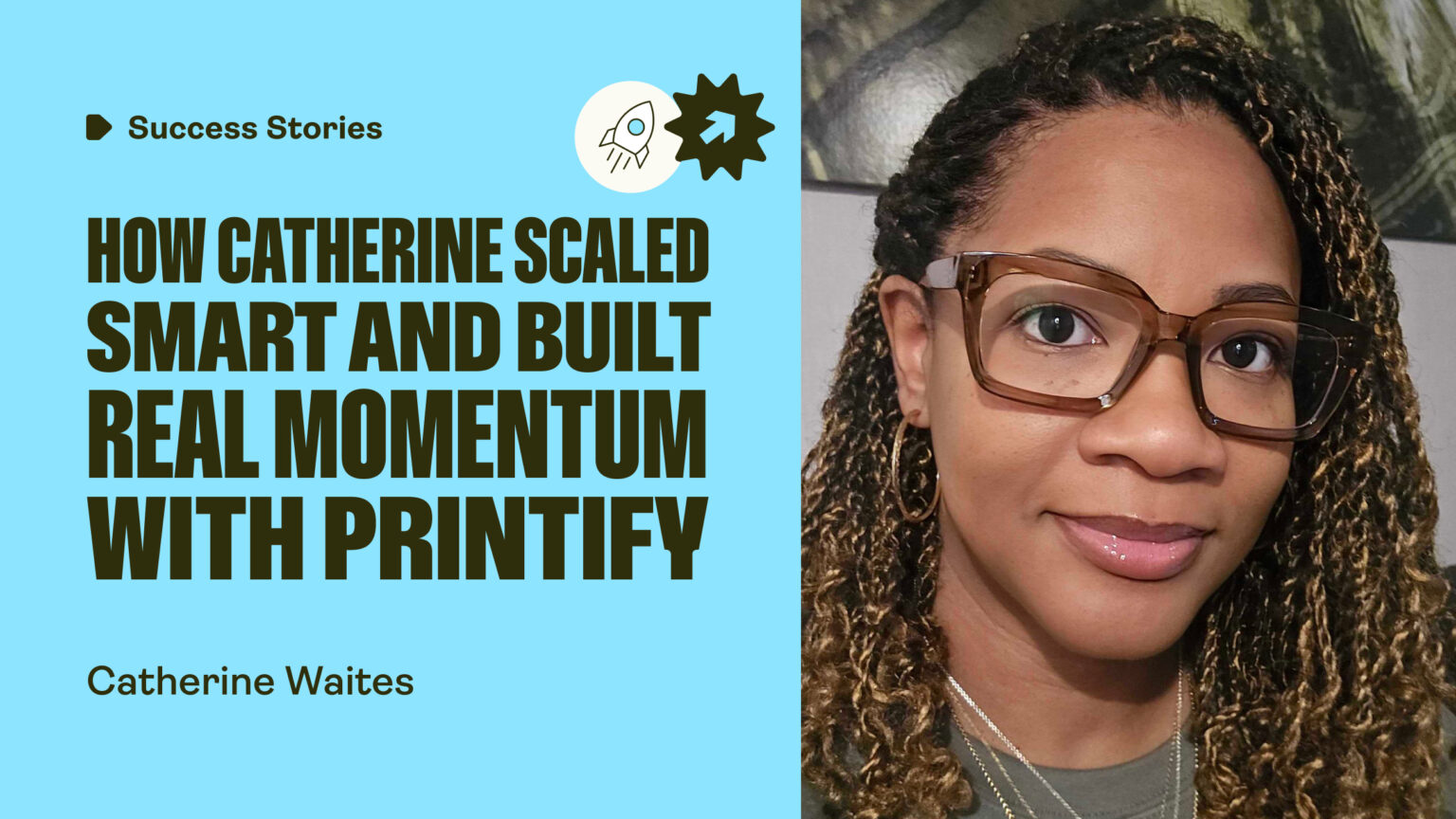
For Catherine Waites, building a successful print-on-demand business didn’t start with a viral design or a perfect SEO strategy. It started years earlier at her kitchen table, making handmade projects with no plan to sell a thing.
Today, she runs multiple Etsy shops, handles high-volume seasons with confidence, and helps other sellers navigate the same learning curve.
This is the story of how a lifelong creative built a sustainable storefront and grew with the help of Printify.
A creative background rooted in handmade work
Long before Catherine built a steady print-on-demand business, creativity was already woven into her daily life. She made handmade cards, scrapbooks, custom photo books, and early Cricut projects for her kids, friends, and family gatherings.
“I’ve always been a creative,” Catherine explains. “I started with making things by hand – like cards, scrapbooks, and using a Cricut when they first came out. I was doing everything old school and never really thought of it as a business.”
Even when people suggested selling on platforms like Etsy, it didn’t feel realistic. At the time, it was still just a passion project. But those years of hands-on work shaped her instincts around placement, spacing, and visual balance.

Stepping into Print on Demand and letting production go
Moving from handmade production to Print on Demand meant giving up control – the kind that comes from touching every product, managing every supply, and overseeing every step. For someone used to doing everything in-house, trusting an external system felt risky.
“It was a control issue for me, especially with quality,” Catherine admits. “But once I ordered samples and saw how professional the process was, I realized I could trust it. It allowed me to focus on designing instead of worrying about supplies being out of stock or waiting for shipments.”
Print on Demand entered the picture only after she started digging into how others managed volume without a full workshop. She discovered it through YouTube creators like Cassie, Mandy, and Jay’s Way, and realized many successful sellers weren’t printing at home at all. They were designing, uploading, and letting Print Providers handle fulfillment.
Launching on Etsy and finding the first spark
Opening an Etsy shop in 2022 was a reset, not a continuation of her handmade sales. Catherine began with physical inventory she already had – DTF transfers, tees, and sublimation prints – all prepped for a busy holiday season she hoped would arrive quickly. But her shop went live quietly.
The turning point came with her first order. It was a single birthday shirt, printed on a Gildan 5000. Modest, but validating.
“My first sale was in April – a birthday shirt. It came organically, which made it even better,” she says. “I reached out to friends and family after that. I’d ask what they needed, create the listing, and let them order through Etsy, so it helped my shop.”
One early highlight was a bulk order for a cousin’s trip that turned into 19 shirts in a week. The designs matched the group’s vision, and photos and reviews followed. That momentum – built through listening and responding – became something real to grow from.

The steep but necessary lesson in trademarks
She quickly realized not every idea sells. Popular movie phrases, characters, and references that seemed harmless at craft fairs weren’t legally usable on Etsy. It was an area she’d never needed to study until selling at scale became real.
“I had no idea I couldn’t use certain phrases or characters. Seeing vendors sell transfers in person made it look normal, but online is different. I had to learn trademarks properly.”
So she sat down and watched hours of trademark and USPTO walkthroughs, studied registration classes, and learned how to check ownership, suspension status, and pending filings.
Building design skill through repetition and trial
Switching from physical crafting to on-screen design was a learning experience. Catherine knew how to size and place prints from her handmade years, but translating that into Canva files, mockups, and digital composition took practice.
As she put it: “My first designs are not something I’d make today. You learn through repetition from spacing, fonts, and where things sit on a shirt or mug. It adds up over time.”
With every listing, she developed a clearer sense of what felt balanced and what didn’t. Years of using Cricut helped her judge placement without holding a shirt in her hands, and that made designing for Print on Demand less intimidating.
Mockups sped up the decision-making. If a design worked on a sweatshirt, she could downsize it for a mug or scale it for a tote. Instead of creating new pieces from scratch, she adapted best-selling designs across multiple products.
Writing listings the way customers search
When Catherine first listed products, her titles described what she saw on the screen – not what buyers searched for. A “Christmas tree t-shirt” made sense visually, but it didn’t match how shoppers actually phrased their queries. Once she recognized that gap, SEO became a skill she actively worked to understand.
She started paying attention to how people search: birthdays by age, retro shirts by decade, events by theme. Tools like eRank and EverBee showed her keywords in context. Etsy updates over time also taught her to adapt, moving from long keyword-heavy titles to shorter, cleaner formats as platform preferences shifted.
“Etsy itself gives you all the data. It tells you what to do, what not to do. And we have the wonderful world of AI. So now you can literally take what Etsy has given you, plug it into AI as a policy, and write that SEO based on the standards.”
Creating a customer experience that brings buyers back
Customer service became a pillar of Catherine’s shop. With over two decades in call centers and HR, she understood how tone, clarity, and follow-through shape a buyer’s impression long after the product arrives.
“Etsy already sends updates for tracking, delivery, and reviews. I realized I didn’t need to add pressure.”
She built her shop so customers rarely needed to ask questions. “Customer service is what drives everything. I make sure that customers don’t have to reach out for anything. My FAQs are done, policies are set up, and my auto-reply messages are ready. ”
When buyers did reach out, her responses were personal and solution-oriented, not templated.
One buyer ordered items for her daughter’s school, loved the quality, and placed another order later. Catherine reached out then, not to request feedback, but to acknowledge the moment and offer support for future needs.

Handling difficult customers without compromising the business
Not every order ends smoothly – some situations can’t be resolved through goodwill alone. One of her most challenging experiences involved a bulk custom order where the buyer believed she had ordered sweatshirts instead of t-shirts.
“I showed her the dropdown options, the mockups, and our messages. I tried to meet her halfway, but I wasn’t going to give free sweatshirts when she ordered five t-shirts.”
When the buyer demanded free replacements and left five one-star reviews, Catherine couldn’t absorb the loss.
Another situation involved repeated size exchanges – the customer changed her mind multiple times and ignored return procedures. When things became unproductive, Catherine chose to walk away rather than continue the cycle.
To manage these moments, she began using AI tools to reframe responses before sending them. “It takes the emotion out. I step away, plug it in, and make sure I’m responding clearly – not reacting.”
Scaling with what works instead of chasing everything
Catherine scaled by identifying what sold, then building around it. When a niche gained traction, she didn’t pick up something new. She created variations, adjusted colors, tweaked styles, and placed the same idea on different products where it made sense.
“Start with one product and get good at it. Once it sells, move it to a sweatshirt, a mug, a tote. Build from what’s already working.” Every addition came after she had proven a product could sell.
It applied to product types too. Sometimes the same design sold better as a mug than as a tee, confirming that expanding a winning idea often matters more than starting fresh.
“If something’s getting favorites and visits, I’ll make three or four more versions,” she explains. “Maybe they didn’t buy the first one, but seeing similar options in my shop keeps them from going somewhere else.”

How Printify removed the weight of production
As orders increased, Catherine needed a process that didn’t rely on her physically producing every item or waiting on suppliers. Printify let her operate at scale without sacrificing speed or quality.
With fulfillment handled externally, she could spend more time designing, optimizing listings, and serving customers instead of heat-pressing shirts late at night.
She also developed a system for replacements and support. “I love Printify. It’s one less thing I have to worry about. If there’s an issue, I already know what to do. I open a ticket with photos and place the replacement so the customer doesn’t wait – we handle it together.”
Recurring roadblocks sellers face and how to prepare for them
As both a seller and an active moderator in Printify’s Facebook community, Catherine has noticed the same questions come up again and again: driving traffic, what items to sell, and which providers to use.
Driving traffic takes more than listings. Pinterest and social accounts boost visibility, but they work best when sellers build familiarity rather than push for instant sales. Ads work too – on Facebook, Google, Etsy, or Amazon – but only if costs are monitored closely. And not every bestseller reflects personal taste. That’s often the surprise.
Product range is the next challenge. Catherine recommends mastering one category before adding another. T-shirts, mugs, and wall art each require different sizing, mockups, and SEO. Get one right, then expand.
Finally, choosing Print Providers. Catherine tested several before leaning into Printify Choice for consistency and margin.
“Printify Choice kept showing me savings on every order – sometimes more than a dollar each. That was profit I’d been leaving on the table. Once I realized issues can still be resolved when needed, it became easier to trust the network. Now I use Printify Choice regularly, and the samples I’ve ordered have been solid.”
Why sellers lean on Printify Choice
Printify Choice takes the guesswork out of fulfillment. It automatically selects the top Print Provider for every order, giving sellers the best mix of pricing, quality, and reliability.
What you get:
– Lower costs with the most competitive pricing
– High-quality output from top-rated providers
– Stable inventory and fewer fulfillment headaches
Explore Printify Choice
The advice Catherine wishes every beginner heard sooner
After years of trial, adjustment, and steady growth, Catherine believes the biggest hurdle for new sellers isn’t design skill or platform knowledge. It’s impatience.
The pressure to match other shops, rush milestones, or replicate others’ success causes sellers to lose sight of what actually builds a sustainable store.
Early comparison can quietly derail progress. Instead of learning what works for their own audience, many sellers chase what looks impressive from the outside – which only creates unnecessary pressure and confusion.
“The biggest thing I wish I knew was to take it one day at a time,” she says. “You’re not going to learn everything all at once. Focus on your store, your customers, and what’s selling for you, not what everyone else is doing.”
Real progress happens when sellers stop racing and start listening to their data, their buyers, and the rhythm of their own shop.