


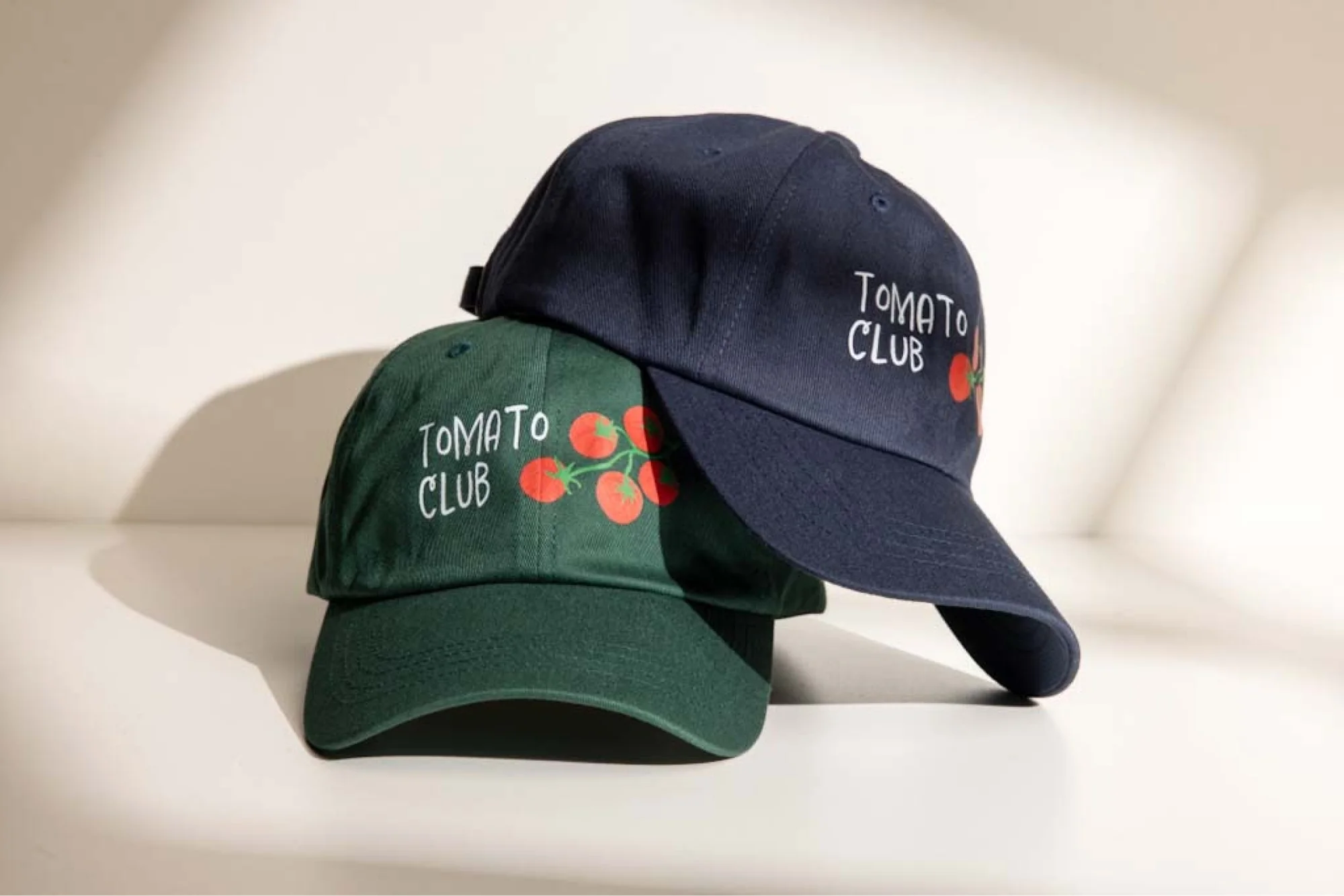
Learning how to start a hat business begins with a specific niche, such as trail runners or bass fishers. Produce your custom hats through Print on Demand (POD), then list them on Etsy or Shopify.
One design carries across dad hats, trucker hats, beanies, and bucket hats. POD produces each hat after a customer orders it, which lets a small business start without buying inventory. Starting a hat business this way keeps your first spend to a sample hat or two.
Key takeaways
- Pick a specific niche and define your target audience before you design anything.
- Start with two or three hat styles, such as dad hats and trucker hats, that carry the same artwork.
- Use embroidery for bold shapes and short text. Use printing for detailed, full-color custom designs.
- POD has no minimum order. On Printify, a classic dad hat starts at $13.84 and a mesh-back trucker cap at $14.40, before Premium discounts.
- Set retail prices above production cost, shipping, and platform fees to protect your profit margins.
- Bulk orders and your own embroidery machine lower the cost per hat, and both require upfront spend on stock or equipment.
[[CTA1]] Design your first custom hat with Printify for free.
Is a hat business worth starting?
A hat business is worth starting when you have a specific group in mind and a design they'd wear more than once. The hat industry shows proven demand. Grand View Research values the global headwear market at $37B in 2025 and projects $62.8B by 2033.
Hats work as fashion accessories, team gear, and outdoor wear. That range lets one design reach more than one customer base.
Most styles also skip sizing. A snapback, dad hat, or beanie fits most heads, so each design needs one listing per color, with no size variants to manage.
The market is crowded, though. Plenty of shops already sell hats, and a plain cap with a logo is easy to copy. Success depends on a narrow audience, original custom designs, and steady posting on the channels your buyers use.
A hat business turns profitable when your retail price clears production cost, shipping, and platform fees on every order.
How to start a hat company in 5 steps
Work through these steps in order. Each one ends with an action you can finish the same day, and none requires buying stock. The order holds whether you're starting a hat company as a side project or building toward a full catalog.
1. Research the market and find your niche

Pick one group whose language you already speak, such as fans of local sports teams, a hobby crowd, or people from your town. Focusing on one narrow group makes custom designs easier to write and ads easier to target.
- Search Etsy for your interest plus the word "hat," open the first page of listings, and read the five-star and one-star reviews. Note what buyers say about fit, stitching quality, and shipping time.
- Check what competing shops sell, what they charge, and which designs collect the most reviews. Review counts give you a rough read on demand.
- Write one sentence that defines your target audience: who they are, where they wear the hat, and what the design on it says.
Keep the work original. Sports teams' names and logos are trademarked, so design around fan in-jokes and local pride. Run a trademark check on any slogan before you list it, because common phrases are often registered.
2. Choose your hat styles
Start with two or three hat styles your buyer already wears, then add more once sales show what works.
- Dad hats: unstructured cotton crown and a curved brim, soft from the first wear.
- Trucker hats: foam front panel and mesh back, cooler for outdoor work and summer markets.
- Snapbacks: flat brim, structured front, and an adjustable plastic strap.
- Fitted hats: structured and sized, so each design needs more variants.
- Bucket hats: soft all-round brim that shades the face and neck.
- Beanies: knit with no brim, built for cold-weather niches.
Match each style to the vibe of your niche and the clothing your buyers already wear. For a sense of popularity, the Printify Catalog tags the Classic Dad Cap and the Foam Trucker Hat as Bestseller.
Compare crowns, closures, and decoration methods in our custom hats range, then shortlist two styles that suit the same artwork.
3. Design your custom hats

Build each design around one bold shape or one short line of text. A hat's front panel offers a small print area, and embroidery loses thin lines and photographic detail.
Upload your artwork in Product Creator, place it on the front panel, side, or back strap, and preview it before you save. Use our guide to hat logo size to set the dimensions for each style.
For stitched artwork, start from our custom embroidered hats range. Each design uses up to six of Printify's 15 thread colors, and Print Providers digitize your file at no extra cost.
A patch covers the front panel with a clean edge and a second material. Leather and woven patches suit dad hats and trucker hats, and they hold detail that direct stitching can't. Your logo or key icon should appear the same way on every hat, so buyers recognize your brand across styles.
4. Pick your production method and supplier
Hat makers decorate hats four main ways. Embroidery stitches the design into the fabric. Screen printing pushes ink through a mesh stencil and suits bulk runs with few colors. A heat press applies patches or direct-to-film (DTF) transfers, and direct printing methods such as DTG and dye sublimation handle full-color artwork.
You can run that production process three ways:
| Factor | POD | In-house embroidery or heat press | Bulk manufacturing |
|---|---|---|---|
| Upfront cost | Lowest. You pay per order after a sale | A machine or press, thread, transfers, and practice hats | A full minimum order before you sell one hat |
| Control over quality | Order a sample and review it before you list | Full control. You inspect every hat | Set by your spec and the approval sample |
| Speed to first sale | List the same day your design is ready | After you learn the equipment | Weeks of production and shipping |
In-house work takes expertise. Hooping a curved crown is tricky, and clean stitching takes weeks of practice.
Whichever route you pick, compare suppliers on four points:
- Different materials on offer, such as organic cotton, polyester mesh, or acrylic knit
- Minimum order quantity
- Turnaround time
- Decoration methods they run on hats
The right manufacturer for a bulk run sends an approval sample before full manufacturing starts.
POD has no minimum order. With Printify Choice, orders route to the production partner closest to your customer, which shortens shipping time.
Printful's in-house facilities also run as a Print Provider in the Printify Catalog, and their hat range includes embroidered dad hats and bucket hats. Order a sample to check quality, then photograph it on a head for your listing.
5. Set your prices and build your store
Add production cost, shipping, and platform fees together, then set your retail price above that total. A low price leaves little room for ad spend, returns, or discounts.
Here's a worked example for a classic dad hat sold on Etsy for $30:
- Production cost: $13.81, the Printify base price
- Etsy listing fee: $0.20
- Etsy transaction fee: 6.5% of $30, or $1.95
- Payment processing: 3% plus $0.25, or $1.15
That leaves $12.86 per hat before the shipping you pay Printify. Etsy also takes its transaction and processing fees from any shipping you charge buyers, so price shipping to cover them. Track revenue per design in your first month to see which ones carry your profits.
Then choose where to sell. You have three routes:
- Your own website: Shopify gives you direct control over branding, pricing, and customer data. The Basic plan costs $39 a month, or $29 a month billed annually.
- A marketplace: Etsy, Amazon, eBay, and TikTok Shop bring shoppers who are already searching. Printify's TikTok Shop integration is available to US sellers only.
- A free Printify Pop-Up Store: a storefront hosted by Printify, with no monthly plan to pay.
Use the same name, logo, and tone across every listing and online store. Custom branding adds packaging inserts and labels for an extra cost per order, so add it once sales are steady. When your hats sell, put the same artwork on matching shirts to raise the value of each order.
Effective marketing for your first hat customers

Shoppers decide on a hat after they see it on a head. Most of the tactics below cost nothing beyond a sample hat.
- Film the hat going on, pair it with three outfits, and post the clip where your target audience already scrolls.
- Reply to every comment about fit or brim shape. Those people are close to a purchase.
- Send one hat to a micro-influencer in your niche and ask for an honest post in their own words.
- Shoot your sample outdoors in daylight and use those images as listing photos.
- Release designs in small seasonal drops. A fixed end date gives buyers a reason to order now.
- Collect emails on your own store and show new designs to past customers first.
- Offer personalized hats, so buyers can add initials or a number at checkout.
How much does it cost to start a hat business?
The cost depends on your business model. POD keeps your first spend to sample hats, and equipment or bulk stock moves the cost into the thousands.
| Business model | What you pay before your first sale | Typical range |
|---|---|---|
| POD | Sample hats and an optional store plan | $13.84-18.42 per sample hat, plus 0-$39 a month for a store |
| In-house embroidery | Machine, hat hoop, thread, stabilizer, software, and blank hats | $300-1,200 for a single-needle machine, $3,000-8,000 for a multi-needle machine |
| Bulk orders | Minimum order, setup or digitizing fee, and freight | Quote-based, set by the manufacturer and order size |
Business registration and sales tax permit fees vary by state. Check your own state's filing costs before you budget.
Print on Demand
You pay per order, after your customer has paid you. A Printify account, Product Creator, and a Pop-Up Store cost nothing.
Your first spend covers a sample hat or two at the base price, plus a Shopify plan if you want your own website. The only money at risk before launch is that sample order.
Bulk orders from a manufacturer
You pay for the full minimum order upfront, plus any setup or digitizing fee, freight, and customs. The unit price drops as quantity rises, and you carry the stock, the storage, and the risk of guessing which colors sell.
Get the minimum order quantity, setup fees, and unit price in writing before you purchase. Printify also takes bulk orders. Ordering 20 or more bulk-eligible items from the same Print Provider cuts Standard shipping by up to 50% for addresses in the United States, Canada, and Germany. Product discounts reach up to 46%, with the minimum quantity set by each product and Print Provider.
Making hats yourself
Budget for an embroidery machine with a hat hoop, thread, stabilizer, digitizing software, and blank hats to practice on. Single-needle home machines cost about $300-1,200, and multi-needle machines run $3,000-8,000.
The learning curve adds a time cost, since clean stitching on a curved crown takes practice. In return, you control every quality decision.
How to start a hat business online with no inventory

Selling hats online with POD means your Print Provider produces each hat after a customer buys it. Here's the sequence on Printify:
- Create a free account. Registration costs nothing, so you can build and test listings before you spend anything.
- Pick your hat. Choose a dad hat, trucker hat, or beanie in the Printify Catalog, then compare Print Providers on location, price, and production time.
- Add your design. Upload your artwork in Product Creator, set the placement, and save the product.
- Connect your channel. Link your Etsy, Shopify, or TikTok Shop store, or publish to a free Pop-Up Store.
- Order a sample. Check the stitching and color in person, then list the hat with your own photos.
Profit per hat runs lower than with a large bulk order, because POD charges a per-item price and bulk manufacturers charge a lower wholesale rate. In return, you buy no stock upfront and pay for production only after each sale.
Start your hat business today
Use these five steps for how to start a hat business. Pick one audience, choose two or three hat styles, build one strong design, connect a Print Provider, and open a store where your buyers already shop.
With POD, your Print Provider produces and ships each hat after your customer pays. You set the designs and the prices, and your small business keeps the profit on every order.
