

You've done the math on a dead booth day, and it's ugly: gas money gone, table fee gone, and a car full of unsold hoodies to haul back home. The fix is a 70/30 booth split—fill 70% of your table with lightweight, high-margin cash-and-carry items and use the other 30% as touch-and-feel apparel samples that capture custom orders online. Below, you'll learn what to stock, how to transport it cheap, how to set up on-site checkout with QR-driven online ordering, and how to fill your booth at wholesale cost using Printify's bulk sample ordering.
The dead booth day problem
Craft fairs promise foot traffic, but most sellers walk away poorer. They overstock the wrong items, run out of the right sizes, and haul home bulky apparel that ate their margin before the doors even opened.
The 3 profit-killers at every booth
Three mistakes drain your cash before you sell a single item:
- Heavy stock. Boxes of hoodies and tees cost more in gas, space, and back pain than they return.
- Sold-out sizes and colors. You bring a Medium in black, the buyer wants a 2XL in forest green, and you lose the sale.
- Bulky apparel that eats margin. Apparel carries the highest per-unit base cost. Stock it wrong and it sits in a bin all weekend.
Why 'stock everything' loses money
Trying to stock every size in every color is the fastest way to bleed cash. You tie up money in inventory that may never sell, and you still miss the exact variant each buyer wants.
The smarter move: stock shallow on apparel, deep on compact impulse items. You cover more buyers with less cash at risk.
The mindset shift
Your table is not a warehouse. It's a storefront and a lead-generation machine.
The physical items on your table close impulse sales on the spot. The samples and QR codes capture custom orders that ship after you've packed up. One table, two income streams, zero dead inventory.
The hybrid booth blueprint
The 70/30 split is a simple rule that protects your cash and kills transport risk. It tells you exactly what to bring and how much of it.
The 70%: cash-and-carry items
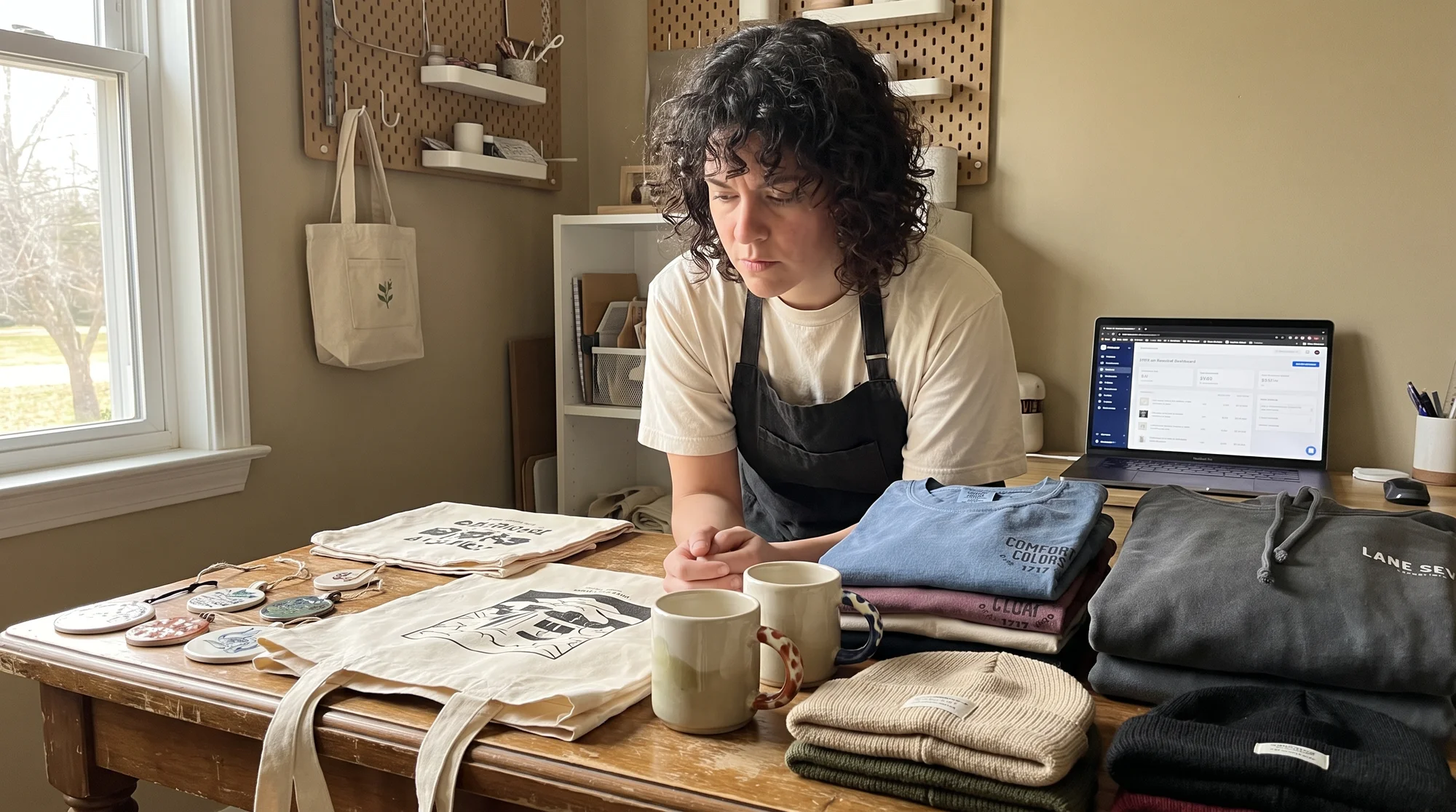
Seventy percent of your table should be lightweight, high-margin, low-breakage items shoppers buy on impulse and walk away with. Think ceramic ornaments, tote bags, mugs, and beanies.
These items are cheap to transport, quick to restock, and priced for the "sure, I'll grab one" impulse buy. This is your on-site cash engine.
The 30%: curated apparel samples
The other 30% is curated samples, not full stock. You bring one of each hero apparel piece so buyers can touch the fabric and try the fit.
You're not selling the sample off the rack. You're using it to close a custom online order in the exact size and color the buyer wants.
Why this split protects cash flow
This blueprint works because it separates what sells on-site from what sells online. Compact impulse items move fast at the table. Apparel becomes a made-to-order product with zero inventory risk.
You stop pre-buying sizes you might never sell, and you stop hauling dead weight home.
The 70% cash-and-carry stack
Winning the 70% comes down to picking compact blanks with high perceived value and easy transport. Here's your stack.
The 4 ideal booth blanks
Build your cash-and-carry table around these four:
- Custom Ceramic Ornaments — tiny, giftable, and irresistible at holiday markets.
- Cotton Canvas Tote Bags — flat-pack transport, zero breakage, high margin.
- Accent Mugs — everyday gift item with strong impulse appeal.
- Beanies — one-size-fits-most, so no size-run headaches.
All four live in the Printify Catalog, so you can design once and order in bulk for the booth.
Localization hack: Geo-targeted graphics
Generic designs get browsed. Local designs get bought.
Print your town, region, or local landmark on mugs and totes. A shopper who'll scroll past a plain mug will buy one that says the name of their hometown. Use the Product Creator to drop localized text and art onto your blanks in minutes.
Why compact SKUs win
Compact SKUs cut your costs at every turn:
- Gas: fewer boxes mean a lighter, cheaper haul.
- Tote space: totes and ornaments pack flat and stack tight.
- Breakage loss: fewer fragile items and smart packing protect your margin.
You fit more sellable inventory in less space, and you keep more of every dollar.
What NOT to bring
Do not bring the full size run of every hoodie and tee. That's the exact mistake that turns a booth into a moving van.
Bring one sample of each apparel hero. Let the QR code handle the rest.
The 30%: samples that sell without stock
Apparel is your highest-margin product, but only if you don't drown in inventory. The trick is selling it without stocking it.
Why you only need one of each
You need exactly one of each hero piece:
- Comfort Colors 1717 Tee — the premium, garment-dyed tee shoppers love to touch.
- Lane Seven Heavyweight Hoodie — a thick, high-perceived-value hoodie that sells itself on feel.
One of each covers every buyer, because the sample validates fit and quality—not the sale.
Using samples as sizing validators
Buyers hesitate to order apparel online because they can't judge the fit. Your sample removes that doubt.
Let shoppers try on the sample, find their size, then order their exact size and color from your QR display. You get the sale without carrying the stock.
How touch-and-feel closes the sale
A photo can't show weight, texture, or drape. Your hands can.
When a buyer feels the heavyweight cotton of a Lane Seven Hoodie, the price stops being a question. Touch-and-feel closes the sale a screen never could—and it's exactly why Printify's Quality promise matters at the booth.
The offline-to-online conversion system
The biggest money at a craft fair isn't on your table—it's in the orders you capture for home delivery. Here's the system that turns one table into two revenue streams.
On-site checkout with POS
For every physical item on your table, take payment on the spot.
Use Shopify POS or a Square card reader (both third-party tools) to accept cards, tap, and mobile payments. Cash-and-carry buyers walk away happy, and you close the sale before they can second-guess it.
The tabletop QR display stand
A $5 tabletop QR stand is the cheapest revenue tool you'll ever buy.
Place a scannable QR code next to your apparel samples. When a buyer finds their size, they scan, land on your store, and order the exact variant for home delivery. Print your stands before the event and set one next to each sample.
Capturing extended sizes and colors
Extended sizes and custom colors are the sales most booths walk away from. You can't stock a 5XL in every color—but your QR code can sell it.
Point shoppers to your online store where every size (2XL–5XL) and color variant is available on demand. You capture the sale instead of losing it.
Two revenue streams, one table
Here's the whole system in one line: on-site POS sales plus online custom orders from a single folding table.
The register pays you during the fair. The QR orders pay you after you've packed up. That's the cash machine.
How to stock at wholesale cost
The secret to a profitable booth is stocking it at base cost and selling at retail. Printify's bulk sample ordering makes that possible.
Ordering sample batches at wholesale
You can order physical batches of your designed products directly from Printify at wholesale base cost.
This turns Print on Demand into a real-world retail channel. You design once, order a batch of ornaments, mugs, and totes, and fill your table with inventory you own outright.
The margin math
The math is simple and it favors you:
- Buy cash-and-carry blanks at base cost.
- Sell them at retail at your booth.
- Pocket the spread on every walk-up sale.
On apparel, you skip the inventory entirely and earn $12–$20 per garment on the online orders your QR code captures—Printify's Profitability promise, working two ways.
Top blanks for a holiday booth
For a high-margin holiday market, bulk order:
- Custom Ceramic Ornaments
- Accent Mugs
- Cotton Canvas Tote Bags
- Beanies
Then add one Comfort Colors 1717 Tee and one Lane Seven Heavyweight Hoodie as your touch-and-feel samples.
Your craft fair weekend playbook
Follow this playbook to build your 70/30 booth from empty table to two revenue streams.
Pre-event
- Bulk order your cash-and-carry stock (ornaments, mugs, totes, and beanies) from Printify at base cost.
- Order one Comfort Colors 1717 Tee and one Lane Seven Heavyweight Hoodie as samples.
- Publish your full size and color range online so every variant is ready to order.
- Print your tabletop QR stands linking to your store.
Booth-day
- Lay out the 70% cash-and-carry items front and center for impulse buys.
- Set up Shopify POS or Square (both third-party tools) to take on-site card payments.
- Place your apparel samples where buyers can touch and try them on.
- Position a QR stand next to each sample for instant online ordering.
Post-event
Your online orders fulfill automatically. Every QR order routes through your store into Printify, which prints and ships to the buyer's door—no repacking, and no post office runs. That's Printify's Speed promise handling the work while you rest.
Next step: Build your booth this weekend
You don't need a warehouse to win a craft fair. You need one folding table, the right split, and a system that sells twice.
Head to Printify's bulk sample ordering and order your first batch of high-margin booth blanks at wholesale—Custom Ceramic Ornaments, Cotton Canvas Tote Bags, and localized Accent Mugs—plus one Comfort Colors 1717 Tee and one Lane Seven Heavyweight Hoodie as your touch-and-feel samples. Then print your tabletop QR stands and build a 70/30 booth that sells on-site and online before your next fair.
More money. More autonomy. More living. Your table is waiting.