


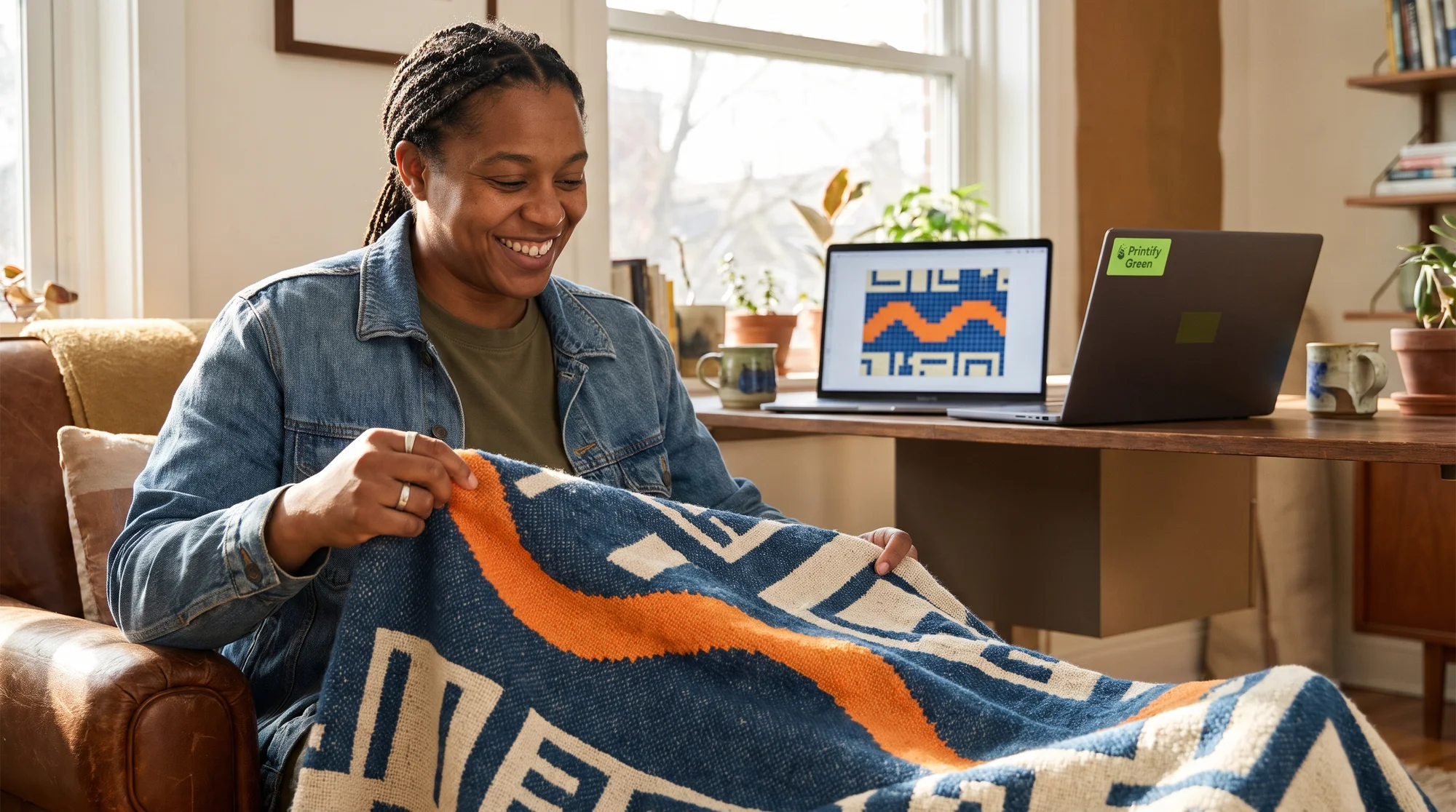
You're staring down a closing Q4 window, and basic printed sweatshirts are a race to the bottom that quietly bleeds your margin dry. Jacquard knitting solves this by weaving your artwork directly into premium, heirloom-grade fabric that shoppers happily pay double for — no needles, no float management, no learning to knit required. In this guide, you'll learn what jacquard actually is, how to prep a design in a few steps, and how to build a seasonal print on demand capsule that clears real profit before the holidays peak.
Here's the best part: you can launch woven blankets, knit beanies, and heavy scarves through Printify's catalog without ever touching a machine. Let's unlock that premium markup.
The Q4 margin problem nobody's talking about
Peak season floods every marketplace with the same basic printed apparel. If you're selling the exact product as ten thousand other stores, price is the only lever left — and that's a fight you lose.
Why basic printed sweatshirts race to the bottom
During the holidays, printed fleece is everywhere. Buyers compare listings side by side, and the cheapest option wins. You cut your price to compete, your margin shrinks, and the hours you pour in barely pay off. The problem isn't your art — it's that a surface print feels disposable, so shoppers treat it like a commodity.
The 'heirloom tax' shoppers happily pay
Here's the shift: during gift-giving season, people pay a premium for pieces that feel substantial. A weighty woven throw or a dense knit beanie signals value the moment someone touches it. That tactile, wash-proof, keep-it-forever quality is what justifies a 2x price — and it's exactly what a flat print can't deliver.
The myth that jacquard means knitting
You don't need to learn to knit. You never touch a needle, a loom, or a strand of yarn. Jacquard is an automated manufacturing process, and through Printify's network, Print Providers handle every stitch. Your job is design and positioning — the creative, high-margin part.
What jacquard actually is (the 60-second version)
Jacquard knitting is an automated textile process that weaves multi-color patterns directly into the structure of a fabric using individually controlled needles. Joseph Marie Jacquard invented the system in 1804; today, computerized circular and flat-bed machines run it at scale.
Plain-English definition
Think of it as the opposite of printing on top of fabric. Instead of laying ink on a surface, jacquard builds the pattern into the cloth, stitch by stitch. Every color in your design is a real strand of pre-dyed yarn locked into the weave.
Why it matters to your margins
This process powers the exact products that command premium prices: woven tapestry blankets, knit winter beanies, holiday sweaters, and heavy scarves. In each one, every pixel in your artwork file maps to a single yarn stitch. The result feels like a gift, not a giveaway.
The seller's edge
Woven color never cracks, peels, or fades in the wash the way surface ink can. That durability, combined with the weight and texture, is your pitch for heirloom-grade pricing. You're not selling a sweatshirt — you're selling something people keep.
The technical stuff you can hand off
You don't manage any of this yourself, but knowing the rules helps you design smarter and avoid surprises. Three concepts cover almost everything.
Single vs double jacquard
- Single jacquard leaves yarn "floats" across the reverse side. It's common in socks and lighter knits — lighter, slightly less premium.
- Double jacquard creates a clean, two-sided reversible structure with no exposed loops. This is the "collector edition" feel used in premium scarves and heavyweight heirloom blankets.
When you want to signal top-tier value, double jacquard is the structure that earns it.
Color limitation and yarn palettes
Forget the millions of shades you get with digital printing. Jacquard runs just two to six pre-dyed yarn colors at once. That means your design must be color-reduced and quantized into distinct solid shades.
This sounds like a limit, but it's actually a speed advantage. Fewer colors force bold, clean, high-contrast designs — the exact graphics that read well across a room and sell fast. Less fiddling, faster launches.
Pixel-to-stitch correlation
The rule is simple: 1 pixel = 1 stitch. But stitches aren't square — they're roughly 1:1.2, slightly wider than they are tall. If you ignore this, your design knits out horizontally squished.
The fix: scale your artwork's width down by about 20% before upload (or stretch the height), so the finished piece lands at the right proportions. One adjustment, and your graphic comes out clean.
Jacquard vs printing vs embroidery
Not all decoration methods are equal in a buyer's hands. Understanding the difference is how you justify premium pricing with confidence.
Structural yarns vs surface ink
Printing deposits color on top of fabric. Embroidery stitches thread onto a surface. Jacquard weaves the pattern into the cloth itself. The first feels disposable; the last feels like an heirloom. That structural difference is the entire reason you can charge more.
Positioning language that justifies the price
Words move premium inventory. Build your listings and product pages around phrases that match the quality:
- "Heirloom grade"
- "Collector edition"
- "Limited seasonal drop"
These aren't gimmicks — they describe what a woven piece genuinely is, and they prime shoppers to expect (and accept) a higher price.
The 2x price math
A basic printed sweatshirt might clear a thin margin after everyone undercuts each other. A woven throw or knit beanie sits in a different category entirely — buyers don't have ten identical listings to compare, so you hold your price. Double the perceived value, double the margin, far less competition.
Build your seasonal cash capsule
A capsule is a tight set of matching products you launch together as a "drop." It's faster to create, easier to market, and sells as a collection instead of one-off items.
Pick your anchor pieces
Start with woven and knitted items from the Printify Catalog — zero machine knowledge required:
- Woven Tapestry Blankets — your highest-impact heirloom anchor.
- Knit Winter Beanies — perfect, giftable, and seasonal.
- Woven Cotton Totes — everyday carry with a premium feel.
- Custom Fringe Throws — the "keep it forever" centerpiece.
Add complementary high-end blanks
Round out the capsule with premium companion pieces so shoppers can buy the full look:
- Lane Seven Heavyweight Hoodie — substantial weight that matches the heirloom story.
- Comfort Colors 1717 Tee — a soft, high-perceived-value staple.
The color-quantize-and-upload workflow
- Reduce your palette to two to six solid colors in your design software (or any external editor you prefer).
- Quantize the artwork so each area is a clean, flat shade — no gradients.
- Scale for stitch ratio — trim the width ~20% to counter the non-square stitch.
- Upload to the Product Creator, place your design, and preview the mockup.
- Publish to your store.
Launch timeline
Ride the trend before it peaks. Shoppers start holiday gift research early, so aim to list your capsule well ahead of the rush. Early listings capture search momentum, build reviews, and let you restock the winners while demand climbs.
Pricing, positioning, and protecting your margin
A great product undersold is still a missed opportunity. How you package and frame the drop protects the premium you've earned.
Bundle a 'drop' instead of selling singles
Sell the capsule as a themed collection — blanket, beanie, and tote together. Bundles raise your average order value and make each piece feel part of something curated and collectible.
Scarcity framing that moves inventory
Frame releases as limited seasonal drops. A clear "available this season only" message gives buyers a reason to act now instead of waiting. Scarcity, used honestly, turns browsers into buyers.
Reinvest Q4 cash into next season's capsule
Here's how the engine compounds: profit from this season funds your next drop — spring throws, summer totes, whatever's next. Each capsule bankrolls the one after it, and you build a seasonal rhythm that keeps cash flowing all year.
You don't need needles, looms, or a factory. You need bold artwork, smart positioning, and Printify's network to weave it all into heirloom-grade pieces people are proud to buy. That's more money, more autonomy, and a Q4 that actually pays off.
