

You didn't quit chasing the 9-to-5 grind to spend your Saturday nights hunched over a weeding table, picking vinyl scraps out of a design that might peel after two washes anyway. Printable heat transfer vinyl is a specially coated sheet that accepts standard desktop inkjet or eco-solvent inks, letting you press full-color graphics onto light or dark garments — but mastering it means owning a contour cutter, buying masking transfer tape, and dialing in precise heat-press settings (305°F–320°F for 12–15 seconds under medium pressure). This guide gives you the complete HTV playbook, then shows you the exact math on why scaling sellers are ditching it for Printify's DTF network entirely.
What is printable heat transfer vinyl
Solid-color HTV can't print a photo, a gradient, or a detailed logo. Printable HTV solves that — and that's why it's the first stop for creators who want full-color designs without a print shop.
The full-color promise
Regular HTV comes in flat, single colors. If your design has a sunset gradient, a photo, or a logo with 12 shades, you'd have to cut and layer each color by hand — a nightmare.
Printable HTV lets you run the whole graphic through a desktop inkjet or eco-solvent printer in one pass. You get gradients, photos, and detailed artwork on a single sheet. For a beginner testing a design idea, that's a real unlock.
The opaque white base layer
Print bright artwork on a dark shirt and the colors sink into the fabric, looking dull and muddy. Dye migration can also bleed the shirt's color up into your design.
Printable HTV built for dark garments includes an opaque white base layer underneath your ink. That white block keeps your colors vibrant on dark cotton or polyester and blocks the fabric dye from creeping through. Match your sheet to your garment color before you buy — "for dark fabric" and "for light fabric" are different products.
Where it fits
HTV earns its place in a few specific spots:
- Hobbyists testing a design before committing to volume.
- One-off gifts where labor time doesn't matter.
- Sub-10-order weeks where you can realistically press each shirt by hand.
If that's you right now, HTV works. But the moment orders climb, the math flips — and we'll show you where.
Ink and substrate compatibility
The number one reason printable HTV fails is a mismatch between your ink, your sheet, and your fabric. Nail these three and your transfers survive the wash. Miss one and your ink pulls off with the film.
Desktop inkjet printable HTV
Most home creators use a standard desktop inkjet printer. The catch: your ink type has to match your sheet.
- Pigment inks sit on top of the coating and generally hold up better through washes.
- Dye inks absorb differently and can fade or run if the sheet isn't rated for them.
Check the sheet's spec before buying. Using dye ink on a pigment-only sheet is a common (and expensive) way to ruin a whole print run.
Commercial eco-solvent vinyl sheets
Once you're printing serious volume, desktop inkjets can't keep up and cost-per-print climbs.
Eco-solvent printers use tougher inks and larger media, giving you better durability and faster throughput. The problem: the machine costs thousands of dollars up front. Only justify it if your volume already fills the machine's capacity — otherwise you've bought a bottleneck that also drained your bank account.
Fabric match chart
The fabric decides whether your transfer lasts or lifts. Match your HTV to your blank:
| Fabric | Works with printable HTV? | Watch out for |
|---|---|---|
| 100% cotton | Yes | Lower press temps to avoid scorching |
| Polyester | Yes, with dark-fabric sheets | Dye migration — use an opaque base |
| Cotton/poly blends | Yes | Test one first; blends behave unpredictably |
| Performance/stretch | Risky | Rigid transfers crack on stretch |
Dye migration is the silent killer here. Bright polyester blanks can bleed color into your artwork days after pressing, long after the shirt has shipped.
The weeding and transfer mask workflow
Here's the workflow no supplier puts on the front of the box. Every printable HTV shirt takes five manual steps — and each one is time you're not spending on your next design.
Step 1 — Print and contour cut
Run your artwork through the printer, then load the sheet into a contour cutter. The cutter reads registration marks and cuts precisely around your printed graphic. Miss the calibration and your cut lines slice through your design.
Step 2 — Weed the excess
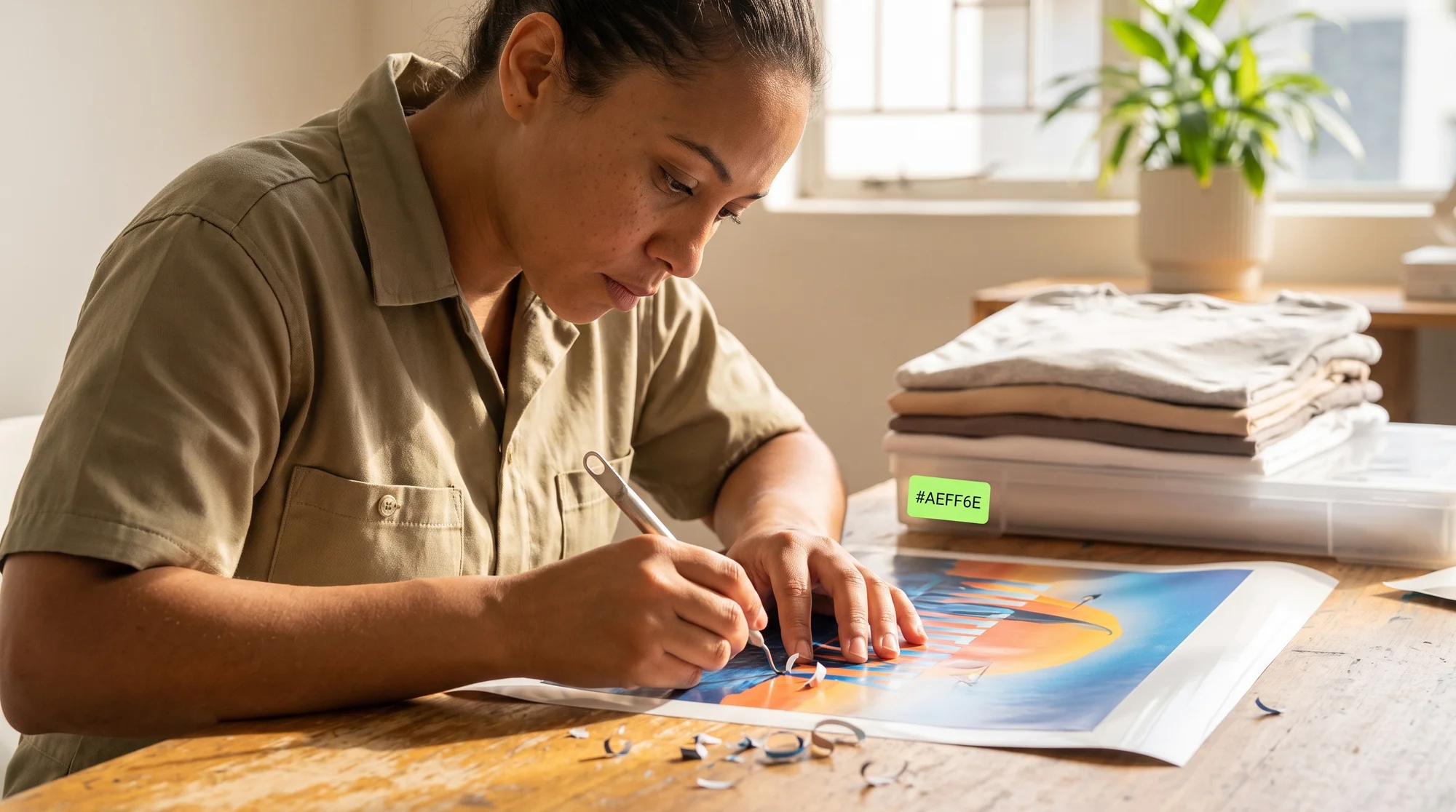
This is the bottleneck nobody warns you about. You manually pick away every scrap of unprinted vinyl around and inside your design with a weeding tool.
Detailed designs with thin lines or small text can take 10–20 minutes each — per shirt. Multiply that across a busy week and weeding alone eats entire evenings.
Step 3 — Apply a transfer mask
Multi-piece designs won't move to the shirt on their own. You apply a heat-resistant transfer mask (like Siser TTD Mask) over the weeded design to lift every piece off the paper backing in the right position.
Apply it crooked and your layout shifts. Now you're re-weeding.
Step 4 — Press
Position the design, then press at 305°F–320°F for 12–15 seconds under medium pressure. Temperature, time, and pressure all have to be right. Too hot scorches cotton; too cool and it won't bond.
Step 5 — Peel and pray
Peel hot or warm depending on the sheet, then hope it survives the wash. This is the gamble at the end of every single shirt — hours of work riding on whether the transfer holds through cycle one.
The hidden costs suppliers hide
The sheet price is the smallest cost you'll pay. The real bills come in labor, returns, and a hard ceiling on how many orders you can fill.
The labor bottleneck
Real reviews of printable HTV tell the same story: ink pulling off with the film during peel, transfers cracking, and designs peeling after just two washes. Every failure is a shirt you re-make for free — and an unhappy customer.
You're not just paying for vinyl. You're paying with your evenings and your reputation.
The rigid, plastic hand-feel
Printable HTV lays a plastic layer on top of the fabric. On large designs, that stiff, heavy patch is the number one reason customers hit Return. It doesn't breathe, it doesn't stretch, and it kills the premium feel buyers expect from a good shirt.
The scale ceiling
Here's the ceiling: HTV physically chains you to a heat press. One person, one press, five steps per shirt. There's no version of this that scales.
When a design goes viral and 500 orders land overnight, HTV can't fill them. You'll be weeding at 2 a.m. and still shipping late.
The ROI-per-hour reality check
Every hour you spend weeding is an hour you don't spend finding your next winning design. That's the real cost — and this table makes it impossible to ignore.
Manual HTV vs Printify's network
| Factor | Manual printable HTV | Printify DTF/DTG network |
|---|---|---|
| Steps per order | Print, cut, weed, mask, press, gamble | Upload once |
| Time per shirt | 20–40 min manual labor | Zero — providers fulfill it |
| Equipment cost | Printer, contour cutter, heat press | $0 |
| Wash durability | Peels reported after 2 washes | Built for repeated wash cycles |
| Hand-feel | Rigid plastic patch | Soft, integrated print |
| Scales to 500 orders overnight? | No | Yes |
The real question
You could spend the next month mastering 305°F and medium pressure and your peel timing… or you could upload your design once and sell while you sleep. One path caps your income at how many shirts your hands can press. The other lets your best hours go toward growth.
The zero-labor alternative
You didn't build a brand to become a full-time weeder. Printify's Print Providers run the DTF and DTG production for you, so you never touch a heat press again.
Upload once, ship forever
No weeding. No masking. No press. No wash-test roulette.
You upload your full-color artwork one time inside the Product Creator, choose your blank, and publish. When an order comes in, a Print Provider prints, presses, and ships it directly to your customer. You keep the profit and skip every manual step.
Scale on premium blanks
Printable HTV forces a rigid patch onto whatever shirt you can source. Printify's network lets you run full-color drops on premium blanks buyers actually want to wear — like the Comfort Colors 1717 tee and the Lane Seven Hoodie — with zero manual production on your end. DTF and DTG lay color into the garment for a soft hand-feel and durability built to survive real wash cycles.
Chase trends, not transfer tape
The creators who win are the ones finding the next viral design — not the ones stuck at a weeding table. Automated fulfillment hands you back those hours. Spot the trend, upload the design, and let the network produce and ship every order while you move on to the next one.
That's the whole Printify promise in action: Profitability with zero equipment cost, Quality blanks and prints, huge Selection across the Printify Catalog, and Speed to market the moment a trend hits.
FAQ
Is DTF durability better than printable HTV?
Generally, yes. Printable HTV commonly draws reviews reporting ink lifting on peel and designs cracking or peeling after just two washes. DTF prints bond into the fabric and are built to hold color through repeated wash cycles, which means fewer reprints and fewer refund requests for you.
Can I keep my exact designs?
Yes. Your artwork is yours. Upload the same full-color files you'd have printed on HTV into the Product Creator, pick your blank, and publish. You keep every design — you just drop the five manual steps behind it.
What's the break-even order volume?
There's no single number, but the rule is simple: once you're regularly filling more orders than you can comfortably weed and press by hand — roughly the point you pass 10 orders a week — HTV becomes the thing capping your growth. At that stage, every hour at the heat press costs you more in lost design time than it saves in production fees.