


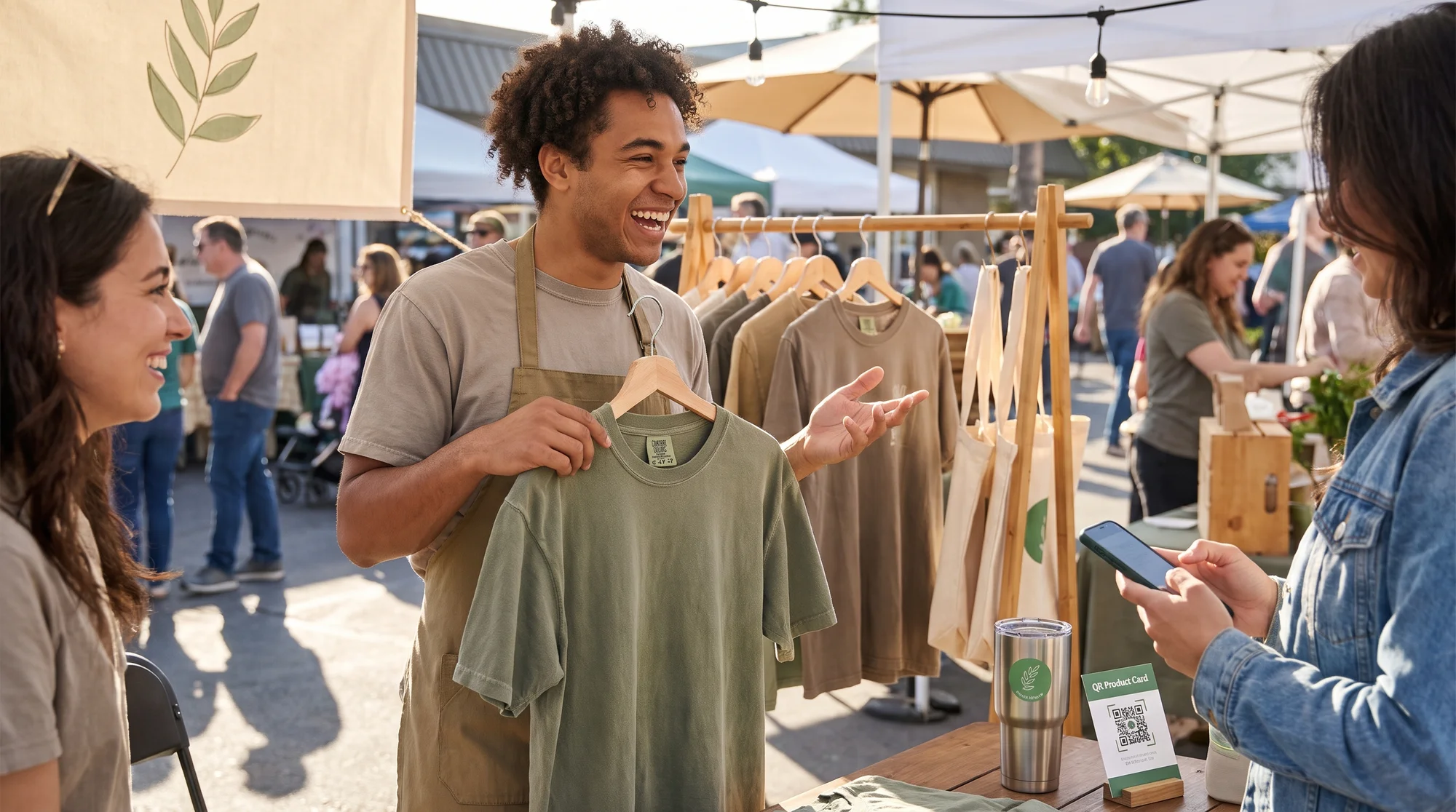
Most pop-up shop advice assumes you need thousands of dollars in pre-printed tees stacked in your garage, which is exactly how new sellers bleed cash on unsold stock. With print on demand, you can run a profitable physical booth on a $250 sample rack and a QR code, with zero deadstock and 65-75%+ net margins. Below, you will find the Hybrid Showroom model that makes this work, six proven booth formats, the point-of-sale logistics, and a 7-day action plan to launch.
Why most pop-up advice drains cash
The traditional pop-up playbook is built for a world where you print first and hope to sell later. That bet rarely pays off, and when it doesn't, you eat the loss. Here is the model that removes the risk entirely.
The deadstock trap
Pre-printing boxes of inventory is a margin killer. You guess which designs will sell, which sizes attendees need, and how many of each color to stock. Guess wrong on any of those, and the unsold pieces sit in your closet as pure sunk cost. Every box you carry home from an event is money you will never get back.
The problem is simple: you are forced to spend cash before a single customer says yes. That is backwards.
The Hybrid Showroom model
Flip the order of operations. Instead of printing inventory, you display samples, let people touch the product, and capture the sale on the spot. The order ships straight to the buyer's door.
Here is how it works at the booth:
- The customer feels the fabric weight and print quality of a physical sample.
- They scan a QR code or check out through your phone.
- The order syncs automatically to Printify, which prints, packs, and ships it directly to their home in 3-5 business days.
You never touch a shipping box. You never carry stock home. You only pay for products people have already bought.
The 3-part setup
You need just three things to run this model:
- A compact sample rack: one or two pieces per design in M, L, and XL, so shoppers can judge fit and feel.
- QR Product Cards: table tents or hang-tags that link each design to its checkout page.
- Automated Printify fulfillment: production and direct-to-home shipping handled for you.
That is the entire footprint. It fits in a tote bag.
The margin math
Because you skip the bulk print run, your cost structure changes completely. You are not spreading the price of 200 unsold shirts across your few sales. You pay the base cost only when an order comes in.
The result: buyers get their order in 3-5 business days, and you net 65-75%+ with zero unsold stock. No guessing. No markdowns. No garage full of regret.
6 high-converting pop-up archetypes
Different venues attract different buyers. Pick the archetype that matches your designs and your local scene.
Concept A: coffee shop takeover
Peak Saturday foot traffic already exists at your local specialty cafe or craft brewery. You just need to set up where it flows.
Partner with a venue for a zero or low booth fee using a revenue-share deal or a co-branded limited tee they can sell too. Display 8-10 lifestyle samples, such as the Comfort Colors 1717 tee, Heavyweight Canvas Totes, and 30oz Tumblers, each with a QR table tent. Customers sip, browse, scan, and leave with the order already placed.
Concept B: hyper-local pride booths
Local pride triggers instant impulse buys. People will pay for a shirt that says exactly where they are from.
Set up at weekend farmers' markets or street fairs with hyper-local typography, vintage collegiate emblems, and city coordinates. These designs sell themselves because they tap community identity, and every buyer becomes a walking word-of-mouth ad for your brand.
Action steps:
- Research neighborhood nicknames, landmarks, and area codes.
- Create 6-8 designs built around that local identity.
- Book a market stall and display samples with QR cards.
Concept C: niche event showrooms
Niche crowds buy deep. Dog expos, fitness competitions, gaming tournaments, and car meets gather people who spend on their passion.
Book a 10x10 booth and build a "Fitting Rack" of blanks in sizes S through 3XL. Attendees confirm their exact fit in person, then scan to order the event-exclusive drop. The fitting rack removes the one objection that kills online apparel sales: uncertainty about size.
Concept D: store-within-a-store consignment
You do not even have to staff the booth. Let an existing business host your rack.
Place a curated 6-SKU capsule rack inside an independent gift shop, hair salon, or gym. Shoppers scan the hang-tag QR code to pay online, and the host venue earns a 15-20% affiliate commission with zero inventory to manage. The host gets passive income, you get a permanent sales point, and nobody stocks a thing.
Concept E: live personalization bar
Personalization commands premium prices and closes sales on emotion. A name, a number, or a pet portrait turns a generic product into a keepsake.
Bring an iPad to a bridal expo, youth sports tournament, or holiday market. Create live custom mockups inside Printify's Product Creator, show the buyer their design in seconds, and check them out on the spot. When a parent sees their kid's name on a tournament hoodie, the sale is already made.
Concept F: digital flash drop kiosk
Sometimes you want the buzz of a physical presence with no physical stock at all. This format is pure scarcity marketing.
Pair a QR lookbook poster wall at a gallery opening or music venue with a 48-hour online-only countdown. The physical space builds desire; the ticking clock closes the sale. You display nothing but a poster and still drive a wave of orders.
Zero-deadstock operations and POS logistics
The model only works if checkout feels effortless and the wait feels worth it. Here is how to remove every point of friction at the table.
Event-only free shipping incentive
Market shoppers love walking away with something in hand. A 4-day wait can feel like a letdown after the energy of a live booth.
Offset it. Offer Free Express Shipping plus a free die-cut sticker on every QR order placed at your booth. Carry a stack of stickers in your pocket so buyers leave with a physical token immediately, while their full order ships express to their door. The sticker scratches the instant-gratification itch, and express shipping shortens the wait.
Shopify POS and Tap to Pay
Bulky card readers slow you down and scream amateur. You do not need them.
Accept Apple Pay, Google Pay, and credit cards directly from your smartphone with Tap to Pay on iPhone. Orders flow through your Shopify webhook straight into Printify production. No extra hardware, no manual order entry, no delay between the sale and fulfillment.
QR cards vs POS checkout
Use each tool where it fits:
- QR Product Cards: best for self-service browsing, unstaffed consignment racks, and high-traffic tables where you cannot reach every shopper. The customer completes checkout on their own phone.
- Shopify POS: best for face-to-face sales, custom personalization, and any moment you are actively closing the deal. You take payment in your hand and keep the momentum.
Most booths run both. Cards catch the browsers; POS closes the conversations.
Equip your showroom for under $250
You do not need a warehouse. You need a small kit of samples that shows off quality and fit, and nothing more.
The core sample kit
Build your rack around products people want to touch:
- Comfort Colors 1717 tee: soft, heavyweight, garment-dyed, the fabric that sells itself.
- Lane Seven Heavyweight Hoodie: premium weight that justifies a premium price.
- 30oz Stainless Steel Tumbler: a non-apparel bestseller with broad appeal.
- Heavyweight Canvas Totes: an easy impulse add-on at any booth.
Order these in M, L, and XL where sizing applies, and your entire showroom costs under $250 in discounted samples.
How samples replace inventory
A single sample does the work of a full inventory box. It proves the quality, confirms the fit, and demonstrates the print, all without committing you to a bulk run.
One tee shown at a booth can generate dozens of orders across every color and size, because the buyer orders their exact choice at checkout. You carry one; you sell many.
Let Printify handle fulfillment
Once the order is placed, your job is done. Printify handles all printing, packing, and direct-to-home shipping automatically. That is the Profitability and Speed promise working together: you focus on the booth and the buyer, while fulfillment runs on its own.
Your first pop-up in 7 days
You can go from idea to live booth in a single week. Here is the plan.
- Day 1-2: pick your archetype. Match it to your designs and a venue you can actually book this week.
- Day 2-3: order your samples. Choose your core blanks and request discounted samples so your rack arrives in time.
- Day 3-5: build and print your QR Product Cards. Link each design to its checkout page and test every code with your own phone.
- Day 5-6: book your spot. Confirm the cafe, market stall, consignment host, or event booth, and set up Shopify POS with Tap to Pay.
- Day 7: launch. Set up your rack, carry your stickers, and start capturing orders.
Order your first samples and start your Print on Demand business today.
Articles in the Printify Knowledge Hub are researched, written, and published with the help of generative AI, and cover topics related to eCommerce and Print on Demand. They are for educational purposes only and do not constitute legal, financial, or business advice.
