


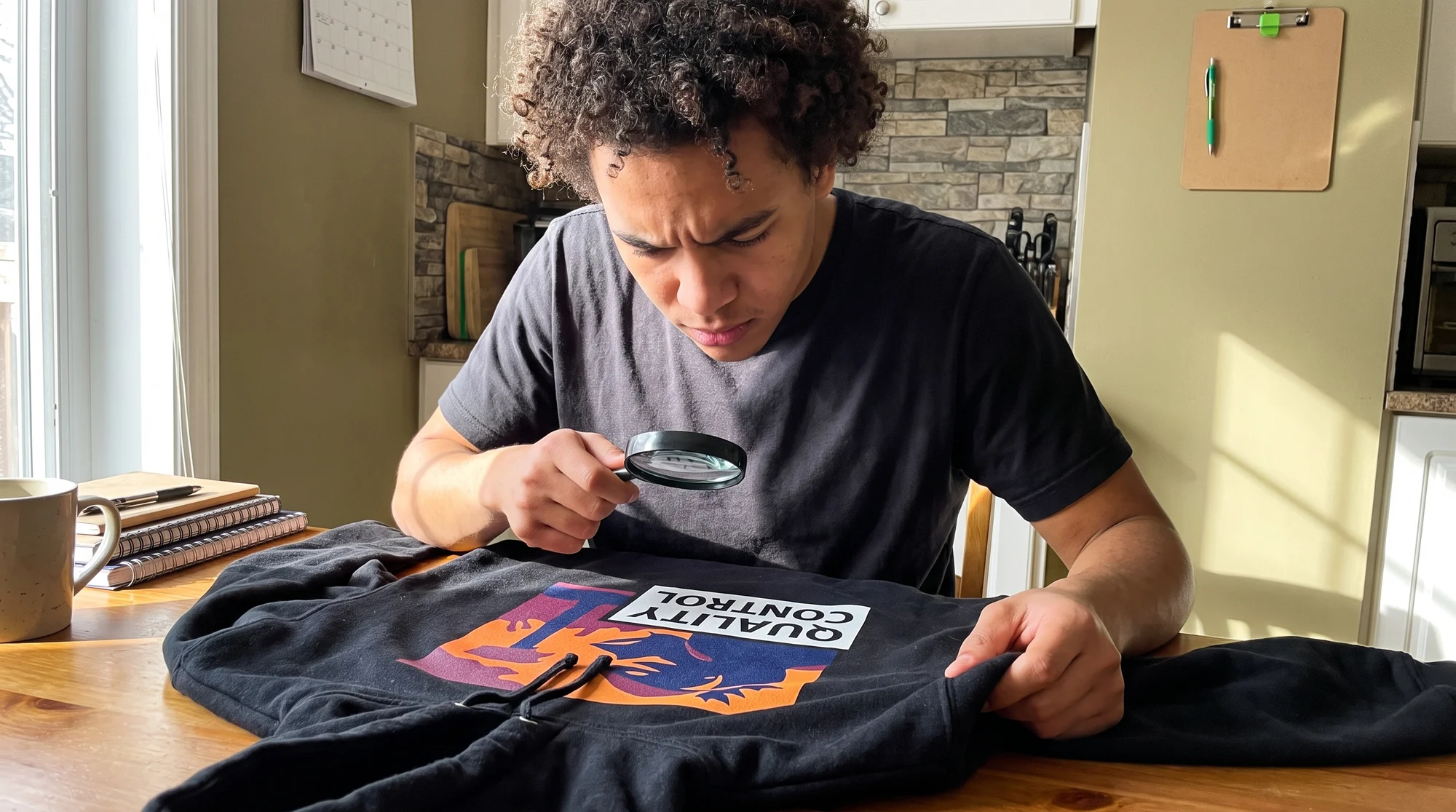
Nothing kills a viral product faster than a five-star buyer opening a box of cracked ink and demanding a refund. To avoid that disaster, you vet a Print on Demand provider by stress-testing four non-negotiable benchmarks before you scale: print quality consistency, real-world fulfillment speed, laundry wash durability, and unboxing presentation. Below, you'll order one aggressive torture-test sample, audit your provider's location, grade the unboxing, and cross-check everything against Printify's real-time Print Provider Network Scores.
The 4 benchmarks you vet fast
Here's the bottom line: vetting a provider means stress-testing four operational benchmarks before you scale—print quality consistency, real-world fulfillment speed, wash durability, and unboxing presentation.
The hard rule you never break: never publish a listing without ordering a physical sample unit. You inspect white-ink underbases, color accuracy, and packaging integrity under real stress. A homepage mockup won't survive a washing machine. Your buyer's order will.
Reframe this in your head. This isn't slow, spreadsheet-heavy due diligence that drags on for weeks. It's a rapid pre-launch stress test that protects your margins at the exact moment your sales peak. Test hard now so you don't refund hard later.
Why 'pick the best' advice fails
You've read the "best 11 POD companies" lists. They tell you who to use—but never how to prove that provider won't collapse mid-viral-spike. That's the trap. A shiny brand homepage tells you nothing about how a garment holds up after ten washes.
The real risk hits when volume is highest. Slow fulfillment, cracked ink, and a flood of refund requests torch your profit exactly when you're finally making money. One viral moment turns into one viral pile of one-star reviews.
The fix is simple: run one aggressive torture sample instead of building endless vetting spreadsheets. Let a single garment do the arguing.
Step 1 — The torture-test sample order
For the 8,477 artists chasing a breakout design: your art is only as good as the last print that ships. One bad batch, and your reputation eats the loss.
Build the one breaking sample
Order a single sample loaded with complex edge cases. If a provider can print this cleanly, it can print anything you throw at it.
Pack your test design with all four elements:
- Fine lines — expose registration issues and misalignment.
- Rich dark gradients — expose banding and uneven transitions.
- Vibrant primary colors — expose weak ink saturation.
- A solid white text block — expose a thin or patchy underbase.
Each element is a trap. A weak provider fails at least one. A strong one nails all four.
The 5-10 wash durability test
Print quality on day one means nothing if the design cracks by week two. Buyers wash their clothes—so you test yours first.
Wash the sample garment 5 to 10 times in warm water. Then inspect it hard, before it ever reaches a real buyer.
Screenshot this pass/fail scorecard and reuse it for every provider:
| CheckPassFail | ||
| Cracking | Print stays smooth and intact | Ink splits or flakes |
| Fading | Colors stay vibrant | Colors dull or wash out |
| Peeling | Design bonded to fabric | Edges lift or peel |
| Underbase | White stays solid and bright | White thins or turns gray |
If it survives ten washes, it survives your customers.
Step 2 — Evaluate production location
For the 12,203 business owners scaling toward serious volume: transit time isn't a detail. It's the difference between a repeat buyer and a refund.
Where the print node lives
Slow shipping kills momentum. Every day a package sits in transit is a day your buyer's excitement fades and their patience runs out.
Inspect where the facility physically sits relative to your core customer base. Localized regional print nodes drop average transit from 6–8 business days down to 2–3 days. Faster transit means lower late-shipment defect rates—which means fewer momentum-killing refunds right when your sales are climbing.
Quick location audit checklist
Run this fast:
- Map your top customer regions — where do most of your orders actually ship?
- Match each region to the nearest print node — find the facility closest to your buyers.
- Flag any provider forcing cross-country or cross-border shipping — that's a speed red flag you can't ignore.
Step 3 — Rate unboxing presentation
A perfect print inside a crushed box still earns a bad review. The unboxing is the first physical impression your buyer gets, and it drives both reviews and repeat orders.
Grade your sample's arrival honestly:
- Does the garment arrive folded clean, with no wrinkles or crush damage?
- Is the packaging intact, or dented and dinged from transit?
- Any ink transfer, smudging, or marks from rough handling?
That first open-the-box moment is free marketing—or a free complaint. Make sure it works for you.
Step 4 — Skip guesswork with network scores
You've torture-tested one provider. Now let data handle the rest.
Why manual vetting doesn't scale
You can't torture-test 140 facilities by hand. You'd never launch. The smart move is to test one thoroughly, then lean on hard performance data for everything else.
How to read the network scores
Printify gives you complete transparency into individual Print Provider performance—no guessing, no marketing spin. Use the real-time Print Provider Network Scores, which track:
- Quality — how consistently the facility delivers clean prints.
- Speed — real fulfillment and shipping times, not promises.
- Stock reliability — whether the products you need stay in stock.
These are the same benchmarks you tested by hand—now measured across the whole network, in real time.
Lock in top-rated facilities
Use the scores as your shortcut to proven Print Providers like Monster Digital, SwiftPOD, or Dimona Tee. Then combine your torture-test data with their network scores. That's zero-guesswork provider selection—profitability, quality, selection, and speed, all confirmed before you scale.
Your 48-hour battle-test playbook
Copy, paste, and run this before you launch:
- Order one torture-test sample — fine lines, dark gradients, vibrant primaries, and a solid white text block.
- Wash it 5–10 times in warm water. Check for cracking, fading, and peeling.
- Audit the print-node location — map your top regions and match them to the nearest facility.
- Grade the unboxing — clean fold, intact packaging, and zero ink transfer.
- Cross-check Printify Network Scores — verify quality, speed, and stock reliability.
- Lock in your provider — combine your sample results with the data.
- Launch and scale — battle-tested and refund-proof.