

Your Print on Demand margins are getting shredded by rising ad costs and saturated digital trends while you refresh your dashboard hoping for a sale. The fix is to take your products into the real world with a weekend pop-up that captures instant, in-hand cash sales. Below, you'll lock in a low-risk venue, stock the right mix of physical and QR-linked products, and turn a single $50 Printify sample order into a booth that sells out.
Why physical booths win
Online-only Print on Demand has become a race to the bottom. Meanwhile, the seller at the Saturday market is stuffing a cash box while you wait on slow, ad-driven traffic.
The margin squeeze
Every online-only seller fights the same fight: ad costs climb, trends saturate overnight, and thin digital margins get squeezed to nothing. You pay to reach a customer who may never buy.
A physical booth flips this. Foot traffic is free. The customer is already standing in front of your product, wallet open. No CPM. No algorithm gatekeeping your sale.
The instant cash advantage
Online, you wait days for an ad to convert and weeks for the money to clear. At a booth, someone picks up a mug, likes it, and hands you cash. Done.
That impulse sale is the fastest money in Print on Demand. You capture buyers at the exact moment they want the product, then hold the cash the same day.
Why this beats dropshipping
You're not gambling thousands on dead inventory. A pop-up runs on real cash from real customers with near-zero downside. You order a small batch of proven blanks, sell what you can carry, and route the rest through Printify. No warehouse. No dead stock. No dice.
The core mechanic
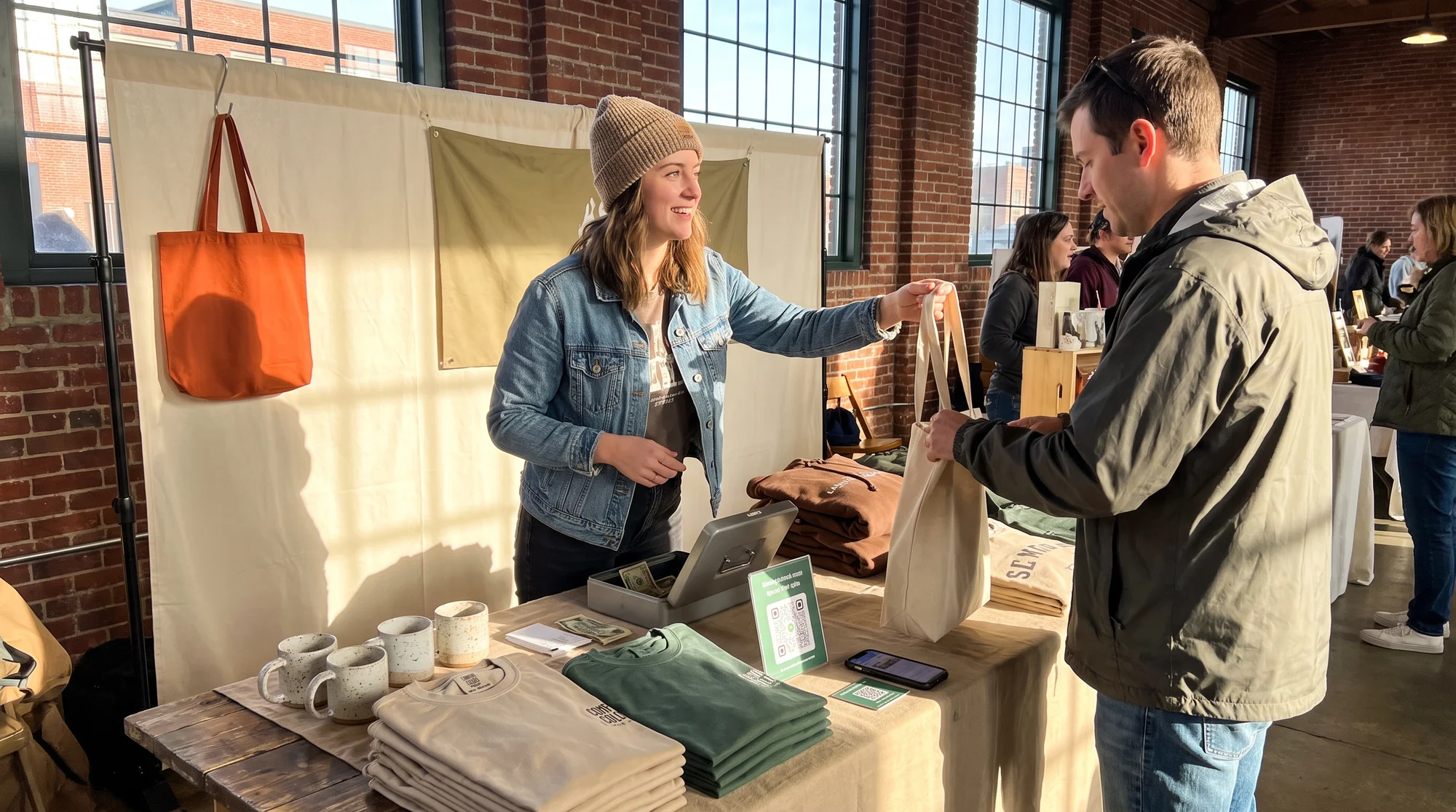
Stock cash-and-carry impulse items at the booth, offer QR codes for extended sizes and colors shipped straight to the buyer's home, and negotiate revenue-share venues so you protect your cut. That's the whole system.
Step 1: Lock in a low-risk venue
A dead location or a fat lease can sink you before you sell a single tee. The move is to secure short-term space with zero fixed risk.
The 3 best cash-booth venues
Pick a venue that already has your customer walking through the door:
- Shop-in-a-shop: Set up a table inside a complementary local boutique. Their foot traffic becomes your foot traffic.
- Holiday markets: High-foot-traffic seasonal markets bring buyers primed to spend on gifts.
- Local art galleries: Perfect for apparel and wall art with a creative, higher-spend crowd.
The margin-protecting negotiation
A fixed lease fee means you pay whether you sell or not. Instead, pitch a revenue share of 10 to 20 percent. You only pay when you make money, which removes your risk entirely.
Use this simple script:
"I'd love to run a weekend pop-up in your space. Instead of a rental fee, I'll give you 15 percent of everything I sell. You get extra revenue and fresh product for your customers with zero cost to you."
Venues say yes because they earn from your traffic without spending a dollar. It's found money for them.
How to vet foot traffic
Don't gamble on a dead corner. Before you agree, visit the venue during the exact hours you plan to sell. Count how many people pass in 30 minutes and watch whether they actually stop and browse. Ask the owner for their busiest days. If the floor is empty when you visit, walk away.
The weekend-only angle
A permanent presence kills urgency. A 48-hour, weekend-only setup creates a "get it now or miss it" pressure that drives sell-outs. Promote it as a limited drop, and buyers act instead of walking away to "think about it."
Step 2: What to stock vs QR
Over-order and you eat dead stock. Under-order and you lose sales. The hybrid model solves both.
The cash-and-carry shelf
Stock only the items buyers grab and pay for on the spot:
- Canvas totes
- Ceramic mugs
- Ornaments (especially for holiday markets)
- Core apparel sizes, S through XL
These are low-risk, high-turnover items with broad appeal. They fit almost everyone and make quick, easy sales.
The QR display-stand trick
You can't physically carry every size and color, and that's fine. Set up tabletop QR display stands next to your samples. A customer who needs a 2XL to 5XL or a custom colorway scans the code, orders online, and gets it shipped home.
You capture the sale without carrying the inventory. Zero extra risk, zero missed customers.
How the hybrid model kills dead stock
By stocking only fast-moving core items and pushing everything else to QR orders, you never over-order. Your worst-case scenario is carrying a few extra mugs, not a closet full of unsold 4XL hoodies. Printify fulfills the online orders, so your inventory risk stays near zero.
Mobile POS setup
If you can't take a card, you'll lose sales. Set up a mobile point-of-sale reader (Square, Stripe, or PayPal Here are all third-party options) that plugs into your phone and accepts cards. Keep a cash box with small bills for change. Between the two, no sale ever walks away.
Step 3: Turn samples into stock
You can't pitch a venue or sell at a booth with an empty table. A physical sample batch is what unlocks the entire real-world channel.
How samples unlock retail
Ordering samples from Printify gives you product in hand to show boutique owners, display at your booth, and let customers touch. Quality sells itself when a buyer feels a heavyweight hoodie or holds a solid ceramic mug. This is where Printify's quality promise does the heavy lifting.
The high-margin blank lineup
These proven blanks deliver the perceived value and margin you need:
- Lane Seven heavyweight hoodies — premium weight that justifies a strong price.
- Comfort Colors 1717 tees — soft, garment-dyed, and instantly recognizable to buyers.
- Canvas totes — low cost, high margin, and a fast impulse grab.
- Ceramic mugs — the easiest cash-and-carry sale at any market.
How to price for impulse buys
Impulse buyers decide fast, so keep your prices round and clean. Then build your venue cut into the number before you set it. If a hoodie costs you around $30 to make, price it at $60 to $70. That leaves healthy profit even after a 15 percent revenue share. Round pricing (a $25 tee, a $15 tote) speeds the decision.
The automated backend
While you're selling at the booth, every QR order routes straight through Printify for hands-off fulfillment. You keep collecting cash in person while Printify prints and ships the online orders automatically. That's the speed promise working for you: you sell, they fulfill, you scale.
Your 48-hour checklist
Run this sequence and you're ready to sell this weekend:
- Place your $50 Printify sample order — Lane Seven hoodies, Comfort Colors 1717 tees, canvas totes, and ceramic mugs.
- Lock a venue deal — pitch a 10 to 20 percent revenue share, not a lease.
- Build your booth kit — samples, core sizes S to XL, totes, mugs, and ornaments.
- Set up your QR stands — link to extended sizes and custom colorways.
- Get your POS ready — mobile card reader plus a cash box.
How to reinvest your cash
Don't spend the cash box. Take your weekend profit and roll it into your next, bigger pop-up: more stock, a better venue, and a second table. Each weekend funds the next, and you compound your way from a side hustle to a real business, with more money, more autonomy, and more living.