

If you've ever watched a storefront you spent weeks building get wiped out overnight because of one Naruto poster, this is the last time that has to happen to you. Selling anime posters through Print on Demand works when you create original, anime-inspired aesthetic art instead of copying trademarked characters, then print it on archival paper substrates using high-DPI templates. This playbook walks you through three moves: designing defensible original art, dialing in your paper and color setup, and deploying across Printify's custom wall art catalog for hands-off fulfillment.
The rule that keeps you in business: avoid trademarked character names, copyrighted anime titles, and official logos. That's how you tap high-volume aesthetic niches without the takedown risk.
Why you can't beat the licensed giants
Most sellers make the same mistake. They see anime posters selling like crazy, so they upload fan art of the biggest characters and wait for the money. Instead, they get banned. Here's why that path is a dead end.
The licensed giant problem
You're not competing with other small sellers. You're competing with licensed distribution machines.
- Europosters stocks over 3,000 anime products with official licenses. Official One Piece prints sell for €5.99. Naruto gets slashed to €2.25. Dr. Stone drops to €1.50.
- Displate runs on verified creators and official fandom deals, spanning Star Wars, Marvel, and the NBA on metal prints.
You cannot out-price a licensed giant selling official art at €1.50. And you legally cannot touch the trademarked IP that fills 100% of their catalog. This is a fight you lose twice.
The takedown death spiral
Fan art of Naruto, Goku, or Jujutsu Kaisen doesn't just risk a single listing removal. One rights-holder complaint can wipe your entire storefront overnight, killing your momentum and your income in one shot.
The "safe" alternative most sellers try, generic wall art, buries you in a saturated market with razor-thin margins. Neither option builds freedom. You need a third path.
The gap: aesthetic niches nobody stocks
Here's the opening the giants leave wide open: people don't only search for characters. They search for a vibe. And nobody owns those searches yet.
4 defensible sub-genres to own
Instead of chasing IP you can't have, own the aesthetic that surrounds it:
- Retro 90s cyberpunk cityscapes — neon-drenched skylines, rainy alleys, glowing signage.
- Lofi aesthetic rooms — cozy study nooks, warm lamplight, plants, and a window at dusk.
- Mecha structural line art — clean technical linework of robotic frames and joints.
- Samurai manga ink sketches — bold black ink brushwork, lone warriors, negative space.
Why these convert: they capture high-volume "vibe" searches with almost zero licensed competition. And because you own the art, you own 100% of the margin. No royalties. No rights holder. No takedown button hanging over your head.
Step 1: IP compliance and concept design
For the artist in you, this step protects everything you build. Original IP means zero takedowns, forever.
Never do this
Cross these lines and you risk your whole store:
- Never copy, trace, or generate direct fan art of trademarked characters like Naruto, Goku, or Jujutsu Kaisen.
- Never use trademarked names, copyrighted anime titles, or official logos in your listings, titles, or tags.
Build defensible original IP
The trick is simple: capture the feeling of anime without any specific character. You're selling the atmosphere, not the IP.
Use these style guides as your starting point:
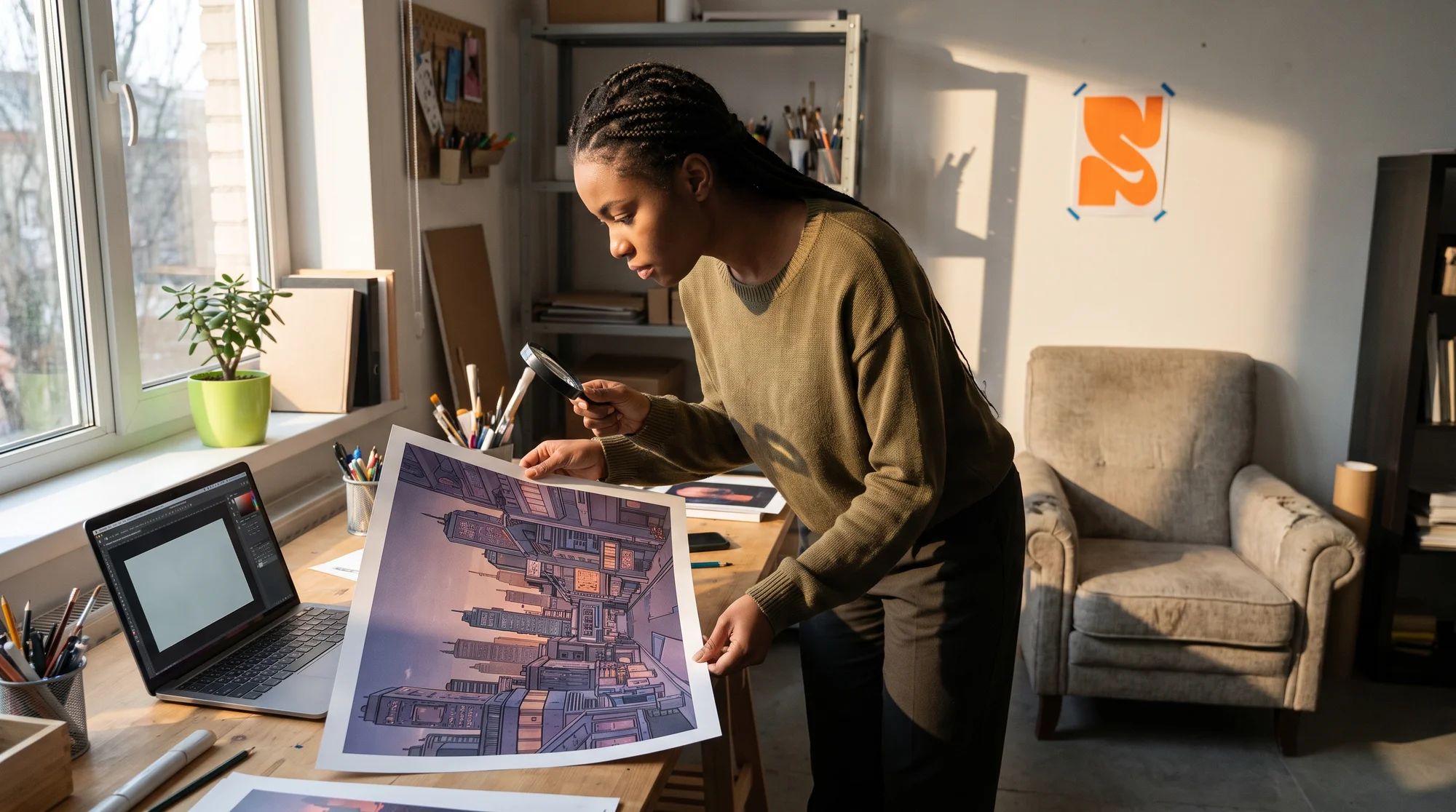
- Cyberpunk cityscape: Original skyline silhouettes, invented street signage (use made-up glyphs, never real logos), heavy neon and reflection. The mood is Blade Runner-adjacent, not a scene from any show.
- Lofi room: An anonymous character seen from behind or off-frame, warm color grading, everyday objects. Sell the calm, not a cast member.
- Mecha line art: Design your own robotic frame from scratch. Focus on structure, symmetry, and clean engineering lines.
- Samurai ink: A faceless or original warrior, dramatic ink strokes, and open space. Reference the art form, never a licensed series.
You can sketch these by hand, work with a designer, or use third-party AI platforms like Midjourney or DALL-E to build original concepts. Printify's own AI Image Generator can also help you generate original artwork inside the platform. Whatever tool you choose, the output must be your own original concept, not a copy of protected work.
Step 2: Paper substrates and color setup
For the business owner in you, print quality is what earns 5-star reviews. And reviews are what push your listings up the rankings. Cheap-looking prints tank your store before it starts.
Get your files right
Weak files produce blurry, washed-out posters. Set the standard before you upload:
- Resolution: 300 DPI, always.
- Dimensions: Build the full canvas at 18×24 in or 24×36 in.
- Ink: Archival pigment inks prevent bleed and deliver deep blacks plus vibrant neon tones, which is critical for cyberpunk and lofi palettes.
Matte vs satin cheat sheet
Choosing the wrong paper mutes your colors or kills your detail. Match the substrate to the sub-genre:
- 210 GSM+ Premium Matte: Best for samurai ink sketches and lofi rooms. No glare, soft finish that flatters ink linework and warm tones.
- Satin Fine Art Paper: Best for cyberpunk cityscapes and mecha line art. Subtle sheen deepens blacks and makes neon and metallic detail pop.
This is where Printify's quality promise does the heavy lifting for you. Premium substrates plus archival inks mean the poster that arrives at your customer's door earns the review that ranks your store.
Step 3: Deploy across the catalog
Slow fulfillment and low margins are what keep sellers stuck. Printify's custom wall art catalog solves both. You upload the art, Print Providers handle everything else.
The top-converting blanks
Start with the products that sell:
- Premium Matte Vertical Poster — your workhorse for ink and lofi designs.
- Satin Poster — the upgrade pick for cyberpunk and mecha color depth.
- Framed Canvas — the premium tier that lifts your average order value.
Sync and automate fulfillment
Use the Product Creator to build your listings, then connect them to your storefront. Push products to Etsy, Shopify, or TikTok Shop, and Printify handles printing and shipping automatically once an order comes in. That's the speed promise in action: hands-off fulfillment while you focus on creating and marketing.
The 24-hour launch loop
You don't need a perfect collection. You need a repeatable system to find winners fast and cut losers faster.
The cycle: create → template → sync → test → cut → scale
- Create one original anime-vibe design in a single sub-genre.
- Template it at 300 DPI on Premium Matte or Satin at full canvas size.
- Sync the listing to Etsy and TikTok Shop.
- Test it for a day or two. Watch clicks, saves, and add-to-carts.
- Cut anything that gets no traction. Don't get attached.
- Scale the winners. Build variations, add sizes, run traffic.
Reading the early data is simple: if a design pulls views but no sales, test a new price or mockup. If it pulls nothing, drop it and reallocate your energy to the next concept. Speed beats perfection here.
Quick-start checklist
Copy, paste, and launch your first takedown-proof collection today:
- Pick ONE sub-genre: cyberpunk cityscape, lofi room, mecha line art, or samurai ink.
- Create one original design (no trademarked characters, names, titles, or logos).
- Export at 300 DPI, full canvas, 18×24 in or 24×36 in.
- Choose your substrate: Premium Matte or Satin Fine Art Paper.
- Build the listing in the Product Creator using a top-converting blank.
- Scrub your title and tags for any trademarked terms.
- Sync to Etsy and TikTok Shop.
- Run the 24-hour launch loop. Cut losers, scale winners.
Pick ONE of the four aesthetic niches, create your first original 300 DPI design, and deploy it today across Printify's custom wall art catalog. Sync it to Etsy and TikTok Shop, then run it through the 24-hour launch loop to find your first winner. No royalties, no rights holders, no takedowns hanging over your head, just your art, your margins, and your freedom. Kiss the takedown emails goodbye.