


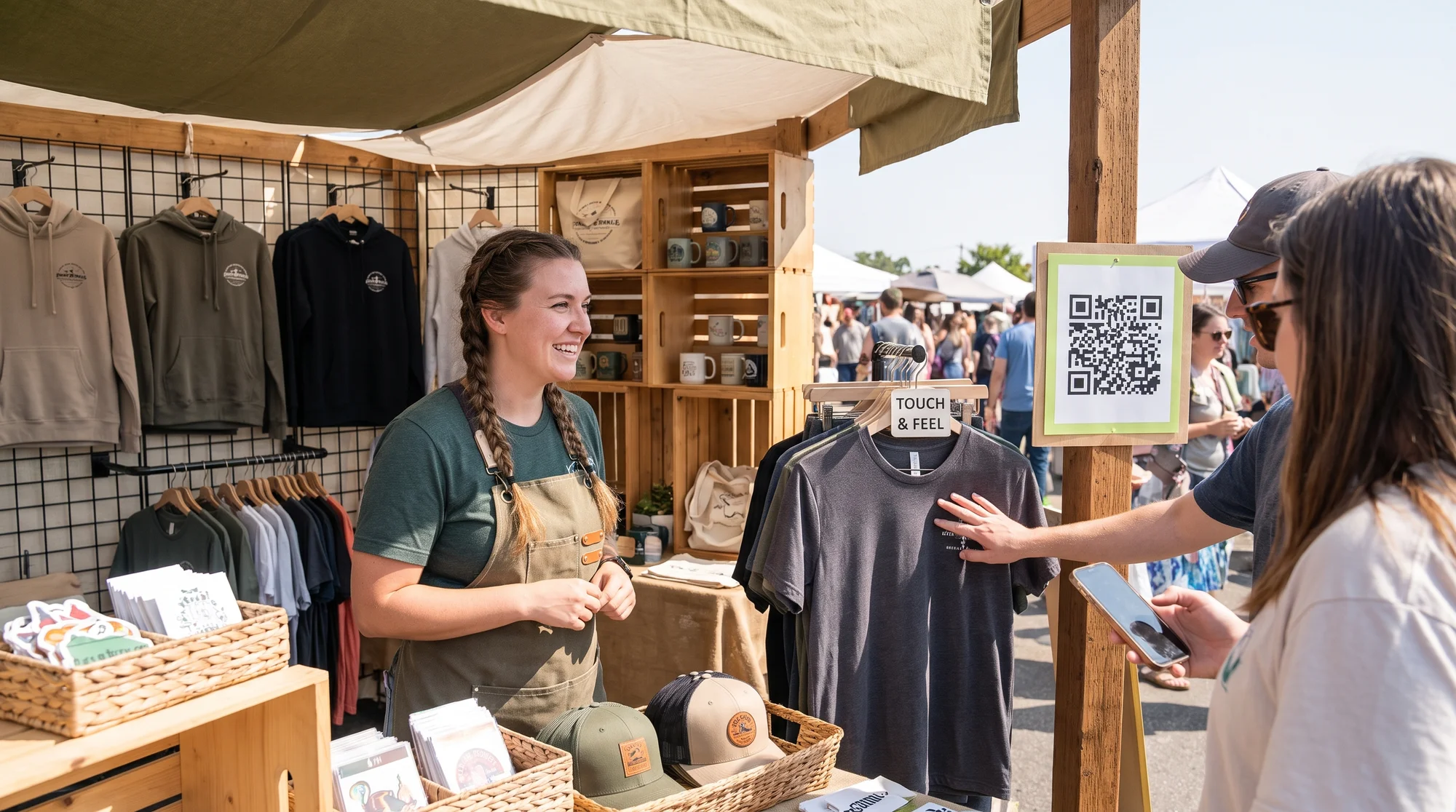
You're hauling a trunk full of backstock to every fair, and most of it drives home unsold while your cash sits locked inside boxes of sizes nobody bought. The fix is a zero-backstock booth: you display one sample of each hero product, then let QR codes and Printify ship every other size and color straight to your customer's door. Below, you'll map your 10x10 tent for max conversion, set up a QR ordering system that sells infinite SKUs, and stock your samples without overbuying a single unit.
Why "pretty booth" advice hurts margins
You've seen those "beautiful booth" guides telling you to knot a bedsheet over your table and sprinkle fake greenery around. None of them tell you how to stop hauling a trunk full of inventory that's slowly bleeding your margins dry.
The tablecloth-and-greenery trap
Most booth advice optimizes for a "boutique feel" instead of dollars per square foot. A booth can look stunning and still lose money if every inch of it isn't working to close a sale. Pretty is nice. Profitable is better. Your goal is a display that pays for your tent fee before lunch.
The real enemy: Backstock capital
The money you sink into a full size run is cash you can't get back if a design flops. Buy 60 shirts in five sizes and three colors, and you've gambled hundreds of dollars before a single customer walks up. That risk eats your profit before the show even starts. Worse, unsold stock becomes dead weight you store, re-fold, and drag to the next fair.
Treat your booth as a conversion machine
Stop thinking of your 10x10 as a display case and start treating it as a conversion machine. Every zone should pull foot traffic from the aisle, hand them something to touch, and route them to a purchase, whether that sale ships from your table or from a Print Provider.
What "zero-backstock" actually means
Zero-backstock is simple: samples on the wall, infinite SKUs via QR, zero dead inventory in your car.
- You display one of each design and size so buyers can see and feel the real product.
- When they want a different size or color, they scan a QR code and order it shipped to their door.
- Printify fulfills that order automatically, so you never carry a backstock unit again.
4 physical display pillars that sell
A flat table of folded shirts buries your best designs and wastes your most valuable asset: vertical space. These four pillars turn a cramped tent into a high-density selling machine.
Pillar 1: Vertical height and tiering
Floor space is limited, but air space is free. The problem with most booths is they merchandise at knee and hip level, where nobody can see the product from the aisle.
- Install grid walls on your back and side panels to hang apparel and wall art.
- Use garment racks to show full garments customers can touch and inspect.
- Stack wooden crates to build tiers that lift mugs, totes, and impulse items to eye level.
Pillar 2: Touch-and-feel sample stations
Online, buyers can't feel fabric. At a fair, that's your edge, so use it. A heavyweight blank sells itself the moment someone grabs it.
Set up a station where shoppers can handle your premium weights, like the Comfort Colors 1717 garment-dyed tee and the Lane Seven Heavyweight Hoodie. When a customer feels that weight and softness, your $45 to $75 price point suddenly makes sense. That's the Quality promise working in your favor.
Pillar 3: Omnichannel QR code purchasing
Here's the pillar that kills inventory risk. Every size you don't physically stock is normally a lost sale. Not anymore.
Place a QR code beside each display that links to your Shopify or Etsy product page. When a customer wants a 3XL you didn't bring, they scan, order, and get it shipped home. Printify auto-fulfills it. You just made a sale with zero stock on hand.
Pillar 4: Impulse price-point tables
Low-cost add-ons at the checkout table lift your average order value with almost no effort. People waiting to pay will grab a sticker or mug on instinct.
Position stickers, ceramic mugs, embroidered hats, and canvas totes right at the point of checkout. These are easy yes purchases that pad every transaction.
Booth layout and merchandise zoning
A disorganized booth confuses shoppers, and confused shoppers walk away. Zoning your tent guides the eye from the aisle to the checkout on purpose.
The focal point (back wall)
Your back wall is your billboard. It has to stop people from 20 feet away.
Hang your high-ticket graphic apparel and all-over-print tapestries at eye level (5ft to 6ft). Choose your most vibrant, boldest designs here. This is the hook that pulls aisle traffic into your tent.
Side walls (racks and grid walls)
Once a shopper is inside, your side walls do the browsing work. Clutter here kills sales.
- Organize apparel by theme or aesthetic, not random product type.
- Order sizes cleanly from S through 3XL so buyers self-serve.
- Keep a QR code on each section for sizes and colors you didn't bring.
Front checkout table
Your checkout table is prime real estate for impulse revenue. Fill it with high-margin add-ons.
Stack ceramic mugs, stickers, embroidered hats, and canvas totes within arm's reach of where money changes hands. Every one of these is a small, easy upsell.
Traffic flow psychology
Think of your booth as a funnel. The back wall pulls them in from the aisle, the side walls let them browse and touch, and the checkout table closes the sale with one last impulse grab. Each zone has one job: move the shopper one step closer to paying.
The QR system that kills inventory risk
The single biggest fear at any fair is "I don't have your size." The QR system turns that dead-end into a shipped-to-door sale, every time.
The exact signage that converts
Words matter. A vague sign gets ignored. A clear one gets scanned.
Frame a sign that reads: "Don't see your size or color? Scan to order, free shipping to your door!" This removes hesitation and gives the shopper a reason to act now instead of walking off.
Linking QR codes to product pages
Point your QR codes directly to the matching product page on your Shopify or Etsy store, not your homepage. Every extra tap loses buyers. Send them straight to the exact design they're holding so they can pick their size and check out in seconds.
How Printify auto-fulfills orders
This is where you stop carrying backstock for good. When that scan-order lands, Printify routes it to a Print Provider, prints it, and ships it to the customer automatically. You never touch the product. That's the Speed promise doing the heavy lifting while you close your next in-person sale.
Group by color stories, not product type
Shoppers scan when they feel something. Grouping items by color stories or local themes instead of plain product type builds that emotional pull. A "Lake Life" or "Downtown Local" section tells a story and drives more scan-intent than a rack simply labeled "Tees."
Stocking samples without overbuying
You don't need a full inventory to run a great booth. You need one clean sample of each hero product, and you can get them at a discount.
Order discounted samples in Printify
Order your booth samples directly in Printify at sample pricing. This is how you build a premium physical display without gambling on a full size run. You get the real product in hand to show and sell from, at a lower cost.
The top-selling blanks to stock
Stock proven sellers that people love to touch and buy:
- Comfort Colors 1717 Tee (garment-dyed, premium feel)
- Lane Seven Heavyweight Hoodie (sells your high-ticket price point)
- Canvas Totes (easy mid-tier gift)
- Tumblers (daily-use impulse buy)
- Ceramic Mugs (low-cost checkout add-on)
Why one of each beats a size run
Displaying one of each size and color lets a buyer see the fit and feel the fabric without locking up your cash in 60 units. The sample does the selling. The QR code and Printify handle every size you didn't bring. You get the Selection of a huge catalog with the risk of almost nothing.
Your pre-fair tech checklist
A dead QR scan at the booth is a lost sale and a frustrated customer. Lock in your backend once, and every future scan sells on autopilot.
Printify integration and SKU routing
- Set your order routing to Automatic so scan-orders fulfill without you lifting a finger.
- Add a billing method in Printify so nothing stalls at production.
- Verify your product mockups in the Product Creator so each product page matches what the customer is holding.
Tax and shipping rules
- Configure your state sales tax nexus so you collect correctly.
- Map flat-rate or calculated shipping profiles across your domestic and international zones so shipping costs never eat your margin.
Legal and trust pages published
Publish and link these in your footer so buyers trust the checkout:
- Privacy Policy
- Refund Policy
- Terms of Service
- Shipping Policy
- Contact Us
Run a live end-to-end test order
Never trust a system you haven't tested. Before the fair, place a real order for a Comfort Colors 1717 Tee.
- Confirm address validation succeeds.
- Check that the order appears in your Printify dashboard.
- Verify the email receipt lands.
- Cancel and refund the order before it enters production.
Now you know every scan will work when the crowd shows up.
Pricing tiers that maximize margins
A booth with one price point leaves money on the table. A tiered lineup captures the impulse buyer, the gift buyer, and the premium buyer all at once.
Impulse items ($5 to $18)
Quick, no-think purchases that pad every sale: waterproof vinyl stickers, acrylic keychains, enamel mugs, and coasters.
Core mid-tier gifts ($20 to $35)
The gift sweet spot where most shoppers land: canvas totes, ceramic mugs, insulated tumblers, and local city or state map art.
Premium apparel and decor ($45 to $75)
Your high-margin anchors that your touch-and-feel station sells for you: Lane Seven and Comfort Colors heavyweight hoodies, oversized sweatshirts, and stretched canvas wall art.
From booth to autopilot with Printify
The real win isn't one great fair. It's a system that sells for you across every fair, without multiplying your risk.
Connect Printify to Shopify
Connect Printify to your Shopify store to automate order routing, inventory sync, and tracking updates. Once connected, a scan at your booth becomes a fully handled order, printed and shipped, with the customer getting tracking automatically.
Sell infinite SKUs while you sell
Here's the freedom this buys you: while you're helping the next customer at your table, the QR-plus-Printify system is quietly fulfilling the order someone scanned two minutes ago. You sell infinite SKUs without touching a single extra unit.
Scale to more fairs without more risk
Because your booth carries samples and not inventory, the same blueprint works at your next fair, and the one after that. You pack the same lightweight sample kit every time. No new stock to buy, and no backstock risk to multiply. That's how you turn weekend markets into real, repeatable income.
Your zero-backstock launch plan
- Build vertical: Use grid walls, garment racks, and crates to maximize sellable surface area.
- Let them touch: Set up a sample station with premium weights like the Comfort Colors 1717 and Lane Seven Hoodie.
- Zone your tent: Hero designs on the back wall, organized racks on the sides, and impulse add-ons at checkout.
- Add QR codes: "Don't see your size or color? Scan to order, free shipping to your door!"
- Stock smart: One sample of each top blank, ordered at a discount in Printify.
- Test first: Run a live end-to-end test order, then refund before production.
- Go on autopilot: Set routing to Automatic and let Printify fulfill every scan.
