


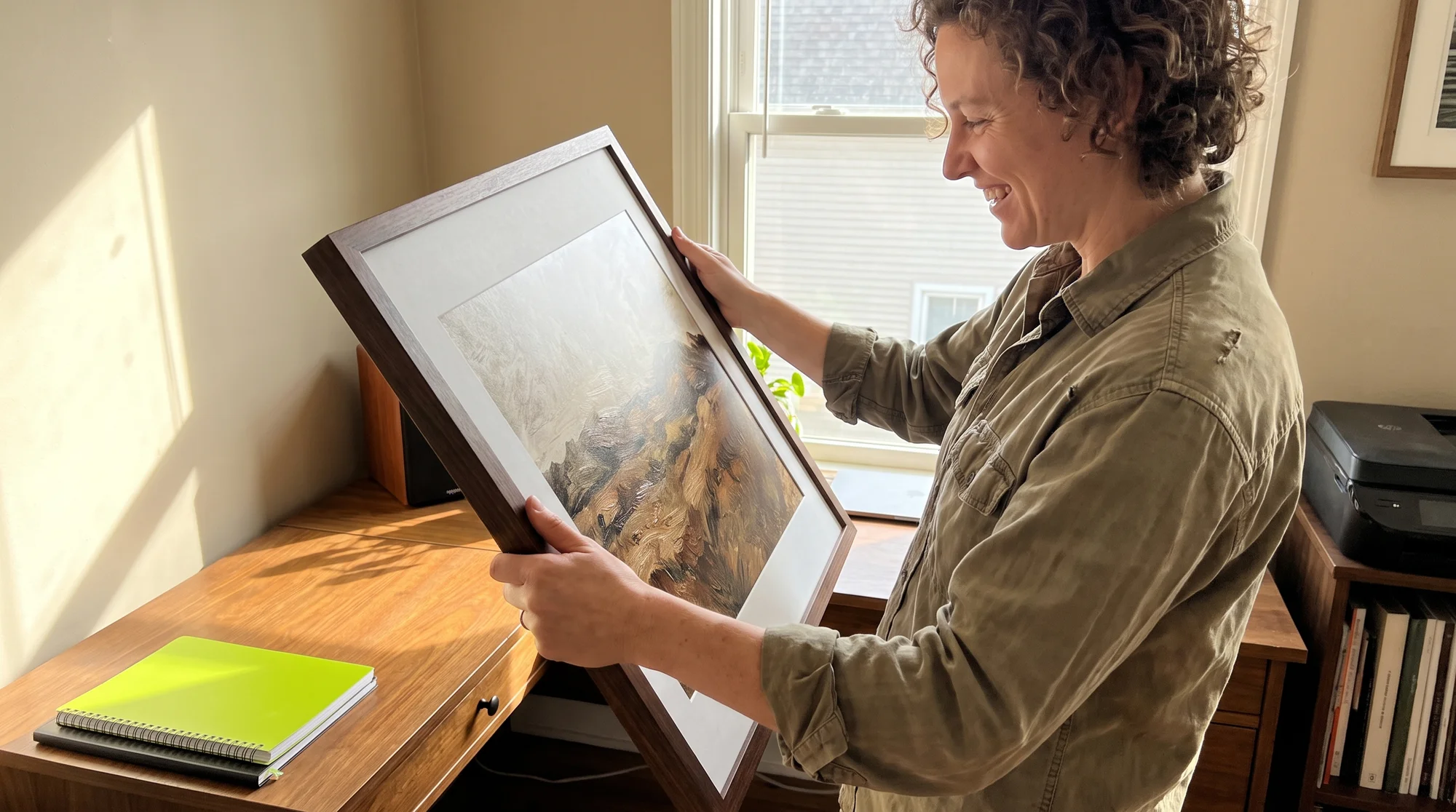
You're grinding to net $4 on a $15 poster in a niche that's already flooded — meanwhile the exact same design, printed on a 12-color pigment archival blank, sells for $89 and doubles your margin. The fix is switching from cheap dye-ink posters to Giclée fine art prints: high-resolution, archival prints on acid-free paper or canvas that command $50–$150+. Below, we'll break down the four non-negotiable Giclée specs, the pricing math that doubles your margins, and the exact Printify blanks that let you sell hands-free.
Why cheap posters are a margin trap
Posters feel like the safe entry point. They're also where most sellers get stuck — thin margins, brutal competition, and no room to raise prices.
The $15 poster math
Here's the problem: a standard poster retails for $15–$25, printed on cheap dye-ink paper. After base cost and platform fees, you're left with a few dollars per sale. To make real money, you need volume — and volume is exactly what a saturated tee-and-poster niche won't give you.
Chasing more sales at $4 profit is a treadmill. You run faster and stay in the same spot.
The Giclée flip in one sentence
Giclée printing is a high-resolution, archival inkjet process that uses pigment-based inks on acid-free fine art paper or canvas — and it sells for $50–$150+ instead of $15–$25.
Same design. Same upload. Different blank. The premium substrate does the heavy lifting on both perceived value and price.
Why this isn't "art school"
Forget the French etymology and gallery jargon. You don't need to know the history of the word or memorize color theory. This is a profit play, not a hobby.
The only thing that matters: knowing the four specs that separate a real Giclée print from an overpriced poster — so you can pick the right blank and charge premium prices with confidence.
The 4 non-negotiable Giclée specs
A "Giclée" label means nothing without the specs behind it. Miss even one and you're reselling a glorified poster at a premium price — a fast way to earn refunds. Here are the four criteria that define the real thing.
Spec 1: Resolution
Your file is the quality gate. A true Giclée print starts with a digital file at a minimum of 300 DPI at 100% scale. Anything lower prints soft, pixelated, or blurry — no substrate can rescue a weak file.
Action: Check your design file's resolution before uploading. If it's below 300 DPI at the size you plan to sell, upscale or recreate it first.
Spec 2: Ink
This is where cheap "Giclée" fakers get exposed. Real Giclée uses pigment-based inks with a 12-color archival gamut — not dye-based inks. Pigment inks resist fading; dye inks shift and wash out over time.
Action: Confirm the blank uses pigment inks. If the listing says "dye-based," walk away.
Spec 3: Paper stock
The feel and longevity live in the substrate. Demand acid-free, 100% cotton rag or archival matte paper at 230+ GSM. Acid-free prevents yellowing; the heavier weight signals gallery quality the moment a buyer holds it.
Action: Look for "acid-free," "cotton rag," or "archival matte" plus a GSM of 230 or higher.
Spec 4: Printer technology
Real Giclée comes off professional wide-format inkjet printers — not consumer desktop machines. This tech delivers the color accuracy and detail premium buyers expect.
The fade test
Why do these four specs matter together? Because pigment inks, acid-free cotton rag, and a pro inkjet make prints that resist fading for 100+ years. That longevity is your entire pricing justification. "Museum-grade, 100-year archival" is what turns a $15 poster into an $89 sale.
Spot the fakes
Watch out for inferior blanks. Some print labs run 7-color dye-based systems at only 200 GSM. That is not true Giclée. A real spec is 12-color pigment ink on 230+ GSM acid-free stock. If you resell an inferior blank as "museum-grade," you'll get refunds and bad reviews. Always match all four specs.
The pricing play: Poster vs Giclée
Now the fun part — the money. Once your blank hits all four specs, you can price like the gallery-grade product it is.
The comparison table
| Factor | Standard poster | Giclée fine art print |
|---|---|---|
| Retail price | $15–$25 | $50–$150+ |
| Ink | Cheap dye-based | 12-color pigment archival |
| Paper | Thin, non-archival | Acid-free, 230+ GSM cotton rag |
| Lifespan | Fades in years | 100+ years no-fade |
| Net margin | Thin | Roughly doubled |
| Perceived value | Disposable | Museum-grade, gallery-ready |
How to price for 2X margins
The strategy is anchoring. When a buyer sees a $20 poster next to your $89 Giclée print, the premium price feels justified — because the quality gap is real.
Action steps:
- Anchor your Giclée price against common poster prices to make the value obvious.
- Build size tiers (small, medium, and large) — bigger sizes carry bigger prices.
- Add framing tiers — framed prints push your Average Order Value even higher.
Why buyers pay more
You barely have to sell. The words "museum-grade," "100-year archival," and "gallery-ready" do the work. Buyers already understand that fine art costs more than a poster — your job is simply to deliver the real spec and say so plainly.
Zero-labor fulfillment with Printify
Here's what makes this a true flip: you sell premium prices without touching packaging, shipping, or inventory. Our Print Providers handle production; you keep the margin.
The 3 blanks that print money
Inside the Printify Catalog, three fine art blanks hit the premium spec:
- Fine Art Posters (Archival Matte) — acid-free, archival matte paper for the classic Giclée look.
- Stretched Canvas Prints — gallery-wrapped, ready to hang, high perceived value.
- Framed Fine Art Prints — the highest AOV tier, arriving gallery-ready.
How to match the specs
You don't need to manage color profiles or scanning — the blank spec handles the technical side. Your job is selection.
Action steps:
- Choose archival matte or cotton-rag-grade paper blanks for prints.
- Choose stretched canvas for the ready-to-hang tier.
- Confirm the paper weight and archival description on each blank before publishing.
Auto-fulfillment on autopilot
Upload one design once. Sell it across multiple sizes and framing options. When an order comes in, it routes straight to the Print Provider — no manual packing, no post office runs, and no inventory sitting in your closet.
That's the Speed and Quality promise working for you while you sleep.
Why reselling beats a lab
A print lab sells prints to you — you pay upfront, then hope to resell. Printify flips that. You resell Giclée at a profit with zero upfront inventory. No cash tied up in stock, and no risk if a design flops. You only pay the base cost after the customer pays you.
The fast-launch checklist
You can go live in an afternoon. Here's the exact path.
Step 1: Audit your file
Open your existing design and check it against the 300 DPI at 100% scale rule. If it passes, you're ready. If not, upscale or rebuild it before moving on.
Step 2: Pick your fine art blank
Open the Printify Catalog and choose a blank that hits all four specs — Archival Matte Poster, Stretched Canvas, or Framed Fine Art Print.
Step 3: Set your price tiers
Set your $50–$150 tiers by size and framing. Anchor against poster prices, then let bigger sizes and frames lift your AOV.
Step 4: Publish and let it run
Hit Publish. From here, auto-fulfillment turns every sale into hands-off profit. One upload, unlimited sales.
FAQ
Is Giclée worth reselling at a premium?
Yes — and the answer is about margin, not art. The same design that nets a few dollars as a poster can double your net margin as a Giclée print at $50–$150+. The premium substrate carries the price.
Does premium mean slow fulfillment?
No. Giclée prints fulfill exactly like any other Printify product — automatically. The order routes to the Print Provider, who prints, packs, and ships. You do nothing after publishing.
What's the poster vs Giclée difference?
A poster uses cheap dye ink on thin, non-archival paper and fades in years. A true Giclée print uses 12-color pigment ink on acid-free 230+ GSM stock and lasts 100+ years without fading. That longevity is what justifies triple the price.
Do I need color management skills?
No. The blank spec handles the technical side — inks, paper, and printer tech are all managed by the Print Provider. Your only job is a 300 DPI file, a spec-matched blank, and smart pricing.
Your next move
Kiss the $4-poster treadmill goodbye. Open the Printify Catalog, pick a blank that hits all four Giclée specs — Archival Matte Poster, Stretched Canvas, or Framed Fine Art Print — upload one design, set your $50–$150 price tiers, and publish. Then let auto-fulfillment turn every sale into hands-off profit. Same design, triple the price, zero extra work.