

You hauled three bins of mugs and tees to a craft fair last weekend, sold half of them, and the first thing the customer who loved your best design said was "do you have this in a Large?" — you didn't, so you drove home with dead stock and a lost sale. The fix is a two-part system: a price-tier closing ladder that gives every shopper a "yes," plus a QR-to-doorstep hack that turns your booth into an infinite warehouse. Below, you'll build a table that keeps closing orders long after you've folded it up and driven home — and you'll learn the best print-on-demand products for craft fairs to stock it with.
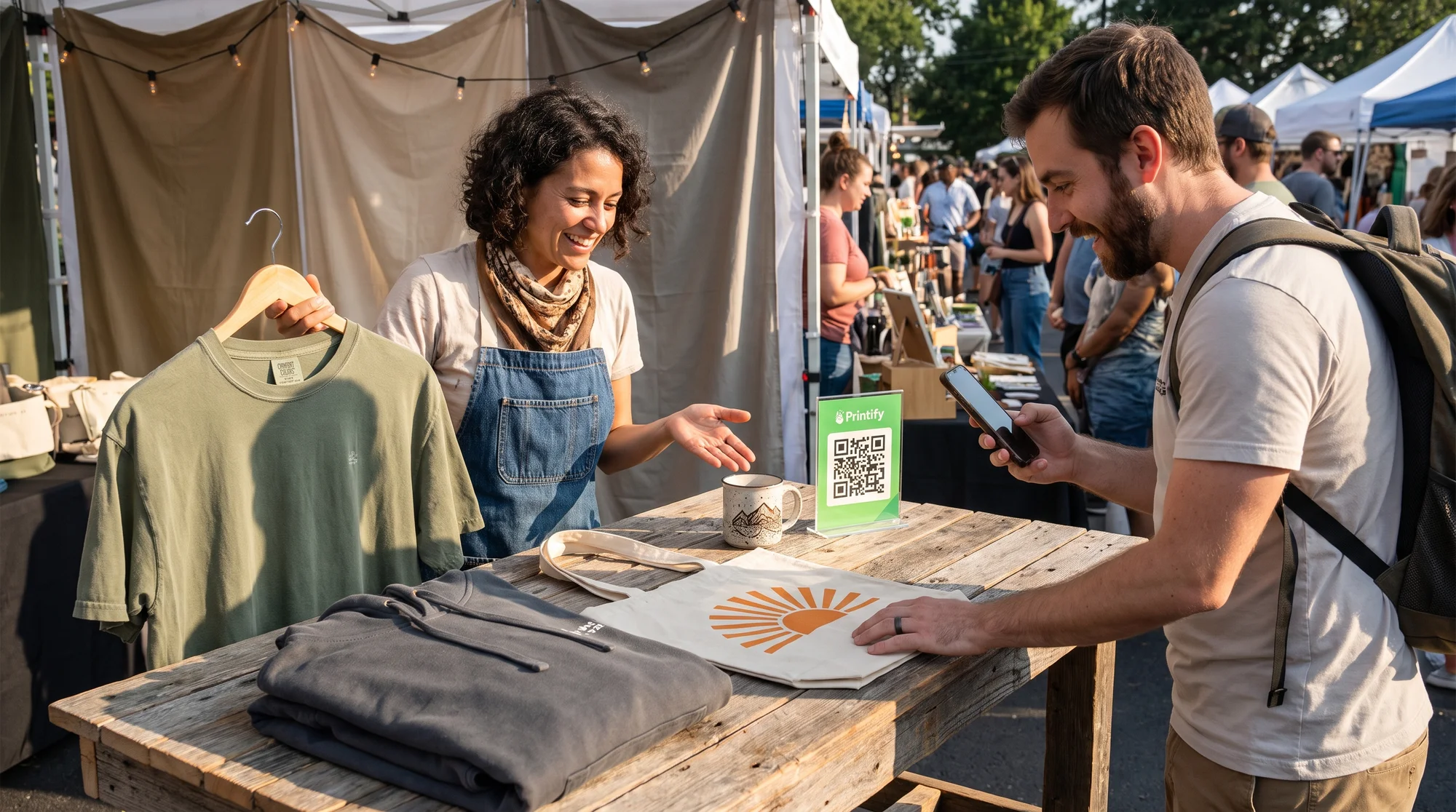
Here's the mental shift that makes it all work: your table isn't a warehouse. It's a demo floor. You carry a handful of hero samples, and Printify holds every size, color, and variant in the Printify Catalog your customers can tap into with a phone.
Why craft fairs kill most sellers
Most sellers lose money at markets before they even open the booth. The problem isn't foot traffic — it's the inventory model.
- The dead-stock trap: You sink cash into bins of mugs and tees, sell a fraction, and haul the rest home. That unsold stock is frozen money sitting in your garage.
- The "sold out" sale killer: Every size and color you didn't bring is a lost sale. The customer who wants that hoodie in a 2XL walks away, and your register never rings.
- The one-weekend dead-end: You treat the fair as a single event. When the table folds, the income stops.
The reframe fixes all three at once. Your table holds hero samples — one gorgeous example of each design. Printify holds the infinite warehouse. You carry zero bulk inventory, you never hear "do you have this in a Large?" again, and the sale follows the customer home. No risk. No dead stock. Just independence and control over your time and money.
The 3-tier price ladder for craft fairs
If there's only one price point at your booth, you lose every shopper whose budget doesn't match it. The fix is a ladder: an impulse grab to warm up the card, a core gift for the majority, and a premium piece that anchors your profit. Here's how to structure it.
Tier 1: Impulse closers
The problem: walk-by shoppers won't commit to a $60 hoodie on a first glance. The solution: give them a low-risk "yes" (in the $5–$18 range) that starts the pile.
- Products: Waterproof vinyl stickers, acrylic keychains, enamel mugs, and coasters.
- Role: Capture every walk-by, build "add it to the pile" momentum, and warm up the credit card for bigger buys.
- Hustler's note: Low base cost plus high attach rate. These fund your whole day and cost you nothing if they don't sell — because the stock lives in the Printify Catalog, not your car.
Tier 2: Core mid-tier gifts
The problem: gift-buyers want something that feels like a real present without breaking the bank. The solution: stock the bread-and-butter price point ($20–$35) where most of your volume lands.
- Products: Heavyweight canvas totes, 11oz and 15oz ceramic mugs, insulated tumblers, and local city or state map art.
- Role: This is your volume driver. Most shoppers close here, and a strong local-pride design turns a browser into a buyer fast.
Tier 3: Premium apparel and decor
The problem: you leave serious money on the table when you have nothing above $35. The solution: anchor your booth with a premium piece ($45–$75) that makes one sale worth ten impulse buys.
- Products: Heavyweight fleece hoodies (Lane Seven or Comfort Colors), oversized sweatshirts, and stretched canvas wall art.
- Role: The profit anchor. One premium sale can beat ten impulse grabs — and the quality of these blanks sells itself the moment a customer touches them.
Merchandising rules that drive sales
A great catalog still fails on a badly arranged table. These two rules turn browsers into buyers and buyers into multi-item orders.
Group by color or local theme
The problem: when you line up "all the mugs here, all the totes there," you kill cross-sells. Shoppers see one category, buy one item, and move on.
The solution: build visual stories instead. Cluster a mug, a tote, and a sticker that all share a color palette or a local-pride theme so they go together.
- Group by a seasonal palette (warm autumn tones, winter blues) or a local theme (your city skyline, state outline, or regional slang).
- Let the customer picture the set: "That mug matches that tote — I'll grab both."
- Watch your average order jump when the display does the upselling for you.
The sign that sells after you leave
The problem: when a size or color isn't on the table, the sale dies right there. The solution: one tabletop sign that ships the order for you.
Place a clear sign next to your hero samples reading:
"Love this design but need a different size or color? Scan here to ship directly to your door!"
Link the QR code straight to your Shopify or Etsy store. This single sign is the difference between a dead-end weekend and a 24/7 cash machine — it captures every "do you have this in…?" sale you used to lose.
The QR-to-doorstep inventory hack
Here's the engine that makes zero-dead-stock possible. Your table shows the sample; the catalog does the selling.
How the scan works:
- A customer loves your hero sample but wants a different size or color.
- They scan the QR code on that design.
- They land on the exact product listing in your store.
- They pick their size and color and check out.
- Printify auto-fulfills the order straight to their doorstep.
Why you never carry bulk stock: Your table is samples only. Every variant — every size, every color — lives in the Printify Catalog. You stopped paying for inventory you might not sell.
The compounding payoff: Orders keep rolling in days and weeks after the event. Someone who grabbed a sticker on Saturday scans the QR and orders the matching hoodie on Tuesday. The market becomes a repeatable system, not a one-day hustle.
Practical setup: Create one QR code per hero design and link it to the matching store collection or product page. Keep it simple — one sample, one code, one clean path to checkout.
What to pack: Ordering your hero samples
Your sample is your sales pitch. When a customer touches a flimsy tee, they walk. When they feel a heavyweight garment-dyed cotton, they buy. So before your next fair, order the real thing.
The problem: you can't fake quality at a booth — shoppers judge with their hands. The solution: use Printify's sample discounts to order low-cost, high-quality physical displays in advance, so every blank on your table earns its spot.
Your hero-sample shortlist:
- Comfort Colors 1717 Tees — the garment-dyed feel that justifies a premium price.
- Lane Seven Hoodies — heavyweight fleece that anchors your top tier.
- Canvas totes — the mid-tier volume driver shoppers love to carry.
- Ceramic mugs — the gift-buyer staple with instant visual appeal.
Before the fair:
- Order samples early using your Printify sample discount.
- Quality-check each one in person — inspect the print, the stitching, and the color.
- Attach a QR code to each hero design.
- Let Printify handle automated fulfillment for every scan so you focus on closing at the table.
This is where our four promises earn their keep: Quality your customers can feel, Selection across every variant, Speed of fulfillment to their door, and Profitability with zero bulk risk.
Run the numbers
The math is lopsided once you stop hauling stock.
- Zero dead stock, zero sunk cost. When the weekend ends, you owe nothing on unsold bins — because there are none.
- One-time sample cost vs recurring bulk cost. A handful of discounted samples is a small, one-time spend. Bulk inventory is a recurring, risky bet that punishes you every time a design underperforms.
- Post-event tail revenue. QR scans keep producing sales long after the table folds. A one-day market quietly becomes a repeatable income stream that works while you sleep.
You carry less, risk nothing, and keep earning. That's more money, more autonomy, more living.
Your repeatable cash machine checklist
Run this before every market:
- Build the 3-tier price ladder — impulse, core, and premium.
- Order hero samples with Printify's sample discounts.
- Merchandise by color or theme, not by product type.
- Deploy the QR "scan to ship" sign linked to your store.
- Pack up, go home, and keep getting paid.
Start building your catalog today
Stop driving home with unsold bins and lost sales. Order your hero samples with Printify's sample discounts before your next market — hold the quality of a Comfort Colors 1717 Tee, Lane Seven Hoodie, canvas tote, and ceramic mug in your hands, slap a QR code on each, and turn your next booth into a table that keeps closing orders long after you've packed up.