


You're grinding to shave pennies off the same $10 cotton tee every other Print on Demand seller is fighting over—and it's a race to the bottom you can't win. Direct-to-Film (DTF) transfers break free from that trap by printing vibrant, durable graphics onto polyester, nylon, canvas, and poly-blends—fabrics that DTG printing physically can't touch. This guide skips the "what is DTF" theory and shows you how to enter hot streetwear and activewear trends with products your competitors are locked out of, then list 3-5 test SKUs before dinner.
This isn't a comparison explainer. It's a move-first arbitrage playbook. Let's get into it.
The unfair advantage hiding in plain sight
Here's the core play: while every POD hustler fights over cotton tees, DTF unlocks the products they can't make—polyester leggings, nylon windbreakers, oversized fleece streetwear, and thick canvas totes.
Unlike DTG, which needs high-cotton content to absorb ink correctly, DTF prints your design onto a PET film that gets heat-pressed onto almost any fabric. That single difference expands your store into the highest-margin niches in apparel—the ones your competition can't legally, physically, or technically enter.
Same demand. Less supply. Fatter margins. That's the whole game.
Why the cotton-tee price war is a trap
The saturation problem
Everyone sells the same blank tees. When you and 10,000 other sellers offer identical Print Providers' base products with a slapped-on graphic, you compete on one thing: price. That's thin margins, zero differentiation, and a permanent race to the bottom.
You can't out-cheap a market that's already at cost. So stop trying.
The DTG ceiling
DTG printing has a hard physical limit: it needs high-cotton content. Print it on polyester and the ink bleeds, the dye migrates, and the graphic looks washed out within a wash cycle or two. Activewear is off-limits. Windbreakers are off-limits. Synthetic streetwear is off-limits.
That limit isn't a bug for you—it's a moat. Your DTG competitors are locked out of the exact niches where buyers pay premium prices.
The arbitrage advantage
The move is simple. Take a hot, high-demand trend everyone's chasing—then serve it on a product DTG sellers can't make. You inherit all the demand with a fraction of the supply.
That gap between demand and supply is where your margin lives.
Products DTG sellers can't make
For the business owners reading this: understand the fabric science, because it's your unfair advantage. While DTG struggles with polyester bleeding and dye migration, DTF uses a specialized hot-melt adhesive powder backing. That powder seals the ink and stops dye migration entirely—so you get retail-grade, high-contrast graphics on synthetic fabrics DTG can't handle.
Here's what that opens up:
Performance gym wear and leggings
Polyester and spandex blends dominate the activewear market, and they're exactly what DTG can't print cleanly. DTF locks bold graphics onto stretchy performance fabric without cracking or fading. This is a premium, repeat-purchase category with buyers who don't blink at higher price tags.
Nylon windbreakers and track jackets
Nylon is slick, synthetic, and a nightmare for water-based inks. DTF's adhesive backing grips it and holds. Windbreakers and track jackets carry high perceived value—and high retail prices to match.
Oversized streetwear
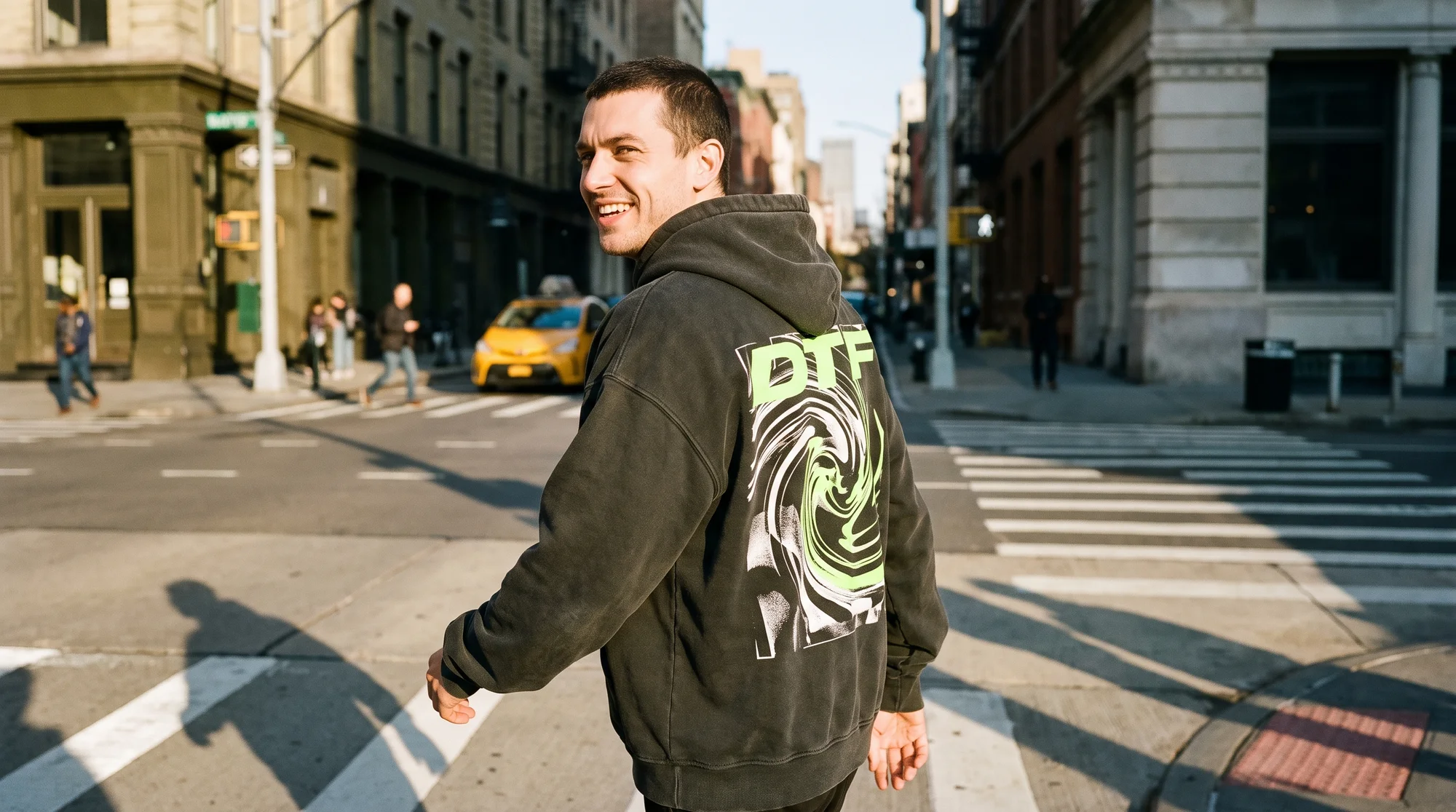
Heavy fleece and poly-blend hoodies are the backbone of modern streetwear. DTF handles the thick, blended fabrics that DTG chokes on, letting you serve one of the most trend-driven, high-margin niches online.
Canvas backpacks and tote bags
Accessories are pure margin. Canvas is dense and textured, but DTF presses clean, vibrant graphics onto backpacks and totes—products your cotton-tee competitors never think to list.
Margin comparison table
| Product | Retail price | Your cost | Profit per unit |
|---|---|---|---|
| Cotton tee | $10 | $8 | $2 |
| Gym legging | $35 | $18 | $17 |
| Nylon windbreaker | $45 | $24 | $21 |
Prices are illustrative—check live costs in the Printify Catalog.
One windbreaker sale equals roughly ten cotton-tee sales in profit. Same effort to list. Wildly different outcome.
Designs that sell on dark gear
For the artists reading this: DTF frees you from color limitations. It prints a solid white ink layer directly behind your CMYK colors on the film carrier. That underbase creates incredible opacity and saturation—even on pitch-black or dark heather garments.
Why the white underbase wins
Most activewear and streetwear ships in black, charcoal, or dark heather. On those garments, colors normally sink and dull out. The DTF white underbase acts like a primer, so your reds stay red and your gradients stay crisp. Your design pops instead of disappearing.
Best design types for DTF
DTF rewards detail. Lean into:
- Complex fine-line vector illustrations that would blur on other methods.
- HD gradient scales with smooth color transitions.
- Detailed typography and branding layouts where sharp edges matter.
If your art is intricate, DTF is where it finally looks right on premium fabric.
Stop perfecting, start shipping
Here's the trap that kills artists: polishing one design for two weeks while the trend dies. Adopt the "good enough to sell" mindset. Your goal isn't a masterpiece—it's a testable SKU. Ship five designs, let the market pick the winner, then refine the one that sells.
Momentum beats perfection every single time.
List 3-5 test SKUs before dinner
Step 1: Filter for DTF Print Providers
Open the Printify Catalog and filter for Print Providers running advanced industrial DTF lines. Printify's multi-vendor production options let you find providers who handle specialty apparel, caps, and complex bag placements—so you're not limited to one factory's capabilities.
This is where selection becomes a weapon: you pick the provider that can print the exact synthetic product your trend demands.
Step 2: Pick your trend SKUs
Check what's climbing on TikTok right now. A viral aesthetic, a slang phrase, a design style. Then match that trend to a non-cotton product DTG sellers can't make—leggings, a windbreaker, or a canvas tote.
Don't overthink it. Pick three to five and move.
Step 3: List on TikTok Shop and Etsy
Speed is the weapon. Use the Product Creator and Mockup Generator to build clean listings fast, then push them live on TikTok Shop and Etsy before the trend peaks. First to market on an unsaturated product wins the sale.
Step 4: Nail the conversion hook
Premium activewear buyers have one fear: paying $35 for leggings whose graphic cracks after two workouts. Kill that fear on the product page. Lead your copy with wash-durability and stretch-resistance claims—that's exactly what closes the sale on high-ticket gear.
Make those two words the headline of every activewear listing.
Speed beats perfect
The sellers still reading "DTF vs DTG" articles are already behind. While they research, you're listing. The playbook is brutally simple:
- Test cheap. List three to five SKUs with minimal effort.
- Kill losers fast. No emotion. If it doesn't sell in a week, drop it.
- Scale winners. Pour your energy into the one product the market rewards.
Because you don't own the printer, hold no inventory, and pay nothing upfront, your risk on each test is close to zero. That's the whole point—momentum over polish, action over analysis.
FAQ
How durable are DTF prints?
Very. The hot-melt adhesive powder bonds the ink into the fabric, so DTF prints survive repeated washing and workouts. Unlike graphics that sit on top of the fabric, a properly pressed DTF transfer flexes with the garment instead of flaking off.
Does DTF crack when stretched?
A quality DTF transfer is built to stretch and recover with the fabric. This is the exact benefit to feature on your product pages—stretch-resistance is what convinces activewear buyers to hit Add to cart. Choose Print Providers with strong reviews on synthetic apparel to be sure.
Can I do this without a printer?
Yes. This is the part competitors ignore. With Printify, you never buy a machine, hold inventory, or ship a package. You design the product, list it, and your chosen Print Provider prints and fulfills each order only after a customer pays. Zero upfront risk.
What margin can I expect on activewear vs cotton?
A cotton tee often nets around $2 per sale. A gym legging or windbreaker can net $17 to $21 on the same amount of listing effort. The higher perceived value of synthetic activewear supports premium retail prices your cotton competitors can't charge. Always confirm live costs in the Printify Catalog.
How fast can I get products live?
You can build and list 3-5 SKUs in a single afternoon. Use the Product Creator and Mockup Generator to spin up listings quickly, then publish to TikTok Shop or Etsy the same day. Speed is your advantage—move before the trend peaks.
Your move this afternoon
Open Printify right now and filter the catalog for Print Providers running industrial DTF lines. List 3-5 test SKUs on a non-cotton product—leggings, a windbreaker, or a canvas bag—to TikTok Shop or Etsy today. Lead every product page with wash-durability and stretch-resistance claims, then let the market tell you which winner to scale.
More money. More autonomy. More living. Kiss the cotton-tee price war goodbye.