


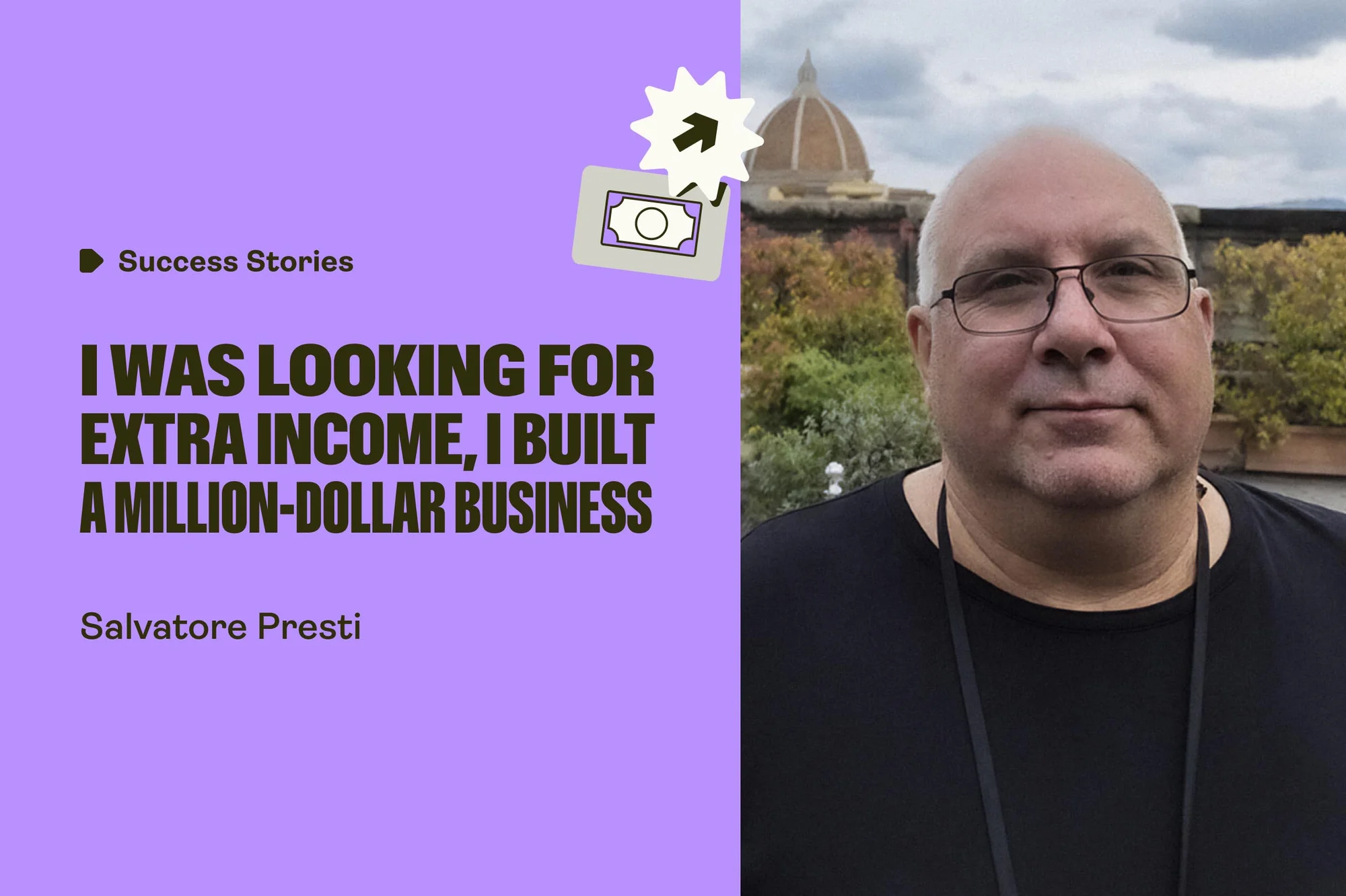
Some of the best moves Salvatore Presti made for his business came out of plans that fell through. A side project he'd set aside years earlier became exactly what he needed when his other income slowed.
Today, he runs a seven-figure Shopify store with Printify, and he still calls himself a newbie.
Getting there took a few false starts and plenty of lessons along the way.
Here's how he built the business, and what he wants every new seller to know before they start.
From the barber's chair to building income online
Salvatore Presti, or Sal as everyone calls him, spent his years in Boston working as a barber. He also managed the shop and used the extra time to look for ways to earn more money.
"I was doing a lot of stuff online, and it started to build. So I thought that I should really focus my attention there and try to build an actual business online."
The project he took most seriously was affiliate marketing. Sal built websites that earned a commission whenever visitors bought the products he recommended. His plan was to sell those sites once they were established, and that's where he put most of his energy.
Print on Demand wasn't on his radar yet. He had no design background and no experience running a store, and he was focused on the websites.
An early start with Print on Demand
One of Sal's friends had just started selling through Merch by Amazon, where you upload a design and Amazon prints and ships each shirt when someone orders it. The program was still new, and his friend thought it was worth a look.
"I signed up and figured I'd make some extra money with it while I was building the websites. This was early 2016, so I think it was only a few months old at that point."
Approval took a few months. Once his account was accepted, Sal started uploading designs without really understanding how the space worked. He's happy to admit his first attempts weren't great.
"My designs were really bad. I started seeing some success mainly because there wasn't much competition back then. But I just plugged away, little by little, and I got hooked on the idea."
He kept this going on the side for a few years. Over time, it stopped being worth the effort, so he set it aside and put his attention back on the affiliate sites.
Why Salvatore chose a store of his own
By the time Sal came back to Print on Demand, his other income had dried up. Google's algorithm changes made it much harder to earn from affiliate sites. He'd also been freelancing for SEO agencies, and as they lost clients, his freelance work shrank too.
He needed something to supplement his income, and an Etsy shop felt like a natural fit given his background in merch. He signed up for an account, but within a couple of days, it was banned before he had uploaded anything. He never found out why, so he did not want to build his next business around a platform where the rules were outside his control.
"Shopify isn't my platform, but it's my store. I bought my domain. I own my email list. I decide what I send people and who sees my ads. It was a much bigger learning curve, but I figured it would be better in the long run."
His first Shopify store targeted Italian Americans, a community Sal is part of. It was profitable right away, and while the money wasn't huge, it was steady.
About a year in, he saw he could do better with a different topic and launched a second store. "That one has kind of taken on a life of its own," he says. He has since closed the first store to focus on it.
How Printify became his go-to partner
Sal had researched Printify years before he ever used it. When he first looked beyond Amazon, he learned that most print-on-demand setups work differently. Amazon handles printing in-house, but everywhere else you need a separate partner to produce and ship your orders.
"At that time, the consensus was that Printify was the best one. It just looked like Printify was going to have more of a reach, and would be a little easier to manage."
But he didn't act on it then. Years later, while setting up his Shopify store, he was following Chris Heckman's YouTube tutorials, and Chris recommended Printify.
"Since I already had that understanding from years earlier, I didn't even have to think about it. I just went with Printify."
Two years on, the support is what stands out to him. Sal works with a success agent at Printify, and that makes the relationship feel like a partnership.
"No system is perfect, especially when there are so many moving parts. But I always feel like there's somebody I can reach out to. When I contact customer service, things get resolved. I've had a genuinely positive experience working with Printify."

Learning a whole new side of marketing
Running his own store meant Sal had to find every customer himself. Amazon had handled that during his Merch years. On Shopify, he was paying for his own ads, and the marketing side felt completely new.
"Yes, it's about putting good designs on quality products, but how you market yourself is what it really comes down to."
His SEO background shaped how he approached Meta Ads. Getting a site to rank on Google is slow, and Sal was used to waiting months before he could tell whether his work had paid off. Ads gave him answers much faster.
"Ads were more complex, and they needed a different mindset to manage. But it was less actual work than organic traffic, and I could see right away what was working and what wasn't."
The community that kept him going
About a month after his first store went live, Sal had more questions than answers and nobody to ask. He'd already been learning from Chris Heckman's YouTube tutorials, so he joined WeScale, Chris’s community on Skool.
"I didn't feel like I was alone in the wilderness. I had people I could bounce things off of, and I could learn best practices. It made it feel safer, because you can end up spending a lot of money on ads."
Sal still remembers the time when his revenue dropped for weeks. He kept changing his ads, but didn’t know they were the problem for a while. Eventually, Chris spotted it within about 30 seconds. A floating email sign-up bar was covering the add-to-cart button. Sal removed it, and sales came right back.
"Signing up for that school was the biggest win. It absolutely changed my life. There were times when I couldn't figure things out, and I might have quit."
Today, he's part of WeScale's Mastermind group for more advanced sellers.
Why the right niche makes everything easier
Plenty of new sellers put off starting because they're afraid of getting something wrong. Sal doesn't pretend mistakes won't happen. He wants people to remember that a mistake doesn't have to end the business.
"You can always start over. You don't have to stick with something that's not working. If you realize the mistakes were fundamental from the beginning, you can take a step back, stop all your ads, rework everything, and start again. The model definitely works."
He's realistic about the limits, too. Doing everything right still doesn't guarantee results. But in his view, one decision shapes the outcome more than any other, and that's the niche you choose.
"The wrong niche can set you on a path that's going to lead you nowhere. When you pick the right one, everything's easier, even when you make mistakes. That's the key."
There's no formula for picking one. A niche that works well for one seller can go nowhere for another, so Sal thinks of it as finding the right fit for you rather than the right niche in general.
Staying humble in a business that keeps changing
Sal has been running his Shopify business for two years. His second store is closing in on $1.5 million in revenue after a little over a year, and he still won't call himself an expert.
"I know a lot about the business and how to do it, and I still feel like a newbie. I'm still learning all the time and open to new ideas."
He sees that mindset as one of the biggest reasons his business grew. Sal thinks being willing to be humbled matters as much as being willing to learn.
It matters even more because the model keeps changing. The tactics Sal relied on when he started no longer work, so standing still isn't an option.
"There are so many paradigms that shift, and you have to be ready to adapt. If you feel like you already know everything, you're not going to be able to adapt quickly enough."

How Sal uses AI without losing his personal touch
AI is now part of how Sal runs the store, including his designs. He's careful about where it fits, though, and the creative direction still comes from him.
"I create the concepts, and then I have AI make the design based on what I'm looking for. It doesn't work the other way around. The niche I'm in requires that I personally understand the context, and I wouldn't get that with AI."
Sal knows sellers who've completely automated design, with scripts that generate new designs while they work on other things. In a broader niche, he says, he'd do the same because saving time matters. It just doesn't suit his audience.
The designs still look good, and most shoppers don't mind how they're made. A few, though, have told him they'd buy if the designs weren't AI-generated. Sal understands where they're coming from.
"But it's a new technology, and we can't stop it. I had to adapt and use it to my advantage."
The email strategy behind a third of his revenue
Ads bring new shoppers to Sal's store, and email brings them back. His email campaigns and automated flows together make up about 35% of his revenue.
He sends three campaigns a week, each written as a newsletter. Two of them cover whatever's in the news for his niche, and every Saturday he sends a roundup of new designs. The flows run on their own. New subscribers get a discount code, and people who haven't visited in a while get an email showing what's new.
What makes email so valuable to him is the cost. Sal pays Meta to bring a customer in once. After that person signs up, reaching them again costs very little. His email software runs $400 to $500 a month and covers tens of thousands of subscribers.
"I'm not paying the cost per acquisition like I would with an ad. Without email, I would not be doing as well as I am," he says.
Building a lean team behind the store
For a long time, Sal handled customer service himself across two stores, including one Q4 when all he had was a spreadsheet. He still thinks new sellers should start that way.
"When you're starting out, doing it yourself helps you understand what your customers need and get into their mindset."
A tool called Gorgias made the load easier to manage. It collects incoming emails and sorts them, so he can see at a glance who has a problem and who's just saying thanks.
Eventually, customer service was eating hours of his day. His rule for outsourcing is to hand off whatever you least want to do or whatever keeps you from growing the business, so it went first.
He now works with a virtual assistant in the Philippines for about 30 hours a week. He trained her on his policies and the tone he wants, and she tackles customer service first each day.
Planning ahead for a busy Q4
Once Sal's store started growing, more sales meant higher printing costs and bigger ad budgets, and for a long time his credit card limit couldn't keep up.
His workaround was to make daily payments until his limit went up. Even then, each payment took four or five days to clear.
"Between the printing costs and the advertising costs, you hit Q4, and it's an explosion. I didn’t scale as much as I could have during those periods because I didn't have a high enough credit card limit. Sometimes I couldn't spend more on the ads that I needed to."
New sellers won't run into this on day one. It shows up later, once the business is already working.
"Once you get to your first Q4 and you've grown and you're profitable, it's important to have access to some capital or multiple credit cards for when it does take off."
What working for himself has given him
Sal started his store to supplement his income. Today, it's his full-time work, and he does nothing else.
He's quick to say it isn't passive. Orders come in while he sleeps, but someone still has to run the business.
"As a freelancer, you might feel like you're your own boss, but your clients are your bosses. I'd be working 10 to 12 hours a day to finish projects. I can still work 10 to 12 hours now, and it happened even recently. But I don't have to."
This summer, he took a few weeks off for vacation and worked about two hours a day while his assistant handled the rest.
"I can be there when my kids have a school play. If I want to go for a bike ride in the middle of the week to clear my head, I can. There's nobody telling me I can't."
There's no perfect moment to start, and Sal would tell you that you'll keep learning as you go. If his story got you thinking about a store of your own, head over to Printify and create your first product today. It costs nothing to begin.
