


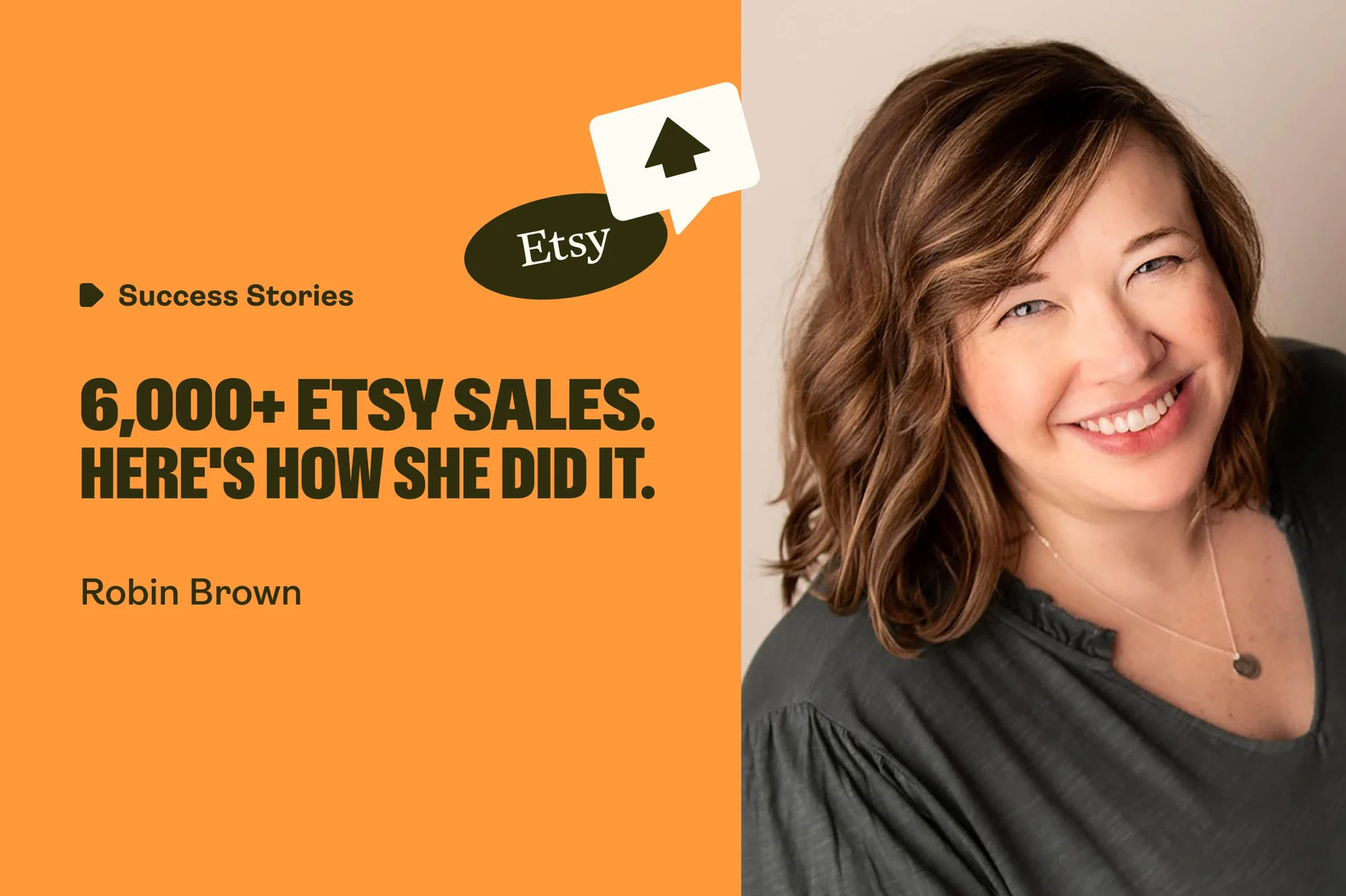
What happens when a graphic designer with no retail or marketing background decides to build an online business from home?
For Robin Brown, it started with a new baby, a decision not to return to her old job, and many questions about whether her creative skills could become a reliable source of income.
She spent months learning how Print on Demand worked before opening her Etsy shop in 2024. The first products taught her what not to sell. Then she found a product, a market, and a way of working that began to click. Let’s see how Robin figured it all out.

Leaving nonprofit IT to start selling online
Robin Brown spent close to 20 years working in youth development for a major US nonprofit. She started out working directly with kids, then shifted behind the scenes into IT and data management. She liked the work, but when her second son was born in 2023, priorities changed.
He arrived early and small. The family spent a month in the NICU before bringing him home, and after her maternity leave ended, Robin couldn't picture dropping him off at daycare.
"I've always been really creative. I studied graphic design in school, and I love making things myself," she says. "But I didn't know how to turn that into income."
Her husband found the answer before she did. He sent her an MSNBC article about a seller earning $400k a year with print-on-demand candles. He thought the products were mostly text and clean design work, and Robin already had those skills.
She googled Print on Demand that same week, compared companies, and landed on Printify. Then she joined the Printify Rockstars Facebook group and started reading. She read posts from months back, absorbing what sellers said about their wins and mistakes.
Starting with passion products and learning what actually sells
Robin had read plenty of advice telling new sellers to pick a niche they cared about. She took it literally. She and her husband had worked hard to pay off all their student loans and credit card debt, so she created her first products, including shirts, candles, and other designs celebrating being debt-free.
“My husband and I are passionate about being debt-free, so that was one niche. And I'm a data nerd who loves spreadsheets and numbers, so that was the other," she says. "I soon learned that although I love those things, other people aren't really looking to spend money in that area."
The products are still in her shop and are sold occasionally, but they didn't build the business. Robin laughs about it now, looking back at where her head was in those early weeks. The lesson stuck, though, that caring about a topic doesn't mean there's a market for it. She needed to find the gap between what she enjoyed making and what people were actually willing to buy.

Finding a product that finally clicked
She spent much of her first year reading, researching, and watching what other sellers were doing before she felt ready to open her shop. Looking back, she says the research mattered, but she waited longer than she needed to.
“I read and read for like a year. I read articles, I did my research, I looked at the Printify Facebook group and learned what people were asking and sharing in the group.”
She finally pulled the trigger in April 2024. And while all that reading was happening, one product caught her eye. Printify had added woven blankets to the Product Catalog, and Robin's design background made them feel like a fit.
"The woven blankets really attracted me. They only have a limited color palette, and I saw that as a way to design something really special, because a lot of people don't know how to design in only certain colors."
That constraint appealed to Robin because it gave her a design challenge she knew how to solve.
How research and product knowledge set her apart
Robin's data background shaped how she approached selling. Instead of guessing what might work, she built a research habit, using AI tools for market analysis, Pinterest to spot what buyers were searching for, and Printify's own Product Catalog to see which items were trending.
"I try to design evergreen products that are going to be popular all the time," she says. "But you still need to see what people are buying right now. It can inform your future designs and how to list them."
That’s how she approached woven blankets. The product rewards sellers who understand how the finished design will look in a real space, rather than treating it like a standard apparel print.
"I think what continues to set sellers apart with blankets and pillows is that they've learned how to design for that. It's less about clean lines and more about how the whole thing looks from across the room."

Why five-star reviews stick even when orders go wrong
Robin holds a five-star average across her Etsy sales.
With woven blankets, most issues come down to design and not the Print Provider. The colors shift differently from printed products, and if something doesn't look right, it's usually on the seller. Robin accepts that. When the problem is her own design mistake, Robin sometimes puts her own money toward making things right rather than leaving the customer with the problem.
"If you're willing to go above and beyond for your customer, you're going to continue to sell no matter what," she says. "Being willing to have a conversation with someone who's not happy or was confused about what they were buying is huge."
She tells her customers to message her directly before opening a claim. And it works. One buyer left a five-star review even after receiving a product they weren't happy with.
"They said they still kept it because the customer service was amazing."

Saturated products still sell if you know your buyers
Robin has watched woven blankets go from an Early Access product to a bestseller, and with that, the usual worry among sellers that the market is too crowded.
She doesn't buy it. She sells in one of Etsy's most competitive categories, apparel, and still has best-selling shirts in her shop. Saturation looks the same everywhere, and her answer to it is the same, too.
“If you know what people are looking for and you're continually keeping up with popular design trends and what people want, it can definitely help you."
Her take is that saturation only matters if you're making the same thing everyone else is making. Sellers who understand their product, can speak to it clearly, and keep their designs current will continue selling regardless of how many other shops carry the same item.
She also points to Printify's Catalog as a resource that sellers underuse. The platform already highlights trending products, and that data is available to anyone.
How Printify Choice cut costs and gave her time back
Robin came into Print on Demand with no preference for any specific Print Provider. She'd seen other sellers praise Provider names, but she hadn't built her own preferences yet. So when Printify Choice launched, she tried it with a shirt design and kept using it.
She ran the numbers. In March of last year, one of her bestsellers took off, and she did a full cost analysis comparing what she would have spent printing through individual Providers versus Printify Choice.
"In just that one month alone, I saved somewhere around six or seven hundred dollars," she says. "And that was just one product."
The savings went beyond price. Printify Choice picks the Provider and location automatically, which means Robin didn't have to spend time testing or comparing for each order. Out of roughly 4,000 items printed through the feature, her error rate stayed under 1%.
"I have a five-star average review, and I've sold over 6,000 items. I think 4,000 of those were printed through Printify Choice."

A customer's Etsy message that became a lasting collaboration
Robin makes it known in her shop that she's open to custom requests, no extra charge. She likes the design work, and she's found that listening to what buyers want can lead to better products. But one message turned into something she didn't expect.
A customer reached out to tell Robin she loved one of her designs and asked how she'd made it. Robin walked her through the process, which for that particular product involved seven different design tools layered together.
"We talked a lot about Printify and the market. Then she asked if I could create something she had in her head, and we worked together to design it," Robin says. "That shirt became one of my bestsellers."
Robin credited the customer in the listing. The woman has since opened her own shop, and the two now talk almost daily, trading ideas, sharing prompts for AI research tools, and building out their businesses side by side.
"She lives on a completely different side of the country. I can't believe I met her. She's also a mom of two boys, and we just speak the same language."
Running a shop around nap times and breakfast routines
Robin is the only employee in her business. She handles design, listings, orders, and customer messages, all while keeping up with a toddler. Time is the thing she has least of, and she's honest about how hard it is to manage.
"As someone with ADHD, I can get really focused on one thing and then for the next seven days have zero energy or desire to work on it," she says. "I just spent seven hours one night because I was really feeling it. Then nothing for a week."
Her mornings follow a set routine. She gets the kids up, makes breakfast, and while her oldest eats, she sits at her computer and approves orders. For her main shop, she approves everything manually because so many orders are custom.
She runs a couple of automated secondary shops, which let those orders process in the background without her involvement.

The one thing Robin would change if she could
If Robin could start over, she'd stop reading and start listing sooner. She knows the research mattered. It shaped how she picked products, approached design, and understood the market. But a full year of preparation before opening her shop wasn't necessary.
"I was so nervous to get the ball rolling," she says. "But what I didn't realize is that on Etsy, especially with a new store, they're not just going to throw your products in front of anyone. I could have been testing how things printed and how they sold while I was still learning."
She also wishes she'd taken SEO more seriously from the start. Understanding how to list products so buyers can find them is now a core skill for her, and she recommends that new sellers invest time in learning it early, whether through free resources or a paid course.
Where Robin's business goes from here
Over 6,000 sales, a five-star average, and a product line she genuinely enjoys designing. But Robin knows Etsy is one channel, and she's already thinking about what comes next.
"Expanding my selling platforms is going to be huge," she says. "Now that I've built a customer base on Etsy, I want to move to different integrations like Shopify and see how others have been successful in those spaces."
She had planned to make the move in 2026. Whether the timing holds or not, she wants to take what's working and put it in front of new audiences.
Robin doesn't come from a retail or marketing background. She figured this out by doing it, and she's happy to tell anyone who asks exactly how she got here and how Printify made it easy.
If Robin's story has you thinking about starting your own print-on-demand business, head over to Printify and start creating today.
