

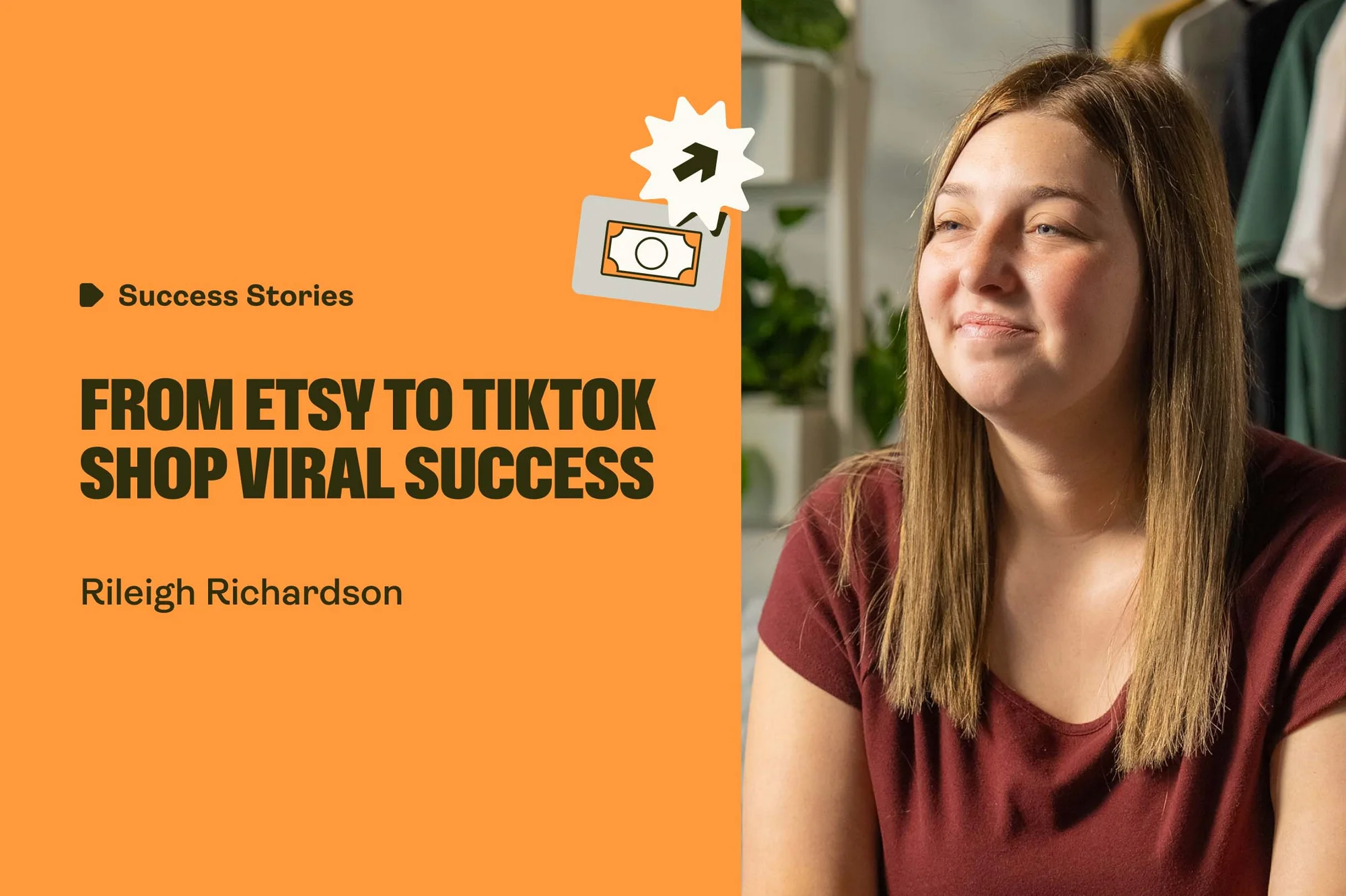
Rileigh Richardson once blocked the TikTok Shop hashtags so she wouldn’t have to see them. Now, TikTok Shop is one of the platforms she sells on, alongside the Etsy shop she started in college.
Nearly four years later, her print-on-demand business has grown to multi-six-figure revenue across several shops, and it’s her full-time job. It took years of trial and error to get there, but today, she mentors other sellers.
Here’s how she built it, and the mistakes she hopes you’ll never have to make.
A broke college student looking for a way to earn money
Rileigh started her print-on-demand business because she needed money. She was studying abroad on a scholarship and had almost nothing left after covering the basics, so she started scrolling TikTok for side-income ideas.
A video from YouTuber heatherstudio introduced her to Print on Demand. The idea quickly clicked for her. Rileigh was working toward a media studies degree and already used Canva for her classes. In high school, she’d also competed in t-shirt design events.
“I really liked design and creating, so it felt like a natural next step. I just fell in love with the idea,” she says.
She opened her Etsy shop almost right away. She had little money for travel or going out, so she had time to spare and spent hours on the shop every day. She eased off a bit after moving back to the US.

Finding her footing in Etsy’s competitive niches
Like many new sellers, Rileigh learned the basics on YouTube, where creators talked about in-demand trends. The catch was that everyone watching went after the same ones.
“If you’re only doing those exact trends without combining them with anything else, you can really struggle.”
Her design process back then was simple. She’d find a cute graphic on Creative Fabrica, a site she still uses, and put her own text on it. Some of those graphics were built around real demand, and some weren’t, so the approach worked occasionally but not consistently. Her listing plan was to publish as many items as she could, even though most sold only once or twice at best.
Soon, after a tip from Cassiy Johnson’s YouTube channel, she made a groovy retro design in Photopea with three wavy, multicolored lines of text. It eventually sold close to 100 times, but those sales came almost a year after she listed it.
“It sold because it was based on a trend and on research,” she says. “I just didn’t understand that at the time.”
Throwing spaghetti at the wall with broad and tiny niches
At first, Rileigh tried a bit of everything to see what stuck, starting with teacher and nurse designs, two huge markets with plenty of buyers.
“If I’d stayed consistent, I think I would have seen success,” she says. “But my design strategy was bad, so I didn’t.”
She then switched to tiny career niches most people have never heard of. She led several of them with little competition, but they generated only 10 to 30 sales per month.
Next, she targeted low-competition keywords that appeared to be high-demand, which she now counts as another misstep. One of them was a bachelorette term she liked, but the design didn’t sell. Rather than drop the idea, she tried a different bachelorette keyword, and one item started selling almost right away. It was the first listing in her shop to take off like that.
Not every batch after it worked, but she kept going.
“Sticking with it, adding birthdays and improving my designs, almost two years in, is when I started seeing a lot more success,” she says.
Today, her main Etsy shop sells customized birthday and bachelorette items, mostly apparel, with Comfort Colors shirts as her top seller, plus some decor.

Learning to spot the designs people actually want
These days, Rileigh’s research starts on Etsy itself. She spends a lot of time on the marketplace side rather than her own listings, browsing like a shopper. She focuses on large niches, since trends usually show up there first, and studies PNGs, t-shirts, and decor to identify which details keep coming up.
“I break it down into patterns,” she says. “What kind of fonts are selling? What layouts? What styles? Is there distressing on them? Is it a specific color scheme or a specific mockup?”
Once she notices the same elements repeatedly, she combines them and applies those combinations to niches where the trend hasn’t arrived yet.
The method means she isn’t copying any single design. Each piece she makes is new, but it’s built from details buyers respond to, and it goes into a space with less competition.
“I’ve watched a lot more YouTube videos since then, and now I understand a lot more about why items sell and how to create the items that sell,” she says.
Why she gave TikTok Shop a chance
About three and a half years into selling on Etsy, Rileigh’s success manager invited her to a conference in Dallas. She’d gone full-time with Print on Demand that January, so she went to network.
She had been deliberately avoiding TikTok Shop content on the app. But hearing sellers like April from Poppy Rose speak changed her mind. Her Etsy sales had plateaued, and TikTok’s reach appealed to her. She’d also built systems that worked for her business, and leaving a job that took 40 hours a week, sometimes 50 or 60, freed up time to expand.
Her TikTok Shop goes beyond her Etsy niche, selling women’s t-shirts to a broader audience, plus a few woven blankets.
“You still need in-demand designs, good listings with nice mockups and solid pricing, so the bones are the same,” she says. “But on a social platform, you rely a lot more on affiliates and content. So rather than creating hundreds of listings, I’m creating hundreds of videos.”
Her own videos mattered too, especially early on.
“You are your best affiliate,” she says. “You know why the product was created, the research behind it, and who your customer is.”
Watching strong affiliate content has steadily improved her own videos.
Choosing affiliates with numbers and a bit of gut instinct
A free shirt costs Rileigh about $15, so she wants each one to go to someone who will post it more than once.
“If they can post it five, ten, 15 times, then I can see a lot more success,” she says.
Early on, almost everyone who asked got a shirt. Now that she’s past 1,000 sales, she’s much pickier, and she can measure some of what she checks. She looks for creators who’ve sold more than $60,000 in GMV (gross merchandise value) as affiliates in the last 30 days.
She also checks their post rate, which shows how many of their samples they actually post, and she wants it to be at least 80%.
“If they don’t post it, even if they’ve sold $1 million, it’s not going to sell,” she says.
She also needs creators who sell products like hers. Someone who's sold 100,000 protein shakes won’t necessarily know how to sell a t-shirt.
The rest comes down to gut instinct. She wants people who make high-quality content, stay engaged, and are willing to back a small business for the long haul.

The TikTok video that brought in $20,000 in sales
Rileigh recalls filming a video for herself predicting that one day her phone would blow up with sale after sale. Within about ten days, that’s what happened.
She had just finished a live with around 15 sales and was showing her father-in-law the dashboard.
“He said, ‘That’s not 15 sales, that says 65!’” she remembers. “I kept refreshing. 65, 70, 75, 80.”
She assumed the sales were for her bestseller, Easy Peasy Lemon Squeezy. They were actually for Bad Day to Be a Hot Dog, a tee that had sold fewer than 20 times up to that point. By midnight, it had 106 orders.
The video behind it was simple. An affiliate laid the shirt on her bed and kept touching and folding it while urging viewers to grab their 4th of July shirt before it sold out. Rileigh has since learned that motion like this keeps viewers’ eyes moving across the product.
The creator posted the same script four more times, and three of those videos reached 1 million, 750,000, and 250,000 views. Over about ten days, the tee brought in $20,000.
Learning TikTok Shop’s order caps and payout rules the hard way
Rileigh soon ran into TikTok Shop’s daily order cap. At the time, her shop had delivered 99 orders, and she thought the cap was 100 items a day until she reached 100 delivered orders.
The limit didn’t reset over the weekend either. She sold 100 a day until her delivered orders reached 199, which raised her cap to 200, and that sold out by 11 o’clock. Meanwhile, the creators who had her samples kept posting.
The payout timing caught her off guard too. TikTok Shop pays sellers 30 days after an order is delivered, but production must be paid immediately. By then, she had sold around 800 of the tee, and she ended up covering production for close to 1,000 shirts, about $15,000. That came on top of roughly 600 free samples at $15 each, and she maxed out her credit cards to keep orders moving.
With no room left to cover more orders, she turned off her sale and her ads.

What her first viral product taught her about TikTok Shop
When Rileigh went over the numbers afterward, she found the viral week had barely turned a profit. She set a 15% affiliate commission on the tee and also ran ads on the creator’s video.
“I didn’t realize your ad commission is supposed to be lower than your regular commission,” she says. “So this creator was getting about twice what she should have per shirt.”
Returns followed. The creator called the tee embroidered, but it was faux embroidery. The description said "faux," but the title didn't. Some buyers requested refunds, and a couple left negative reviews.
As her shop performance score slipped, she avoided the Seller Center and was slow to decline two return requests. Because those were the only cases on her account, her customer service rating fell below one star, and she lost affiliate access for a few weeks.
The TikTok Shop mistakes she wants other sellers to avoid
Rileigh is open about what went wrong in her first months on TikTok Shop, and two mistakes stand out beyond the fee and policy surprises.
The first was overconfidence. She had built a steady Etsy business and assumed TikTok Shop would come naturally.
“I thought I was just putting on a TikTok hat. I didn’t realize there’d be a marketing hat, an affiliate hat, an ad hat, all these hats I’d never thought about wearing.”
The second was letting emotion decide who got samples. She wanted to give every creator a chance, so she sent out around 400 Easy Peasy Lemon Squeezy shirts and only about 50 Bad Day to Be a Hot Dog shirts. The hot dog tee went viral because one shirt reached a creator who had sold over $100,000, not smaller creators in the $500-$1,000 range.
“The 80/20 rule applies to affiliates, too,” she says. “If a creator sells $50,000, $40,000 of that could come from my product. If they sell $50, it’s $40.”
She still works with some smaller affiliates, since they can grow. Most of her samples now go to creators who have proven they can sell.
Mentoring other sellers on Printify
When Rileigh was about two years into selling on Etsy, someone from Printify approached her about a then-new mentorship program, Sellers Club. She ran weekly classes, put together trend reports, and went live with members.
Her favorites were the research and design classes. In those, she walked through what’s trending on Etsy or TikTok, showed how to pick out the in-demand elements, and then turn them into new designs. The hot dog tee came out of her May Trend Report and May Design With Me sessions.
“Sellers Club members got to watch me design, live, an item that went on to sell 1,000 times the next month,” she says. “That’s really special to me.”
The mentoring also gave her something she missed early on. Print on Demand can be isolating, especially when you’re making mistakes, and most people in her life don’t understand eCommerce or why an item sells.
“‘I helped that person make their first mockup,’ or ‘I helped them improve a design.’ It’s really rewarding to be part of that,” she says. She is excited to continue her mentorship collaboration with Printify in the near future.

Why she’s still betting on TikTok Shop
Her first few months on TikTok Shop were demanding. From April to September, Rileigh posted three to five videos a day and went LIVE once or twice a week while still running her Etsy shop. One Halloween LIVE ended early when TikTok flagged her bingo board for gambling, even though nobody paid to play and the prize was an official TikTok giveaway. Not long after, she took two weeks off.
“I needed a refresher,” she says. “When I came back, I thought, ‘Okay, I can do this, and I know the things to avoid now.’”
She’s watching for the next big moment again. One of her Halloween designs has a curated badge from TikTok, sits in more than 100 carts, and already has a couple hundred creator videos.
Despite the setbacks, Rileigh still sees potential in TikTok Shop, particularly for print-on-demand sellers who have hit a plateau on other platforms.
“If I can help just one person learn these lessons the easy way instead of the hard way, I’d love to do that,” she says. “And if I give up now, I’m not going to be driving my dream car next year because I quit too early.”
Rileigh started with some Canva experience and a scholarship budget, and you don’t need much more to begin. Sign up with Printify for free and browse the Product Catalog to start your own print-on-demand business.