


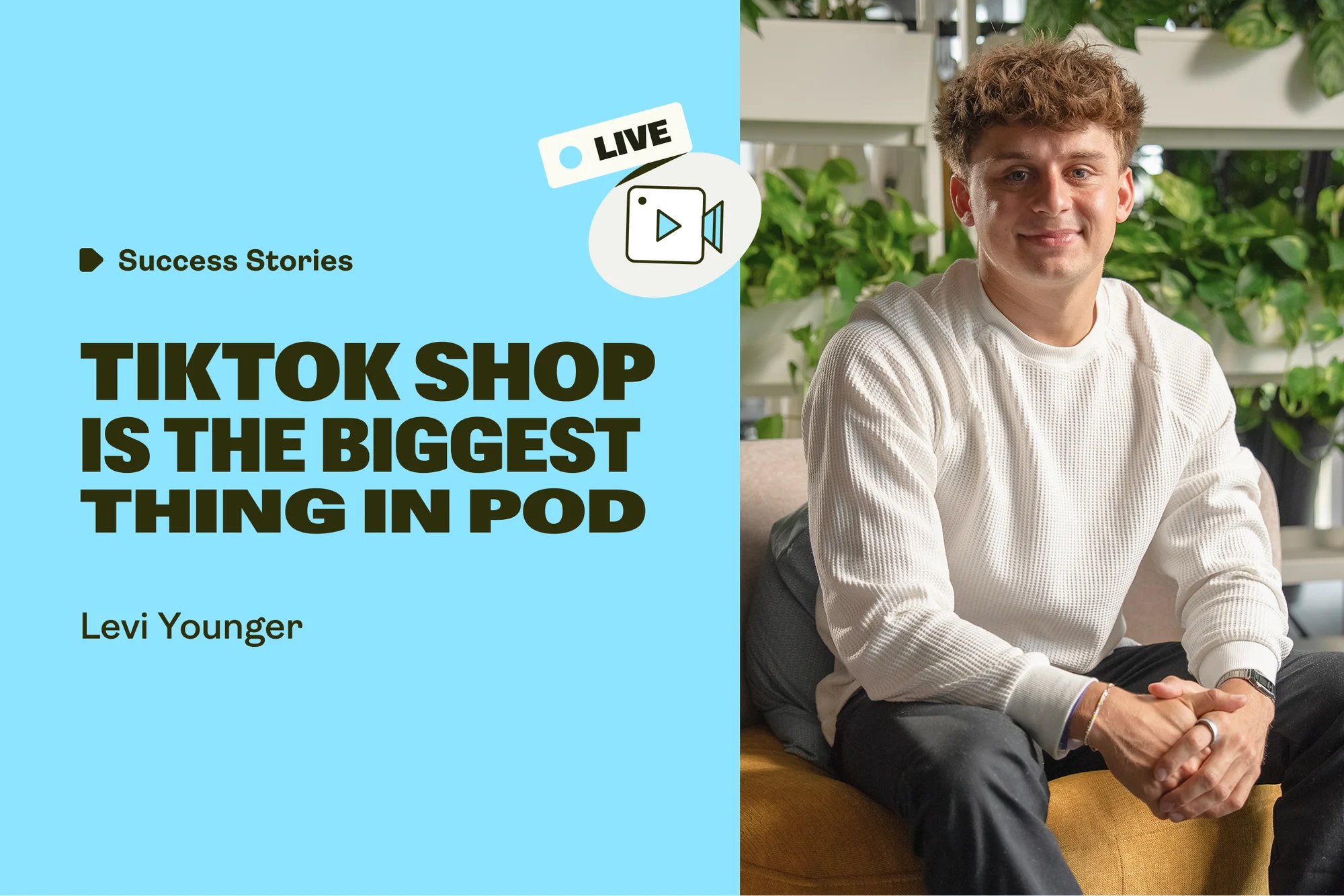
Levi Younger didn't set out to build a brand on TikTok. For a while, he didn't even want to sell there.
His business started in college as a way to earn on the side, and it changed shape more than once before it found its footing. He worked with college athletes, rethought what he sold when sales went quiet, and eventually stepped in front of a camera he'd avoided for months.
Today, Levi runs Launch Club and mentors new Printify sellers who want to build profitable brands on TikTok. Here's how he got there.
From a COVID family challenge to custom merch for college athletes
Levi Younger grew up about an hour north of Seattle in Washington state and now lives in Austin, Texas. When COVID hit, and school moved home, his dad decided the extra time wouldn't go to waste.
"He told us, 'If you're going to be at home instead of going to school, I want you guys to learn something,'" Levi says.
His younger brother chose Spanish. His older brother picked Python, and even his mom started learning the piano. Levi chose eCommerce, and he stuck with it even after he left for college in Texas.
NIL deals had just started then, so college athletes could earn money from their name and image.
“I'd make them their own custom merchandise, and then I did a deal with them where if they posted on social media, promoting this signature item that I made for them, for every sale they made, they would get a cut of the profit.”
A quiet summer and the birth of Launch Club
But the athlete deals came with a built-in limit. They depended on the sports calendar, and Levi found out what that meant once the school year wound down.
"When summertime hit, there were no sports going on at my college anymore, and I wasn't really getting any sales," he says. "So that's when I started doing trends. And that was the birth of Launch Club."
The change moved his products away from individual athletes and toward what people in general were buying.
"Launch Club is something I started in college, and it began as just a side hustle," he says. "I was studying financial technologies, and at the same time, I was running my business the whole time until I graduated."
For sellers, there’s a takeaway. When most of your sales depend on one season, audience, or partner, a quiet stretch can stop the business cold. Levi's answer was to widen what he sold rather than wait for the next season to begin.

Why Levi was hesitant about TikTok Shop
In the early days, Levi didn’t treat TikTok as a place to sell. He posted about his products, worked to build views, and pointed people to the link in his bio, which took them to his Shopify store.
"I used TikTok as just a marketing engine," he says.
Once TikTok Shop launched, his videos stopped getting the same reach. Levi had his own theory about the drop.
"I think TikTok didn't want me taking people off their platform."
Even so, he wasn't ready to join.
"There was a lot of bad context around TikTok Shop back then," he says. "People kind of viewed it negatively, and I didn't want my brand to be associated with that."
TikTok didn't give up on him, though. "They would consistently reach out to me, like, 'We want you to join TikTok Shop. We want you to be selling on our platform."
After enough of those messages, he signed up.
From faceless slideshows to the face of Launch Club
Joining TikTok Shop didn't mean Levi was ready to put himself on camera. He kept his promotion simple and stayed out of view, posting nothing but slideshows for roughly the first six months.
The approach still worked. His very first product on the platform sold thousands of units, and his doubts started to fade. "I was like, 'Maybe it's not so bad being on TikTok Shop.'"
Then TikTok Shop removed slideshows as a product option. Levi thought about quitting to focus on school, but decided to try one video first.
"One of my very first posts got millions of views, and I sold thousands of products."
The result caught Levi off guard. Until then, Launch Club had been a side hustle he enjoyed, but he hadn’t thought of himself as someone who needed to be part of the brand.

Selling to people like yourself
Deciding what to sell is one area where new sellers may get stuck. Levi's answer starts close to home, and it's the advice he always gives people looking to sell on TikTok Shop.
"The easiest way to sell is to someone like yourself," he says. "You know yourself better than anyone else. You know your interests."
At first, his product research came from his own social circle. He listened to what he and his friends talked about, and when a topic came up more than once, he treated it as a lead.
These days, he also runs data and product research across different platforms. He agrees that replicating what's already working is a fair way to get started, but he doesn't think sellers should stop there.
"Pretty soon, you need to realize what your audience is looking for, and they're probably looking for the same things you are," he says. "When you learn how to create your own trends, you can build a much larger catalog of products that are unique to your store. That's how you stand out from every other seller."
Turning comment requests into products and content
Levi runs a few different content strategies, and they all pass the same test. He looks for formats he can keep producing week after week, because TikTok favors creators who post consistently.
His comment section handles a lot of that. Viewers ask about his products or request new ones, and Levi responds.
"When people comment asking about products or asking me to create new ones, responding to them means I always have new creative products in the funnel," he says. "And when you reward people for commenting by responding to them, it encourages more people to comment."
His other go-to format is modeling his own products. It's easy to film, and he can repeat it as often as he needs. Levi believes it works for a simple reason.
"What resonates with people is when you're actually interested in your own products."
For sellers short on ideas, the comment section is a good place to start. Buyers are often already telling you what they want.

The customer care work buyers don't see
From the outside, a growing TikTok Shop store looks like views and sales. Levi says the part people rarely picture is everything that happens after a buyer checks out.
"Something people don't see from the outside is the communication with customers," he says. "I sell hundreds of products, sometimes every day. That's a lot of customers."
He compares it to a physical store. If hundreds of people walked through your door each day, you'd expect to spend much of that day talking to them. Selling online doesn't remove those conversations. It moves them to a screen, where they're easier to underestimate.
"When people are buying things through a screen, you still have to make sure they're happy with their orders, that they're getting the products they ordered, and that everything fits them correctly," Levi says.
So, it helps to plan for this before sales pick up. When order volume jumps, questions about delivery and sizing jump with it, and those buyers expect the same care whether they're your tenth order of the day or your 300th.
Judging progress by daily inputs instead of monthly revenue
Levi is open about the emotional swings that come with running a business. In his experience, an entrepreneur's mindset tends to jump between two extremes.
"It's either 'Wow, I'm killing it!' or 'I'm going to fail, and I'm going to have to quit,'" he says.
He stays level by judging himself on the work he puts in rather than the numbers that come out. A big month feels good, but he doesn't let it decide whether he's on track.
"Even if you have a $10k month or a $100k month, that can't really be what you hang your hat on. It needs to be the inputs you're putting in every day," he says. "If you're consistently making new products you're confident in and marketing them to the best of your ability, that's all you can control."
Keeping those inputs steady meant tradeoffs in college. Levi double-majored and was part of a fraternity while running a growing store.
You have to be willing to burn the candle at both ends or say no to something socially, so you can keep working on your business. That's been the secret to success for me," he says.

Why Levi sees TikTok Shop as a high-traffic storefront
For Levi, expanding your existing business to TikTok Shop is mainly about getting closer to where people are already spending their time. He started on Shopify and later added TikTok Shop, seeing the platform as a way to reach more people.
His comparison is simple. A seller could set up a lemonade stand somewhere hardly anyone passes, and maybe a few people pass by each day. Put the same stand on a major highway, and millions of people drive past.
"That's what TikTok is," he says. "There are millions of people scrolling on TikTok, whether you're selling on there or not, and capturing that audience has almost no ceiling."
The buying process is the other half of his case. A shopper used to see an ad, click it, land on a website, and then check out. On TikTok Shop, they can buy straight from a video in one click.
The platform has also changed since he joined. Early on, TikTok subsidized reach and paid to ensure people saw sellers' content. Now, ads do much more of the work, and Levi reaches buyers by promoting his own content and his affiliates' videos.
Giving back by mentoring new Printify sellers
Printify has been part of Launch Club since the early days, and Levi credits it with much of what he's built. "Printify has been a huge reason for my success," he says. "It's the manufacturer that helped build my business from the ground up."
He was also early to pair it with TikTok Shop. When he first connected the two, few sellers had tried it, and he couldn't find anything that explained the process.
"Nowadays, there are so many resources that show you exactly how to do it, step by step. The whole process has been built out so well that it's super easy," he says. "You could connect Printify to TikTok Shop in probably 30 minutes or less."
Printify noticed his growth and reached out. "They told me, 'What you've done is very special, and you can have a large impact on people,'" Levi says. With texts and DMs coming in from people hoping to earn even $1,000 extra per month, mentoring felt like the right way to give back.
His focus with new sellers is mindset. He encourages them to learn the skills one by one, from creating products to running ad campaigns.

Where Launch Club goes next
Launch Club is an apparel brand today, and most of what Levi sells is t-shirts and hoodies. He doesn't expect it to stay that way.
"When I look into the future for Launch Club, I see an expansion in a lot of ways," he says. "Number one, I see an expansion in products. In five years, I could see Launch Club selling all different types of products."
He already has a short list of where he'd like to go, and it comes from his own shopping habits.
"My favorite things that I often purchase are sunglasses, backpacks, hoodies, and sneakers," he says. "So I'd love to expand into some of those categories and grow Launch Club into something more than it is today."
Moving from a core apparel line to accessories is a step many sellers consider once their main products sell steadily. Levi's list is short and specific, which makes it easier to add one category at a time and see how his audience responds before taking on the next.
3 Things Levi would tell himself on day one
After starting Launch Club as a side hustle and continuing to build it through college, he has three things he would tell his younger self.
The first is about timing, and he uses an old saying to make it.
"The best time to plant a tree was 20 years ago. The second-best time is today," he says. "If in ten years you see yourself running a business, then it's up to you to start that today."
The second is about effort. Sales will rise and fall, and Levi thinks it's a mistake to wait for a slow stretch before working harder.
"There are ups and downs, so don't wait for a downtime to give more effort to what you're doing."
The third is about belief. "What you invest your time in is just like investing your money in a stock or a bond," he says. "If you're selling on a platform, you should believe in that platform."
Levi planted his own tree at the family table during COVID, with nothing more than an assignment from his dad. Today, it's an apparel brand with its own following and a founder who spends part of his week helping other sellers get started.
If Levi's story has you picturing a brand of your own, create a free Printify account and connect it to TikTok Shop. You can plant your tree today.
