

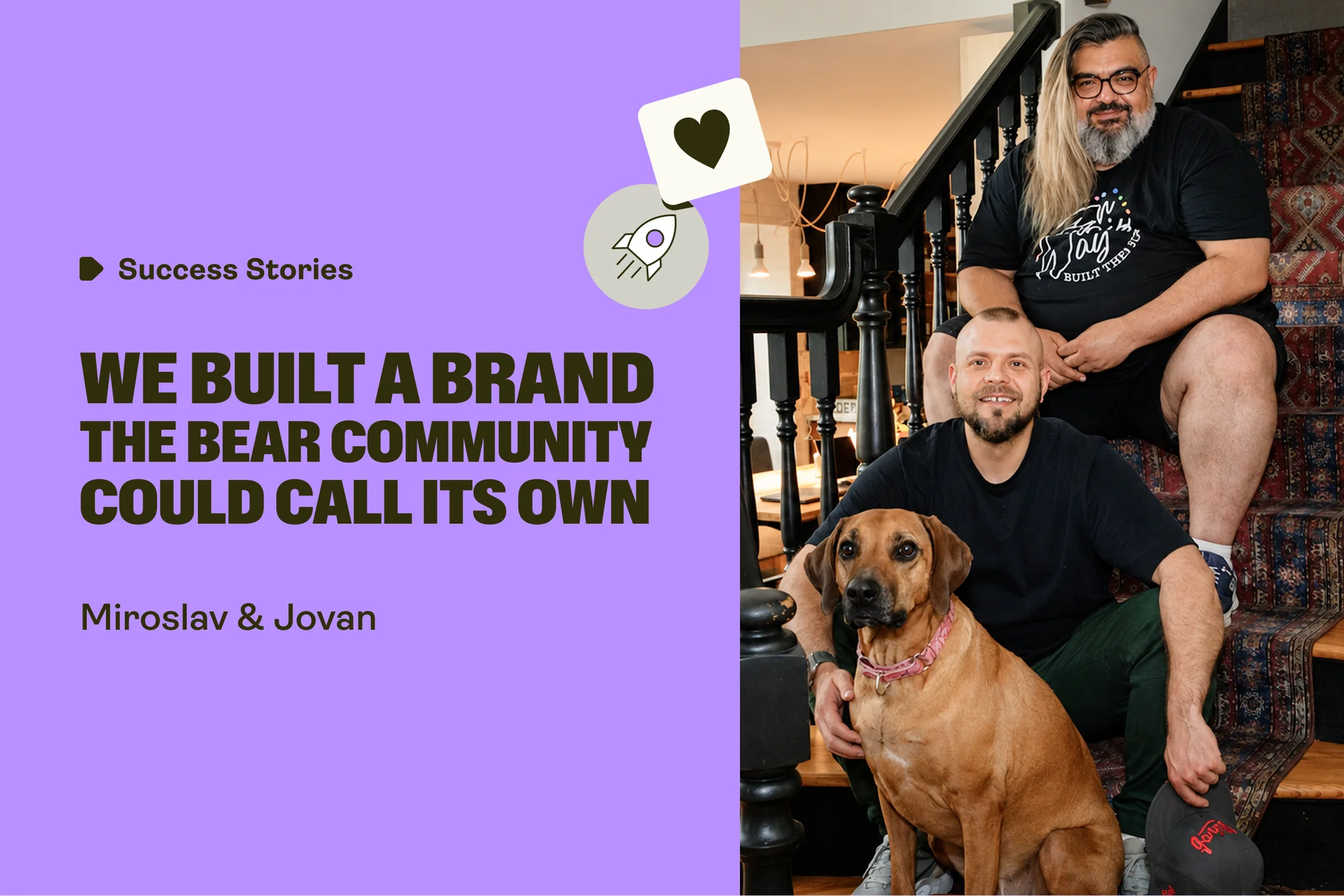
Jovan handles numbers. Miroslav handles designs. Together, they built Bearly Tees, a print-on-demand apparel brand made specifically for the gay bear community, with flat pricing across all sizes and designs.
It took a test shop, a course, several months of losing money on ads, and one unexpectedly viral t-shirt to get there. But less than a year in, they got over 350 five-star reviews.
This is the story of how the duo built a brand for a community that deserved more than predictable bear-themed designs.
Building a business around skills they already had
Long before they launched their store, Jovan and Miro knew they wanted to build something of their own. The challenge was finding an idea that felt worth pursuing.
"We had an idea of starting an online shop for a long, long time, but we never came up with the right idea and product that we would offer to customers."
Their professional backgrounds couldn't have been more complementary. Jovan spent most of his career in customer service and customer success, while Miro worked as a graphic designer and creative professional.
"Miro is the artist of the family. I'm the accountant of the family."
At the time, neither of them knew where those skills would eventually lead. They only knew they wanted to create something together.

The shop that taught them what not to sell
Before launching Bearly Tees, Miro spent years building an art business from the ground up. He created digital artwork, set up an online store, and learned eCommerce largely through trial and error.
Around the same time, the pair enrolled in Chris Heckman’s eCommerce and print-on-demand course to better understand how the business worked. Following the framework, they launched a coffee-themed t-shirt store. The experience was valuable, even if the concept never felt quite right.
"It was a very wide and very saturated market."
The store helped them learn the mechanics of eCommerce without the pressure of getting everything perfect. By the time they were ready to move on, they had a clearer understanding of what they didn't want to build.
Finding a niche design that starts conversations
The pivot came from a simple question – why not sell something we actually know? For Miro, the connection was personal.
"I'm a bear, so it felt kind of natural to make a gay bear t-shirt shop."
The more they looked at what was available for that community in the POD space, the clearer the gap became.
Most designs were some version of the same thing – a bear head in the colors of the bear pride flag. Repeated across shop after shop, with little variation and even less originality.
Miro says, "We were thinking, let's make this fun. Let's give it a double meaning, a hidden meaning."
A lot of the Bearly Tees catalog is built on humor with a deeper layer underneath. The kind of design that works on two levels – something you get right away, and something you only catch after a beat. Bears in the community are, as Miro puts it, expressive. They're not shy about who they are. The designs reflect that.
This approach separated them from the bulk of what was already out there. The result? Customers kept saying that their shirts were starting conversations in supermarkets, at events, and with strangers.

The pricing principle that built the brand's foundation
While researching the space, Miro kept running into something that bothered him – brands charging extra for plus-size t-shirts. They decided Bearly Tees wouldn't do that. Every t-shirt, regardless of size, would cost the same.
"We truly believe that's wrong," Jovan says. "We don't think you should charge somebody based on their body size."
It wasn't a marketing angle they landed on after some planning session. It was a decision about values they made early and built the shop around. Printify's Catalog made it practical. The sizing range was there, and the economics worked.
For a brand selling to a community where body acceptance is central, it also held them to a standard. Every product they stocked had to be available across the full size range. If it wasn't, it didn't go in the shop.
Customer feedback as a growth strategy
From the beginning, Jovan built a system for listening. Every customer who made a purchase received a survey asking about the product and the shop experience.
When feedback came in through reviews or direct messages, Miro would act on it quickly, whether that meant adjusting a design, fixing a placement issue, or reconsidering a product.
"We constantly listen to the community. Invested so much time and effort in building so many tools on the back-end of things to gather information about how people react to certain things," Jovan says.

When a customer mentioned that a print wasn't centered correctly, Miro would fix it as soon as possible. The reviews that followed started consistently mentioning two things – the quality of the product and how many compliments people were getting on the vibrant designs.
In less than a year, Bearly Tees received 350 five-star reviews.
Learning marketing the hard way
While the creative side of the business came naturally, marketing was an entirely different challenge.
Like many first-time store owners, Jovan and Miro had little experience with paid advertising. Running campaigns and understanding how advertising platforms worked took months of experimentation. Along the way, they tested different approaches and gradually developed a better understanding of what drove sales.
At one point, they brought in outside help to manage their Meta campaigns. Rather than treating it as a hands-off solution, Jovan used the opportunity to learn by observing how campaigns were structured and optimized.
"I learned by watching what they do, and I started to understand how Meta actually works."
They learned that guidance can shorten the learning curve, but building the business still requires time and persistence.
When the numbers started making sense
The shift toward meaningful sales happened gradually, over months of tightening the ad structure and getting clearer about which products were actually worth promoting.
By early 2025, both shops (Bearly Tees and Miro's separate art shop, Mirror on the Wall) had become Miro's primary source of income. For Jovan, it remained a serious side business alongside his day job.
Then, in January of that year, a moment they hadn't planned for came. Miro designed a t-shirt, posted it on social media without any expectations, and the community responded immediately. The shirt has since gained nearly 1,000 sales.
"It's interesting," Miro says. "Some designs you invest a lot into, thinking people will love them, and they don't move. Then something you weren't expecting just takes off."

The operational work customers never see
While shoppers see a polished storefront and a growing catalog of designs, much of the effort happens behind the scenes. Product setup, artwork preparation, sizing, branding decisions, and catalog management all require attention long before something is ready to sell.
Miro understood that firsthand from running his art store, where he had built a catalog of hundreds of products.
"I have 700 products, and my prints have three sizes."
Managing that volume wasn’t easy, with different products requiring different specifications and even small details demanding careful planning. Miro separated artwork and signatures into different layers so he could adjust them for various print sizes without rebuilding each design from scratch.
For Bearly Tees, sizing scales automatically on the platform. But branding the product still required decisions. For example, they added an inner neck label to every shirt, which meant thinking through how that label would look on each product. When tank tops didn't support inner label printing, they moved the branding to the front, and it worked.
"If we're building a brand, it needs to be branded."
Why every product had to earn its place
Before launching products, Jovan and Miro order samples and evaluate them firsthand.
"We didn't put out any product before getting the samples and seeing something we can stand behind."
Hoodies performed well throughout winter and received strong reviews, partly because they came in plus sizes at the same flat price. Hats with embroidered designs were another category they tested thoroughly.
Miro washed samples repeatedly and put them through conditions that most customers wouldn't. "I want to know what happens when you put something into a dryer six times."
Once a product hit the storefront, it was something they could stand behind.

Treating customer service as part of the product
When a customer once realized their shirts wouldn't arrive before a bear event they were traveling to, Jovan asked where they were staying and sent complimentary shirts to the hotel.
Their return and exchange policy is written to be generous, but in practice, customer service goes further than that. When someone orders the wrong size, Jovan and Miro tell them to keep the original shirt and give it to someone who'd appreciate it.
"We always tell our customers, just reach out and tell us what happened, and we'll figure it out."
There have been difficult customers, too – a handful across thousands of orders. One customer placed 10 different sizes of a product and then expected the same flexible return process they might get from a large retailer.
Jovan's view is that those situations teach you where your policies need to be clearer. They're not worth losing sleep over, especially when the overwhelming majority of the community has been genuinely warm and supportive.
More time on the brand, less time on the backend
Neither Jovan nor Miro came into Print on Demand with experience using fulfillment platforms. What stood out to them was how quick it was figuring out the platform itself.
"One thing that we didn't have to think a lot about was Printify, because it was so easy to go through everything and set it up."
As the business grew, reliability became just as important as ease of use. On the rare occasions when there were issues with products or print quality, they knew they had support behind them.
"Whenever there's an issue with the quality of the print or product damages, the Printify team quickly jumps in and takes care of things. It’s good to have partners that are actually supportive," says Miro
Jovan's appreciation came from a different perspective. As the person reviewing the business numbers every morning, he relies heavily on reporting and analytics to understand what's happening across the store.
Printify Insights makes this easy. "The fact that I can pull any number that I need in literally five seconds is absolutely phenomenal."

What they'd tell themselves on day one
Ask Jovan and Miro what they would change if they were starting again, and neither points to a major strategic mistake or missed opportunity.
They understand their customers better, have stronger marketing knowledge, and know far more about running an eCommerce business than they did when they launched. But those lessons were earned through the process itself.
The biggest change for Jovan would be less practical and more personal.
"I would be more relaxed. I would believe more in our design."
Like many founders, he had moments when he questioned whether customers would connect with the products the way he and Miro hoped. Their advice for those moments? Believe in the idea and keep going.
A message to the bear community
When asked what they'd say directly to the community they built Bearly Tees for, both Jovan and Miro answered without hesitation.
Jovan went first: "Be yourself, be brave, and enjoy your body as it is. It doesn't come in one shape. Just free yourself. You're loved, and you are enough."
Miro talked about what the community taught him. Coming from outside it, he wasn't prepared for the level of self-expression he'd find there. Bears who are completely at ease, who wear it loudly and don't apologize for it. He says that changed something in how he sees the whole project.
"People are so expressive of who they are. I think that's the amazing thing about the community. It's the acceptance, and the presence of being who you are and looking the way you look, and being just great about it."
That's the shop, really. Two people, the right skills, and a niche they actually belonged to. The rest, as the five-star reviews will tell you, took care of itself.