

Printify sellers picking a decoration method for a new product usually land on the same short list of questions:
- How does the price change at different order volumes?
- How many washes will it hold up through?
- Will this artwork look good on my chosen fabric?
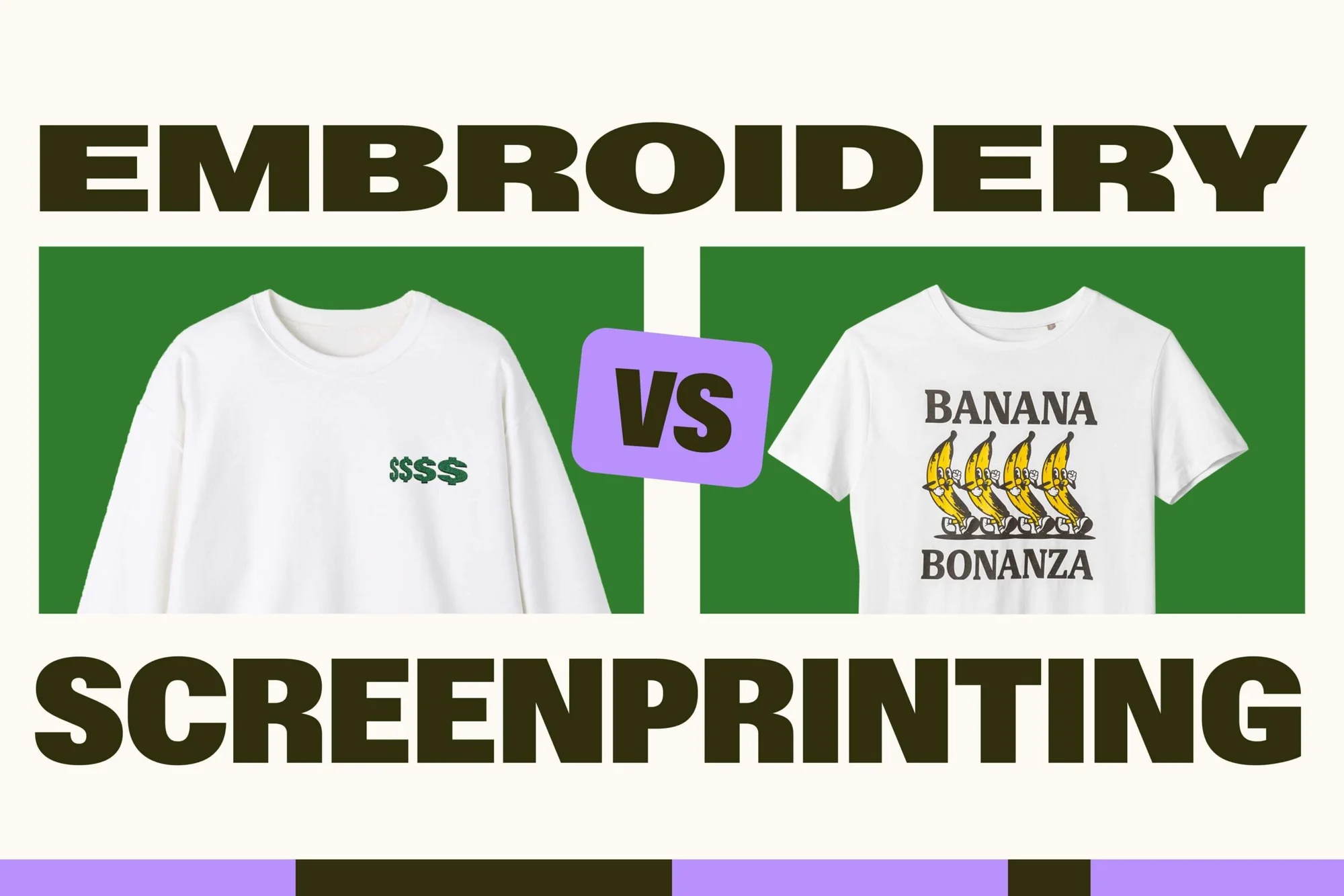
The answers depend on whether you opt for embroidery or screen printing, since one builds a design by stitching thread into the garment, and the other prints ink onto its surface.
This article walks through how each process works, then breaks down cost, durability, and fabric choice to make the right printing method clear before placing an order.
Key takeaways
- Screen printing pushes ink through a mesh screen and works best on flat, lightweight fabrics like t-shirts and tote bags.
- Embroidery stitches thread directly into fabric, producing a raised texture suited to polos, caps, and jackets.
- Screen printing becomes more cost-effective as order volume grows, while embroidery maintains a steady per-piece price regardless of quantity.
- Embroidery generally outlasts screen printing after frequent washing, while screen printing handles complex, multicolor artwork more easily.
How embroidery works

Embroidery is a technique that stitches thread directly into fabric, building the design into the material itself.
The stitching process starts with digitization, converting artwork into a file that informs an embroidery machine where to place each stitch, in which direction, and at what density. Digitizing is typically a one-time fee that carries forward when merchants reorder the same design later.
The machine then builds the design stitch by stitch, layering thread into a raised texture that stands above the fabric.
Pricing scales with stitch count, but the number of thread colors used adds no extra charge, so a small chest logo costs far less to run than a large jacket-back design. Embroidery works especially well on thicker fabrics such as polos, caps, and outerwear, where the material anchors the stitching without puckering.
Custom embroidery designs look best when simplified, since dense stitching struggles to capture fine text or photographic detail. Embroidery threads come in dozens of shades, so you’re free to create super colorful graphics.
Embroidered logos suit chunky lettering, simple shapes, and intricate patterns rendered in a limited palette, and they offer a professional appearance that ink alone cannot fully replicate, thanks to the raised texture they leave on embroidered garments.
Tip
New to the method? Printify's beginner's guide to embroidery breaks down how stitching, digitizing, and thread selection work before you place your first order.
How screen printing works

Screen printing, also called silk screening, transfers ink onto fabric through a stencil made of fine mesh. Designers separate the artwork by color, then burn each color onto its own mesh screen using a light-sensitive emulsion.
During the screen printing process, printers place the screen over the garment and pull a squeegee across it, forcing ink through the open areas of the mesh while the blocked areas keep the surrounding fabric clean. Each additional color requires a separate screen, so a four-color design requires four screen-creation steps and four passes through the press before curing.
Screen printing works well for complex designs that need vivid, flat color coverage across a large area, making it a common choice for bold designs on tees, hoodies, and tote bags. The ink sits flat on the fabric's surface rather than soaking in, so screen-printed designs look smooth, bold, and vibrant, and the finish holds up through repeated wear when properly cured.
Screen printing works exceptionally well on cotton and cotton-blend garments, but not as well on synthetic fabrics or other materials.
Embroidery vs screen printing: Key differences
Cost, durability, design complexity, and fabric compatibility all shift depending on which customization method you pick.
Cost
Screen printing, as a general decoration method, charges a setup fee per color and gets cheaper per piece as order volume grows. Printify doesn't offer screen printing, but our sister company, Printful, takes screen printing orders starting at 500 units. Fill out the form to get a custom price quote.
Embroidery pricing is based on stitch count and remains pretty consistent regardless of quantity. On Printify, embroidered products start at $9.29 for kids' t-shirts, $16.50 for adult tees, $13.50 for hats, and $19.61 for sweatshirts, and Printify Premium cuts those base costs by up to 33%.
Durability and washing
Embroidery survives frequent washing better than screen printing because the thread gets woven directly into the fabric. Screen printing mostly relies on plastisol ink, engineered by manufacturers like Wilflex for wash durability when properly cured, though the ink still sits on top of the fabric and can crack or peel if the cure falls short.
Embroidered thread, woven directly into the material, resists cracking and peeling for the life of the garment. Sports apparel and casual wear that are washed regularly benefit from either method, but uniforms and long-term corporate wear favor the added durability that embroidery provides.
Design complexity and detail
Screen printing handles gradients, photographic images, and fine details that embroidery cannot reproduce cleanly. Embroidery requires design elements at least 0.05 inches thick and text at least 0.25 inches tall to stitch cleanly.
Complex artwork with soft shading or dozens of colors suits screen printing, while embroidery struggles with intricate designs and favors bold, simplified shapes with fewer colors.
Fabric compatibility
Fabric choice narrows the options before design complexity even enters the conversation. Screen printing works best on smooth, lightweight fabrics like cotton tees, tank tops, and canvas bags, since the ink needs a flat surface to sit on.
Embroidery, unlike screen printing, needs a stabilizer behind the fabric and performs best on thicker or structured materials such as polos, quarter-zips, beanies, and heavyweight jackets.
Delicate fabrics with high stretch, such as performance athletic wear, risk thread breakage under embroidery unless printers lower stitch density and add extra stabilization.
When to choose screen printing

Screen printing is a better decoration method for large, colorful, or fast-turnaround orders.
It suits:
- Bulk t-shirt runs of 50 or more units with one to four colors.
- Bold designs and full-color graphics that need vivid, flat coverage.
- Full-front graphics, photographic artwork, or gradients that embroidery can’t reproduce.
- Event merchandise, fundraiser apparel, and promotional merchandise sold or given away in large amounts.
- Lightweight fabrics like cotton tees, tank tops, and tote bags.
When to choose embroidery
Embroidery is the better decoration method for smaller runs, structured garments, and any project where the finished product needs to look and feel premium.
It suits:
- Embroidered designs for corporate wear, where a professional look matters more than unit cost.
- Company logos on polos, caps, jackets, and button-down shirts.
- Corporate wear, uniforms, and promotional items that are priced above roughly $65 retail.
- Garments meant to last for years of regular wear and washing, beyond a single event.
- Thicker fabrics with enough body to hold a dense stitch count.
Is embroidery better than screen printing?
Neither method beats the other outright in a screen printing vs embroidery matchup. Each fits a different combination of budget, garment, and design.
- Embroidery adds a raised texture, a professional appearance, and greater durability during frequent washing, making it the preferred method for company logos, sports apparel, and corporate wear.
- Screen printing offers a lower cost per unit at volume and handles detailed images, complex artwork, and full-color graphics that embroidery cannot stitch cleanly.
A given order's desired outcome should decide the customization method, well ahead of any fixed ranking in the embroidery vs printing debate.
Selling embroidered custom apparel with Printify

If you want to sell embroidered products without buying equipment, Printify and Print on Demand are the way to go. Our Catalog includes more than 140 embroidery-ready products, from t-shirts and hoodies to hats, bags, and accessories, out of our full 2,000+ product range.
Printify doesn't offer screen printing. Merchants after that bold, opaque look on cotton apparel typically choose DTG or DTF printing instead, both available across a wide range of Printify products. Printful, Printify's sister company, does offer screen printing, but only for large enterprise orders.
Screen printing at Printful starts at 500 units, and prices are quoted individually rather than through a standard Catalog listing. If you want to avoid bulk ordering, stick with DTG or DTF.
Tip
Filter Printify's custom embroidery Catalog by embroidery or large embroidery to compare price, Print Provider location, and ratings before listing a product.
Printify's embroidery specs at a glance:
- Thread colors: Up to six colors from a palette of 15
- Embroidery area: 4 x 4 inches on the left or center chest for most apparel, with a large embroidery option on select jackets, hoodies, and sweatshirts
- Digitizing: Free and ready within 36 hours
- Setup fee: None, unlike most independent embroidery shops
Conclusion
Cost, durability, and design detail each pull toward a different method depending on the order. Screen printing wins on price and detail for bulk orders, and embroidery wins on durability and a premium feel in smaller runs.
When picking between embroidered vs screen-printed apparel, the real choice comes down to how the finished product will be worn and washed.